
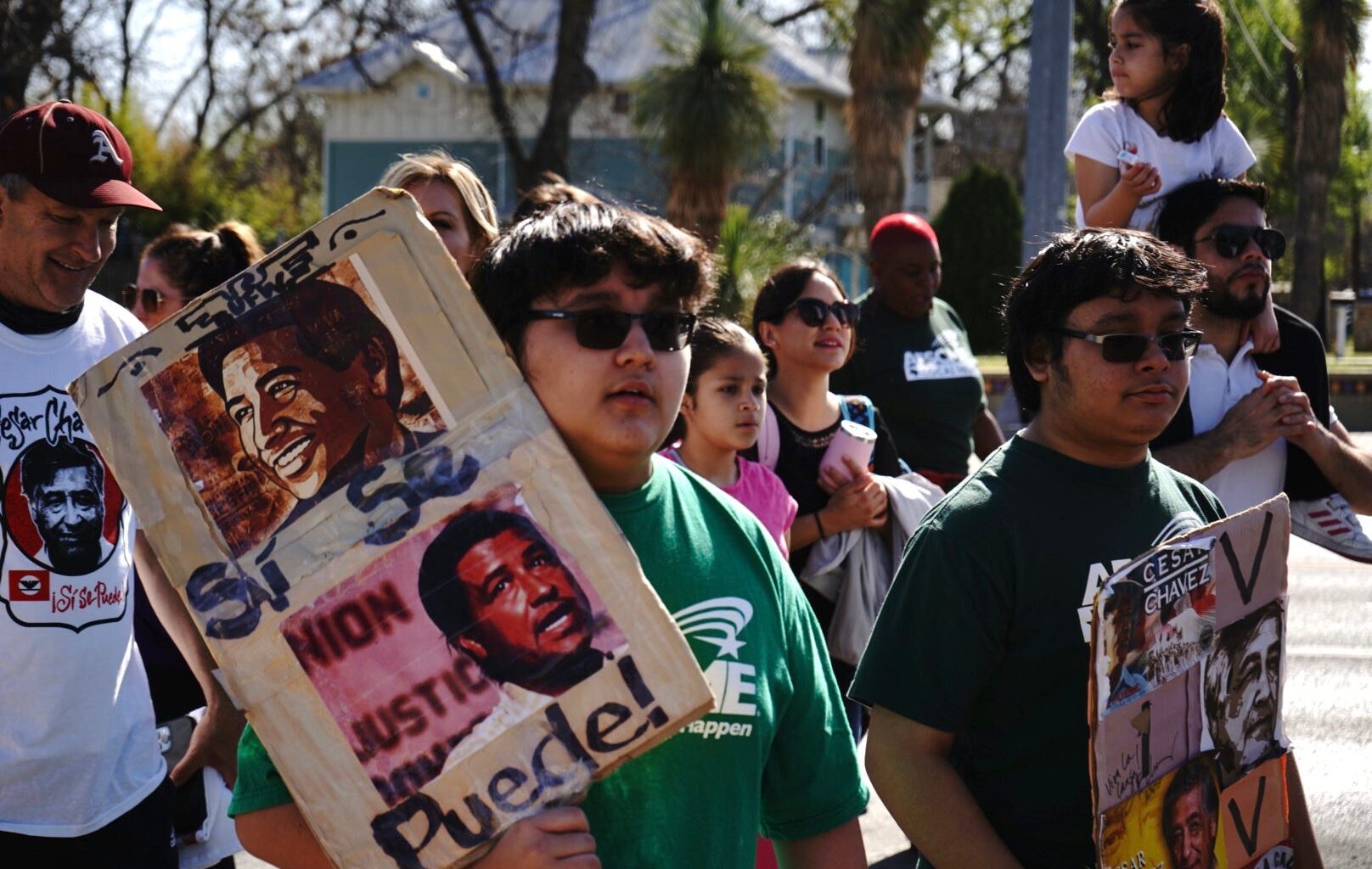
¡Sí Se Puede! César Chávez March & Day of Action! returned in 2022 after a two year hiatus to honor the life of César Chávez, whose legacy is now facing scrutiny over allegations of sexual misconduct.
Madi Donham
Organizers have canceled this year’s Cesar Chavez parade and celebration, citing growing concerns following newly disclosed allegations involving the late labor leader.

The annual Cesar Chavez and Dolores Huerta Marcha de Justicia and Celebration, which was scheduled for March 28 at Terrazas Branch Library, will no longer move forward, event organizers told the American-Statesman on Wednesday. The decision comes as community leaders across Austin grapple with allegations that Chavez engaged in inappropriate sexual relationships with women and minors.
Article continues below this ad
John Cobb listens to the rally at City Hall after the 14th Annual Cesar E. Chavez “Si Se Puede!” March on Saturday March 28, 2015. JAY JANNER / AMERICAN-STATESMAN
Austin American-Statesman
Susana Almanza of PODER, left, and Paul Chavez, son of Cesar Chavez, gather for the 14th Annual Cesar E. Chavez “Si Se Puede!” March on Cesar Chavez Street on Saturday March 28, 2015. Hundreds marched from the Terrazas Library to City Hall. JAY JANNER / AMERICAN-STATESMAN
Austin American-Statesman
Susana Almanza carries a portrait of Cesar Chavez as she and Paul Chavez, right, son of Cesar Chavez, walk in the 14th Annual Cesar E. Chavez “Si Se Puede!” March on Cesar Chavez Street on Saturday March 28, 2015. Hundreds marched from the Terrazas Library to City Hall. JAY JANNER / AMERICAN-STATESMAN
Austin American-Statesman
Liza Soto got her t-shirt autographed by Paul Chavez, son of Cesar Chavez, the 14th Annual Cesar E. Chavez “Si Se Puede!” March on Cesar Chavez Street on Saturday March 28, 2015. Hundreds marched from the Terrazas Library to City Hall. JAY JANNER / AMERICAN-STATESMAN
Austin American-Statesman
Arthur Rios Moreno chants slogans during the 14th Annual Cesar E. Chavez “Si Se Puede!” March on Cesar Chavez Street on Saturday March 28, 2015. Hundreds marched from the Terrazas Library to City Hall. JAY JANNER / AMERICAN-STATESMAN
Austin American-Statesman
Austin Mayor Steve Adler, left, and Paul Chavez, son of Cesar Chavez, lead the 14th Annual Cesar E. Chavez “Si Se Puede!” March on Cesar Chavez Street on Saturday March 28, 2015. Hundreds marched from the Terrazas Library to City Hall. JAY JANNER / AMERICAN-STATESMAN
Austin American-Statesman
An altar for Cesar Chavez at the Terrazas Library during the 14th Annual Cesar E. Chavez “Si Se Puede!” March on Cesar Chavez Street on Saturday March 28, 2015. Hundreds marched from the Terrazas Library to City Hall. JAY JANNER / AMERICAN-STATESMAN
Austin American-Statesman
Jaqueline Olvera chants slogans during the 14th Annual Cesar E. Chavez “Si Se Puede!” March on Cesar Chavez Street on Saturday March 28, 2015. Hundreds marched from the Terrazas Library to City Hall. JAY JANNER / AMERICAN-STATESMAN
Austin American-Statesman
People walk in the 14th Annual Cesar E. Chavez “Si Se Puede!” March on Cesar Chavez Street on Saturday March 28, 2015. Hundreds marched from the Terrazas Library to City Hall. JAY JANNER / AMERICAN-STATESMAN
Austin American-Statesman
The accusations, recently published in the New York Times and acknowledged in statements by the Cesar Chavez Foundation and the United Farm Workers, have triggered a broader reckoning nationwide. Several cities have already canceled Chavez-related events, and the United Farm Workers said it will not participate in any activities tied to Cesar Chavez Day on March 31, his birthday.
Chavez had a lasting impact on labor rights and Latino civil rights in Austin, which he frequently visited from the 1960s through the 1980s.
Local organizations involved in planning Austin’s annual march — including the Hispanic Advocates Business Leaders of Austin (HABLA), the League of United Latin American Citizens (LULAC), and People Organized in Defense of Earth and Her Resources (PODER) — had been weighing whether to proceed with the event. The nine-person board of HABLA, the celebration’s main organizer, unanimously voted Tuesday night to cancel the event.
Article continues below this ad
“Out of respect for the potential victims and just the national attention around these allegations being made, we don’t want to cause additional harm,” said Peter Baez, the chairman of HABLA. “We just thought, out of respect for all parties involved, it was best for us to cancel the event.”
HABLA has no plans to rename or replace the event, Baez said.
Allegations spark reactions
In light of the accusations, Austin District 3 Council Member José Velásquez told the Statesman that the city will consider renaming Cesar Chavez Street, a prominent east-west thoroughfare that runs through downtown and the historically Mexican American part of East Austin. Formerly known as First Street, the corridor was named for Chavez in 1993, shortly after his death.
Article continues below this ad
“It will be a community-centric discussion,” Velásquez said.
Velásquez did not go so far as to say whether he would support the renaming, but told the Statesman that “movements are about a people, not about a person.”
In a statement Wednesday afternoon, Texas Gov. Greg Abbott said he will push the Republican-controlled state Legislature to remove Cesar Chavez Day as an official holiday, saying the allegations “rightfully dismantle the myth of this progressive hero and undermine the narrative that elevated Chavez as a figure worthy of official state celebration.”
The Times report has shifted the opinions of some who initially expressed skepticism about the allegations. Susana Almanza, an environmental activist who has long participated in the annual Austin march, suggested Tuesday that the claims were political efforts to discredit Chavez, similar to what she believes were efforts to undermine Martin Luther King Jr.
Article continues below this ad
But after reading the Times investigation, Almanza said Wednesday she was “devastated” to read that the allegations reached as far as Dolores Huerta, Chavez’s collaborator and another founder of the United Farm Workers union. In a statement Wednesday, Huerta accused Chavez of raping her on one occasion and manipulating and pressuring her to have sex with him on another.
“I have never identified myself as a victim, but I now understand that I am a survivor — of violence, of sexual abuse, of domineering men who saw me, and other women, as property, or things to control,” Huerta said.
Almanza said she spent Wednesday morning grieving after learning more about the allegations.
Article continues below this ad
Her organization, PODER, will strip Chavez’s name from its annual social justice awards ceremony, which is held each year on Cesar Chavez Day. But she said it’s too early to tell whether community members will decide to remove his name from a city street and a statue honoring him on the University of Texas campus.
“It’s going to take more discussion,” Almanza said. “Everyone is in this surreal kind of moment. It’s an unbelievable moment for all of us.”