
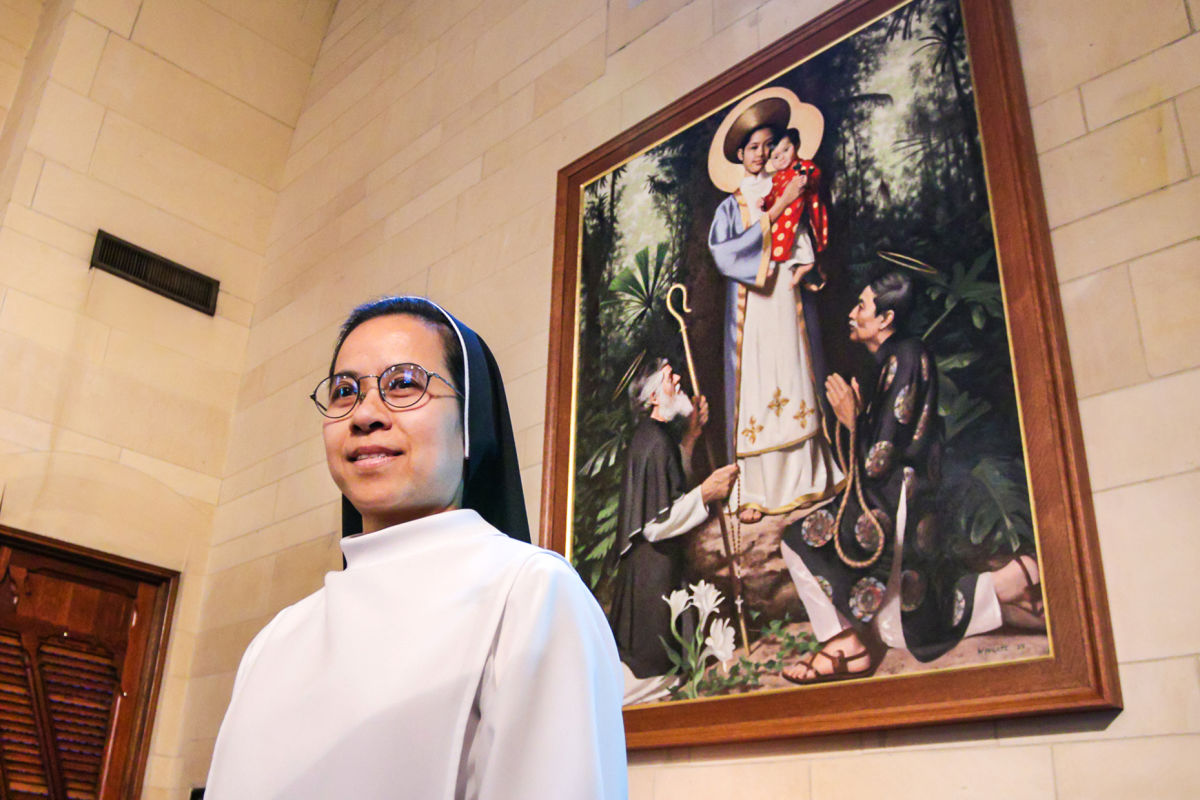
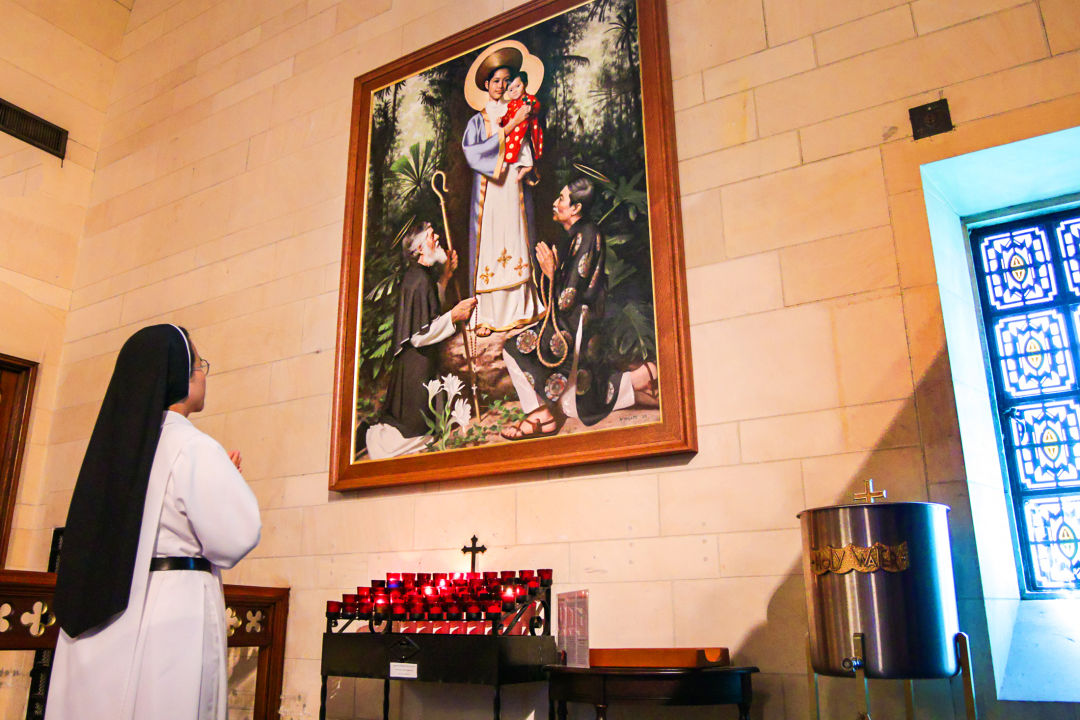
Our Lady of La Vang was said to have appeared to Vietnamese Catholics fleeing persecution in Quảng Trị Province, and is of great importance to the diaspora.
More than 50 years ago, the fall of Saigon triggered one of the largest refugee movements of the twentieth century. Thousands of Vietnamese families resettled in Houston in the 1970s, transforming the city into one of the nation’s largest Vietnamese enclaves. Today, over 140,000 Vietnamese residents call the city home, with Vietnamese art and artists enlivening the region and its outlying communities: murals in Asiatown, a Vietnam War Memorial in Bellaire, an ongoing portraiture exhibit in Baytown, and, now, a new oil painting of Our Lady of La Vang at Holy Rosary Catholic Church in Midtown.
The sacred image, rooted in a centuries-old apparition to Catholics in hiding, reflects the same themes of refuge, resilience, and faith that have shaped Vietnamese life in Houston for generations.
Holy Rosary debuted the canvas in January, detailing a Marian apparition—a reported vision of Mary, the mother of Jesus—that took place in Vietnam in 1798. The parish commissioned the new work to mark the 50th anniversary of the Vietnamese Dominican friars and Catholic families who first arrived in Houston after the fall of Saigon. The 70-by-54-inch painting, which hangs at 3617 Milam St., echoes a broader story that endures today—how people carry their faith, memories, and cultural identity with them when they leave home, and how those traditions take root in new places.
Founded by the Dominican Order in 1913, Holy Rosary has long served as a spiritual hub for Vietnamese families, beginning with the refugee community. In September 1975, Holy Rosary took in two refugee priests who were staying at Fort Chaffee in Arkansas. At the church’s first Vietnamese-language Mass on September 14, 1975, an estimated 35 people attended; today, you’ll see around 200 in the afternoon Mass.
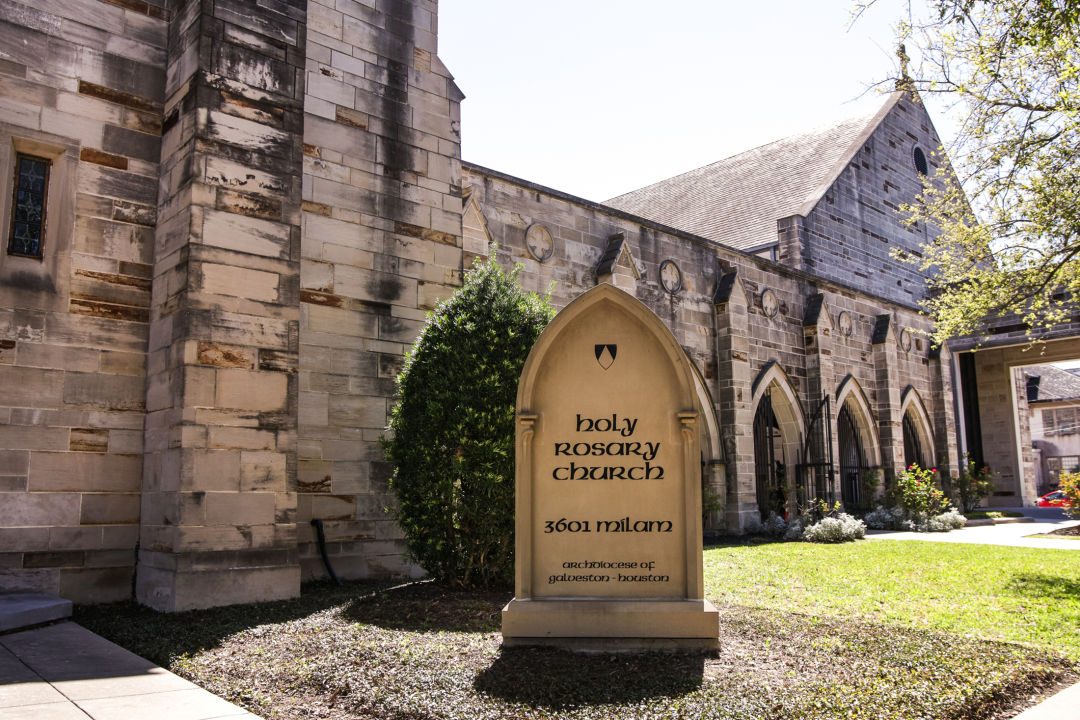
Midtown’s Holy Rosary Church has welcomed a large congregation of Vietnamese Catholics for over 50 years.
Other parishes, including Our Lady of Lavang, Our Lady of Lourdes Catholic Church, and Vietnamese Martyrs Catholic Church, have since opened, but Holy Rosary remains a mother church in both a literal and metaphorical sense.
“I think in the beginning—and this is what the Church does—we were responding to a need. When the people of God present an urgent need, the Church tries her best to respond,” says Father Joseph Paul Albin, OP, pastor of Holy Rosary.
As the story goes, during a time of persecution in 1798, Vietnamese Catholics fled to the Quảng Trị jungle in La Vang. While praying the Rosary at the foot of a tree, Mary appeared with an infant and two angels, comforting those seeking safety and telling them to boil leaves from nearby trees as a medicine for their illnesses. Holy Rosary’s work details this appearance, with a few personal touches.
In the painting, Mary is dressed in a traditional blue-and-white áo dài (long gown), adorned with gold embroidery, and crowned with a prominent Eastern-style disc halo. The viewer’s eye is drawn to Mary’s skin-to-skin embrace of an infant Jesus, clothed in a bright red-and-gold áo dài. At Mary’s feet is the Hoa Huệ flower, representing purity and reverence, and Saints Ignatius Delgado and Dominic An-Kham, two Dominican martyrs with petite halos. From idea to installation, the work took over a year to complete, with the artist, clergy, and advisors in both the U.S. and Vietnam collaborating for months to ensure culturally appropriate fashion choices, color palettes, anatomy, and symbolic elements.
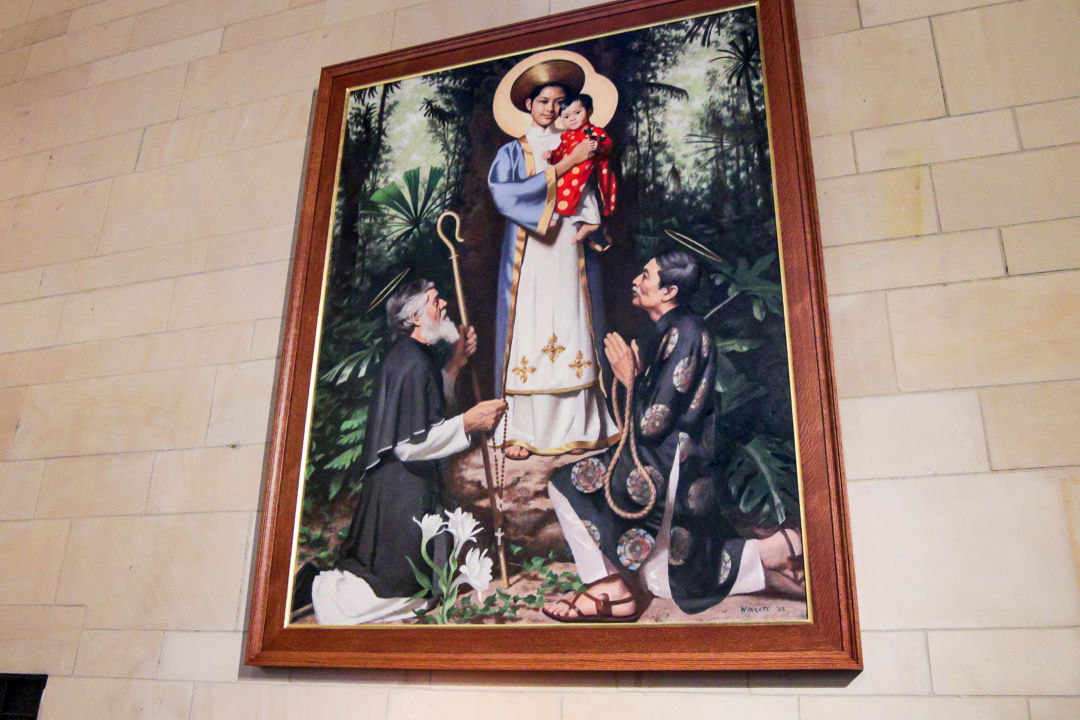
Artist Henry Wingate wanted to ensure the figures in the reverent painting were depicted as Vietnamese both culturally and sartorially.
“In La Vang, this is the very first time in my country that Mother Mary showed up and helped, because we know from the beginning a lot of people received many blessings from Mother Mary,” says Tung Le, who, along with his wife, Agnes Hoa Vo, has been at Holy Rosary since the 1980s. Like many Vietnamese Catholics, Le and Vo feel a great devotion to Our Lady of La Vang. Le cites the supposed miracles associated with the Marian figure as reasons La Vang has remained important to the Vietnamese community and why Holy Rosary’s painting is so meaningful to the congregation. “We love the picture, and any time I come here to the holy church, I pray to Mother La Vang,” Le says.
Holy Rosary’s new painting also highlights the beauty of a faith lived across continents and Mary’s closeness to those who flee persecution, including migrants and refugees. Marian apparitions are explored in great detail in religious art, with subjects such as Our Lady of Guadalupe and Our Lady of Fatima, which depict her comforting followers in times of hardship and despair. Although Our Lady of La Vang lacks the formal investigative approval from the Vatican that Fatima has, it still holds great spiritual significance in Vietnam and beyond.
Holy Rosary’s director of religious education, Sister Theresa Vu, OP, who is also a member of the Dominican Sisters of Mary Immaculate Province, aided Albin in communicating with experts on topics like garment choices and whether it was appropriate to portray saints kneeling at Mary’s feet. In studying various representations, one important question was how to make her look authentically Vietnamese in both features and fashion.
“[In] many images, many statues, Our Lady’s face looks more European, like models. She’s thin and small and has a long nose. She is beautiful, but she doesn’t look Vietnamese,” Vu says. Such artistic interpretations of Mary that feature a Caucasian woman with pale skin, light eyes, and features reflect a Renaissance-era beauty. Yet in her apparitions, she reflects the cultures and people to whom she presents herself. Even at Holy Rosary, there are the familiar European portrayals of Mary, but, along with the painting of Our Lady of La Vang, there is also Our Lady of Guadalupe from Mexico. To that point, Vu says, “We don’t want to look down on ourselves, but we have to admit that our nose is not small and sharp, and the eyes are not round and big, and all of that.”
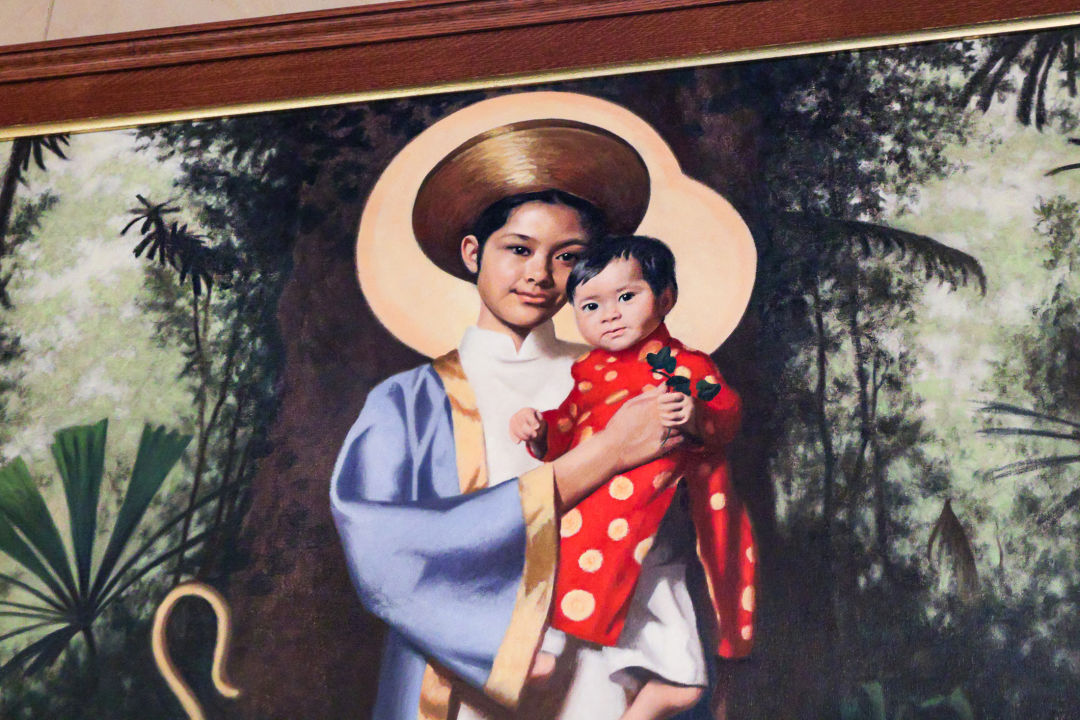
Detail of Mother Mary and Baby Jesus.
Virginia-based artist Henry Wingate, who previously worked with Albin on a commission at the University of Dallas, used real-life models to ensure the subjects had authentic Vietnamese features. Specializing in traditional realism and naturalism, Wingate’s work is reminiscent of artists like John Singer Sargent, in which the light comes alive, and the subjects are suspended in a moment of stillness.
It’s a classic style that feels unexpected in the modern era, but it’s what makes the La Vang painting look like it existed long before its 2026 debut. “I loved this commission, and it was something new for me, with the Vietnamese connection. It was more difficult and took more time and effort to research, find costumes, and models, but the reception has been wonderful,” Wingate says. Interestingly, the model used for the figure of Christ is actually the grandchild of the man who posed as Dominic An-Kham.
For centuries, the Catholic Church has used art as a visual connection to the divine, and Holy Rosary’s Our Lady of La Vang channels that in a way that feels deeply personal to the Vietnamese community’s history in Houston. But for the people who pray before it, its meaning is measured less by its artistry and more by the memories and hopes it holds for those shaped by displacement and perseverance.
“My biggest hope for the image is that it’s a place of prayer and reverence. The response has been overwhelmingly positive, but more importantly, when I see people bowing their heads in front of the image, and the fact that all the candles [by it] are lit on Sunday, means it’s doing its job as a sacred work of art,” Albin says. “There is something about Holy Rosary, a very Marian church, that does a good job of portraying Mary as both a creature and Queen of Heaven. First in the order of grace, but still a human like us.”
Editor’s note: Layne Van Vranken is a parishioner of Holy Rosary Catholic Church.