
Julia Clarke: I’m going to add to that, I’ll just say that figuring out whether you have a new species, it might be interesting to know, is not an easy process because you have to compare the attributes of the new specimen, the new skeleton, to all other known dinosaurs.
And there are different data sets that help you do that, but it’s like you have to look at every bump on every bone, at the characteristics of every part of the skull to make sure that you don’t have another representative of a previously described species.
So when we finally had that evidence and we could clearly say that this was a new species, yeah, it was a very exciting moment. I mean, given this is the first — a new dinosaur species described from Korea in how many years is it, Jongyun?
Jongyun Jung: After 15 years.
In 15 years, so it’s pretty remarkable. Well, I know much of the research around this fossil was done there at UT Austin.
Dr. Clarke, can you share a bit about the role of the geosciences department there and what it did in undertaking this study?
Julia Clarke: It’s been a really fun collaboration and I’ll go back a little bit further in time.
I was visiting Korea to give a seminar at the home university of the Korean Dinosaur Center and Jongyun and his colleagues showed me the fossil in the block and I was like, wow, that’s very cool, but I can’t tell what it is. And I could see that this rock was really, really hard and the bones actually softer than the surrounding rock.
And so I was like, this is a great candidate for CAT scanning or CT scanning, using x-rays to see inside the block. And so, I invited Dr. Jung and his colleagues to come to UT and we would CT scan the fossil.
And I think that’s where we had the totally crazy “a-ha” moment where Dr. Jung and colleagues were looking inside the block and they’re like, “we have a skull.” And that was just very cool.
» GET MORE NEWS FROM AROUND THE STATE: Sign up for Texas Standard’s weekly newsletters
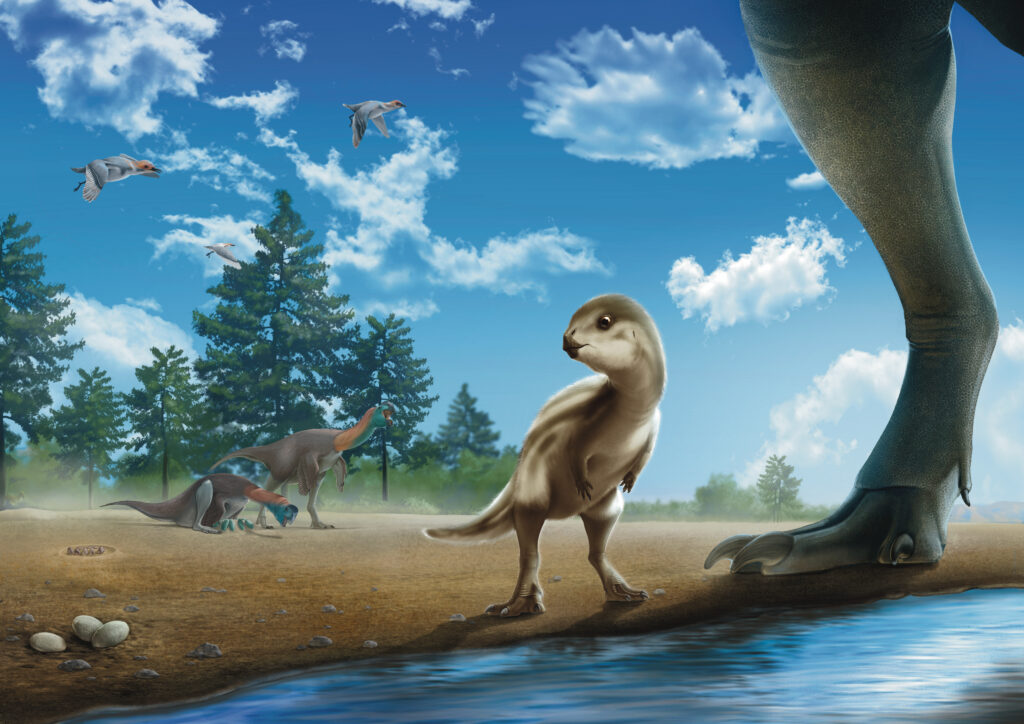
Dr. Clarke since, as we mentioned, this is being hailed as a new species of baby dinosaur, tell us about what this discovery means to our evolving understanding of the dinosaur world.
Julia Clarke: Yeah, it’s very cool. You have, essentially, in the Korean Peninsula, you have a chance to sample Far East Asian dinosaurs from this really key time interval, which is this mid-Cretaceous time. And this is a time period where there’s a lot of exchange between what we now… You know, Eurasia and North America.
And so what is really neat about the new species is it samples part of a lineage that has representatives both in North America during this time period and Asia, but it fills in kind of another piece of that story. It tells us more about the connections between those species on these two, what are today, very distant continents.