
In the Texas Firsts series, old and new residents alike experience linchpins of Lone Star State life and culture.
It started a few months ago, when an editor handed me a seemingly simple assignment: Go to the Houston Livestock Show and Rodeo, write about what you see, have fun. The event would have more than enough worth reporting on, and since I’d never been to a rodeo before, all would be fresh.
Weeks passed, and I held on to that belief, until I started thinking about—overthinking—what I would actually write. If you’d seen the shoddy, faux-suede cowboy hat I purchased a few days before the rodeo, I wouldn’t have fooled you: I am not from here. I’m a transplant from a village in New York about as far from bull riding and 100,000-seat college football stadiums as you can get. I’ve spent the months since I moved checking things off my Texas must-do list, but still, I’m mostly oblivious to the cultural touchstones Texans get briefed on in preschool. That would be a problem for a piece like this one, I realized. The wide-eyed outsider describing an alien-to-him environment has been done to death.
This innocuous assignment could tank my Texas Monthly career before it started. I didn’t know then that I’d see the heir to our country’s most prominent cowboy family take a gamble and lose, and in so doing honor his name; that I’d sample some of the state’s finest wines mere moments after waiting in vain for a sow to give birth; that I’d search for an eight-foot-tall chicken covered in half a million mirrored tiles named Hennifer, who supposedly dangled in the daylight like a grain-fed god; or that a country-pop singer would pull off a performance that shattered my brain. That would all come later.
For now, I mustered some low-rent courage and drove my rented Nissan Altima east on U.S. 290, past the budding bluebonnets, the Buc-ee’s gas stations, and the substantial stretch of highway named for President Ronald Reagan. I got to Houston a little before noon and checked into a Holiday Inn, where I was met by a concierge who knew my business immediately. “Sure, the rodeo,” he said, looking skeptically above my head. “Nice hat.”
Thirty minutes later, I arrived at NRG Park, where a Ferris wheel cast a shadow over rows of carnival attractions—Alien Abduction, Dizzy Dragon, Silly Seas, and the ambiguous Fun Factory. The Astrodome, inside which the rodeo took place for 37 years, now jutted out from the center of the festivities, morose and unused. Then, a beacon: Mama Tina’s Gumbo. I’d heard that the mother of Houston-born Beyoncé had launched this pop-up for the rodeo; that the twenty-hour recipe was beloved by her family, presumably meaning Beyoncé; and that, if lucky, one might run into the elder Knowles herself. There she was. We had no opportunity for small talk, but when Beyoncé’s mother offers you a meal, you eat it.
Cavorting with celebrities hadn’t been on my rodeo syllabus, though I still hoped to find Hennifer, who’d been flown by United Airlines from Denver to Houston for the event. I assumed I’d run into her eventually. The sun had come out, women in denim dresses held hands with men in pearl-snap shirts, and pig racing was about to kick off at the Pork Chop International Speedway. The announcer informed us that each heat would feature a quartet of swine hurtling around a caged track in pursuit of a “delicious, delectable Oreo” waiting at the finish. For the finale, Swifty the Swimming Pig dove into a basin of water, swam across it in seconds, and was raised into the air like a porcine Holy Grail.
For five dollars I could’ve taken a picture with Swifty, and I would have, had mutton busting not been scheduled so soon in the next tent over. I took my seat as a rider named Ryder rode a sheep named Woolly Nelson directly into a tarp-covered fence. This was my introduction to the sport. I tried to find a corollary in my own childhood to the daredevil euphoria seen in these children hanging on to sprinting sheep for dear life, but I came up empty. When the contest finished, the announcer asked the two cochampions how it felt to win. Amanda and Megan shrugged their shoulders—in the sheep-riding game, is winning the point?
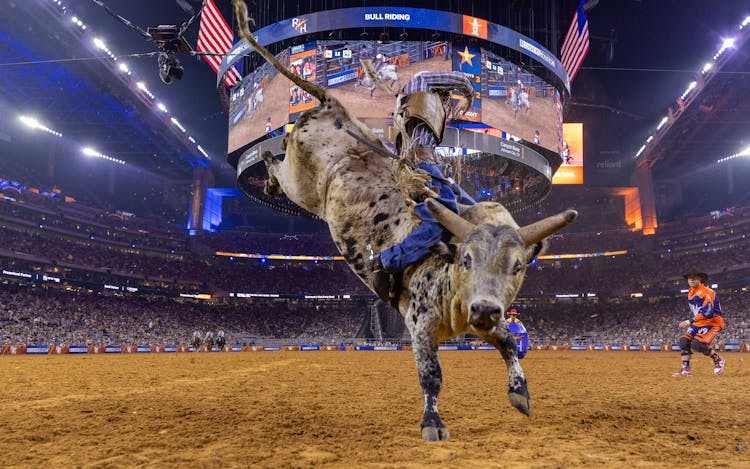 Canyon Bass during the bull-riding competition. Courtesy Houston Livestock Show and Rodeo
 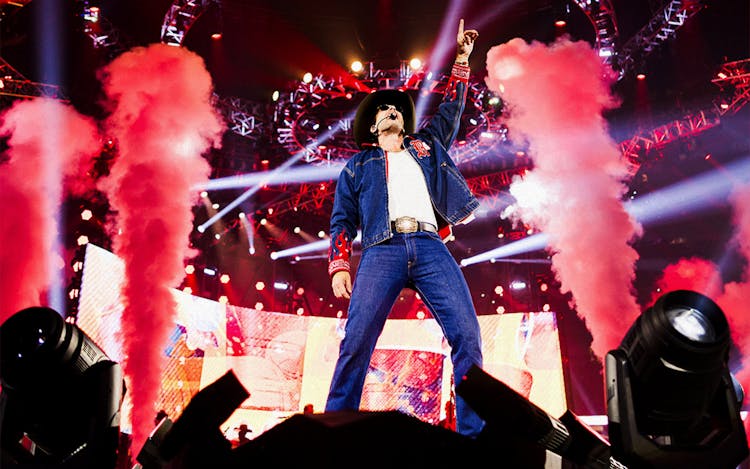 Russell Dickerson put on a show on March 5. Courtesy Houston Livestock Show and Rodeo
Time was creeping up on me, and I couldn’t risk missing the livestock shows before the main event started a few hours later. I hustled over to NRG Center, where the rodeo’s “Agventure” led me to a cattle show of American Brahmans. From the stands, I watched exhibitors lead their cows in a circle on a turf field. It was a packed house, and I tried to parse out what about these animals kept the crowd so rapt. A slim, middle-aged man to my right confidently wearing a cowboy hat and checkered shirt looked like he might know what was going on, so I asked him. He shook his head. “No idea.”
Maybe I wasn’t the only ignorant transplant walking around that day—and I had done research beforehand. I knew that the first iteration of the Houston rodeo (now host to more than two million annual attendees) had taken place in 1932 and been called the Houston Fat Stock Show and Livestock Exposition, and that in 1938 the event had been held at the Sam Houston Coliseum, downtown, where it remained until moving to the Astrodome in 1966. Because of this magazine, I knew that Myrtis Dightman helped lead the first group of Black trail riders through the Fat Stock Show parade in 1957, and that Black cowboys in general are at the core of the rodeo tradition. Gene Autry was the rodeo’s first featured singer, I discovered, in 1942, and since then, Elvis and Selena, George Strait and Taylor Swift, Alan Jackson, Kelly Clarkson, and Cardi B have performed. That this background knowledge would give me the authority to report on the subject, or that anyone would care if I chimed in, seemed unlikely.
I needed color, drama, a scene. Fortunately, a nearby tent of pregnant animals could deliver on all three. I strolled over to the Birthing Center, where large mammals rested in enclosures before onlookers who hoped to witness the miracle of existence. A large screen above them displayed the progeny that had so far been spawned: two calves, seventeen lambs, and zero piglets. I had hoped for a newborn swine, but I settled for observing the just-hatched chicks nearby, then decided to get a breath of fresh air.
Outside NRG Center, I saw a sign advertising Texas Wine Celebration Day—today! Moments earlier, I’d tried coaxing a pig into begetting life; here I drifted into Provence. Or, more accurately, Hill Country. Sipping a dry red from Sandy Road Vineyards, my mind drifted back to Hennifer, whom I had still failed to stumble across. Some deeper research into the rodeo programming revealed that the disco bird had, in fact, only been on-site for the World’s Championship Bar-B-Que contest, which had concluded days before the rodeo proper. I spent some time in despair, until the sun began to set. NRG Stadium beckoned.
I made it to my seat in time for the national anthem and looked down on four thousand cubic yards of dirt. (The rodeo stores it on a lot off-site and trucks it into the stadium every year.) On it, right around 7 p.m., the Professional Rodeo Cowboys Association competitions began, led by tie-down roping. At just nineteen years old, Ace Reese from Aquilla looped his hitch knot around a fleeing calf the fastest, in 10.4 seconds, in the first round. Through the team roping, the bareback riding, the saddle bronc, and the steer wrestling, each cowboy’s name seemed more ideally rugged than the last—Riggin Smith, Jate Frost, Colton Byram, Ryder Wright—but none carried the gravity of Rocker Steiner of Weatherford.
You may know that the 22-year-old Steiner comes from what’s probably the single-highest-achieving rodeo family there is. He’s a fifth-generation Steiner cowboy. His grandfather Bobby was a world-champion bull rider; his father, Sid, was a world-champion steer wrestler; his sister, Steely, would compete in that evening’s barrel racing competition; and Steiner himself, the “Bad Boy of Rodeo,” had won the bareback-riding world championship at the National Finals Rodeo, in Las Vegas, last year. (His 2022 high score of 95 points is a world record in the discipline.) I perked up as soon as his name was called. From above, I could see his red vest and black cowboy hat, and with a roar from the stadium, Steiner and his horse busted out of the gate. Immediately, something happened—the audience let out a groan. But Steiner completed his ride and scored an 82, locking him into a four-way tie for first: “Kissing your sister,” said the announcers. On the JumboTron, I could see Steiner grimace and then enter a heated discussion with the judges. There’d been a hiccup with his horse leaving the chute, meaning he could redo his ride if he chose, albeit risk losing his tied top spot by doing so. A Steiner had to ride again, I thought—it’d be an abnegation of destiny if not. Upon Bandana Babe, he did, and scored an 81. He lost as a champion should.
As it drew closer to nine, when the night’s concert was set to begin, I thought over how I’d render Steiner’s resolve in luminous prose. I knew then that my assignment was doomed. What Steiner the younger did the night I saw him was impressive, but this was a mere Thursday in a nonchampionship round of the rodeo’s first week. For days prior, I’d gone over how to approach this essay without relying on sarcasm or awe, but I looked at my notes, and they all read like melodrama. Again I analyzed whether any of my outsider observations would be worth relating. Hadn’t they all been tried out, romanticized, reflected at every angle? I could see the last line of my report—some revelatory cliché of, oh, I’d been a Texan at heart all along.
By the time the animals cleared out and the stage was rolled out onto the dirt, my brain pictured only the white space soon to appear under my byline. Worse still, I doubted that that night’s act would be the antidote I sought: Russell Dickerson, a Tennessean country singer often heard on pop radio, belongs to a genre mostly absent from my playlists. When he stepped before the crowd in his flame-decal denim jacket and white wifebeater and ordered me to “get ready to Russell,” I looked deep into my hands. Okay, I thought. Forget the assignment, all your opinions and concerns. Try, against your will, to Russell.
When Dickerson began his set atop the slowly rotating star-shaped stage, something in me shifted. I wrote down nothing; for the first time in a while, my mind emptied out. I stood up like the neighbors in my row, cheered when Dickerson broke into “Blue Tacoma,” and laughed in communal confusion when he introduced “God Gave Me a Girl” as a “song about when I broke up with my wife.” Perhaps the peak of his show came toward the end, when he executed a flawless moonwalk—something Michael Jackson hadn’t even introduced yet when he played the rodeo in 1974. In another article, I would’ve called it either corny or breathtaking. Really, I don’t know what it was, but I won’t forget it. Dickerson ripped off his shirt. He told us this night was the greatest of his life, and I believed him. Whatever I’d expected from Russell Dickerson, here was someone willing to bare it all. Here was a man who, clearly, was not overthinking.
Read Next