
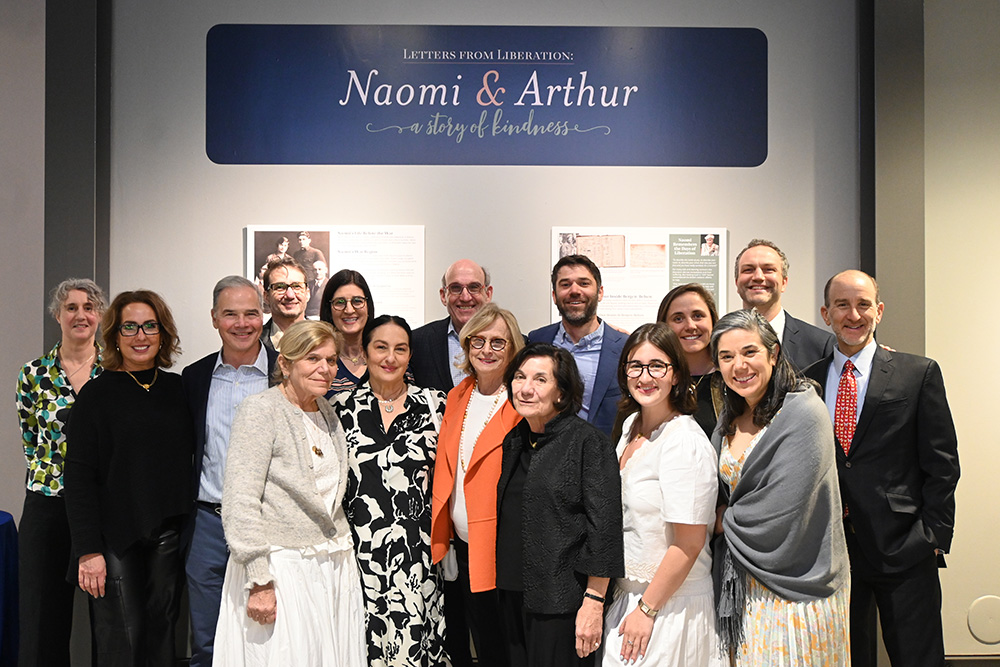
“The story of this exhibition actually begins in April of 1945, during the liberation of Bergen-Belsen,” Gary Weisserman, CEO of Holocaust Museum Houston, told an audience at an exhibition opening on Thursday, March 12. “Amid the devastation of that moment, a young Jewish survivor named Naomi Kaplan encountered a British soldier named Arthur Tyler.”
She approached him with a simple request: Please write to her family in America and tell them she was alive.
The exhibition, “Letters from Liberation: Naomi and Arthur, a story of kindness” opened March 12 at Holocaust Museum Houston and runs through Aug. 2.
The soldier, Arthur Tyler of the Oxfordshire Yeomanry, did more than promise. He wrote the letter.
That single act of kindness – a letter sent across the Atlantic – would reconnect Naomi with relatives in Houston and ultimately shape the rest of her life.
Born in Eastern Poland in 1920, Naomi survived three concentration camps – Auschwitz, Ravensbrück and Bergen-Belsen. Naomi Warren died in 2016 at age 96, after building a life and legacy in Houston.
For Naomi’s granddaughter, Elyse Kalmans, the story had long been part of family lore, but many details remained unknown.
“We always knew the story that my grandmother had met a British soldier when she was liberated from Bergen-Belsen, and he wrote to her family in Houston to tell them she was alive,” Kalmans told the JHV. “She had an uncle who used to send her a check for her birthday, and she always had to write thank-you notes, and so she knew the address.”
For decades, the soldier’s identity remained a mystery.
The missing pieces emerged during the COVID-19 pandemic, when an Oxford researcher began combing through wartime records and found the letters between Arthur and Naomi’s sister, Elizabeth Brandon. The researcher eventually located Naomi’s family in Houston.
“She found my uncle Benjamin Warren, because he was the board chair of the Holocaust museum,” said Kalmans.
On the 80th anniversary of the liberation of Bergen-Belsen, a permanent exhibit about Naomi and Tyler opened at the Soldiers of Oxfordshire Museum in England. Elyse and many members of Naomi’s family traveled there for the opening.
Now the story has come full circle with the exhibition opening in Houston. It opens near another milestone: the 80th anniversary of Naomi’s arrival in New York on March 15, 1946, just 11 months after liberation.
Today, that moment forms the heart of the exhibition “Letters from Liberation” at Holocaust Museum Houston, which traces the connection between Naomi Warren and the British soldier who helped reunite her with family.
Included in the exhibition are the letters, biographies of Naomi and Arthur and highlights from the Soldiers of Oxfordshire Museum’s Life Lines project, where artists are invited to create works inspired by their story.
The power of a single act
For Kalmans, the letters illustrate the extraordinary impact of a simple act of compassion.
“I remember my grandmother telling us that lots of soldiers said they would write, but he actually did. And it’s this whole idea that just one act of kindness can really be so transformational. He helped my grandmother get to the United States quickly and also brought her family – who didn’t know where she was – a measure of comfort that she was still alive and they could work to get her back.”
The letter was addressed to Naomi’s uncle in Houston, but circumstances made its arrival even more remarkable.
“The letters were addressed to her uncle, but he was serving as port commander at La Havre in Normandy,” said Kalmans. “And so, he actually wasn’t here when the letters came addressed to him, but his wife was [and she wrote to tell him]. He chaired the 1946 [Jewish] Federation campaign – our family and our involvement in the community, goes back all the way to that era.”
When asked what her grandmother might think about the exhibition today, Kalmans reflected on Naomi’s humility.
“I think she would probably laugh that there was a whole exhibit, because she didn’t think of herself as being special, although we all know how special she was. At the same time, I think she would be amazed, because she would love to see that we connected all these dots.”
Research bringing history to light
The exhibition grew out of the research of Myfanwy Lloyd, historical consultant to the Soldiers of Oxfordshire Museum, who helped reconnect the story of Naomi Kaplan and Arthur Tyler. She told opening night attendees how decades-old letters led her to Naomi’s family and shared plans to expand the permanent exhibit to Bergen-Belsen concentration camp later this year.
“It has been my privilege to reunite Naomi and Arthur and to tell their story,” Lloyd said. “ Thank you for allowing me to stand shoulder to shoulder with all of you.”
Jeff Hajjar, a member of the Holocaust Museum Houston’s board of advisors, said the exhibition also carries a message about personal responsibility.
“Naomi’s story begins with one letter from a British soldier. One act of kindness that changed the course of her life,” Hajjar told the JHV. “What I hope people take away from this exhibit is that they have that same power. You do not always have to do something massive. Sometimes, it is simply showing up.
“As a board member, this exhibit already carries special meaning for me. But knowing Elyse and her family and seeing the love and care with which she has carried her grandmother’s story forward gives it an even deeper significance. You can feel that this is not just an exhibition, but a family legacy being entrusted to the public.”
Eighty years ago, in the uncertain days after liberation, Naomi Kaplan asked a soldier to write a letter to tell her family she had survived.
He did.
Today, that letter still carries its message across time: Even in history’s darkest moments, a single act of kindness can lead someone home.
“Letters from Liberation: Naomi and Arthur, a story of kindness” will be on display at Holocaust Museum Houston through Aug. 2. For tickets and information, go to hmh.org.