
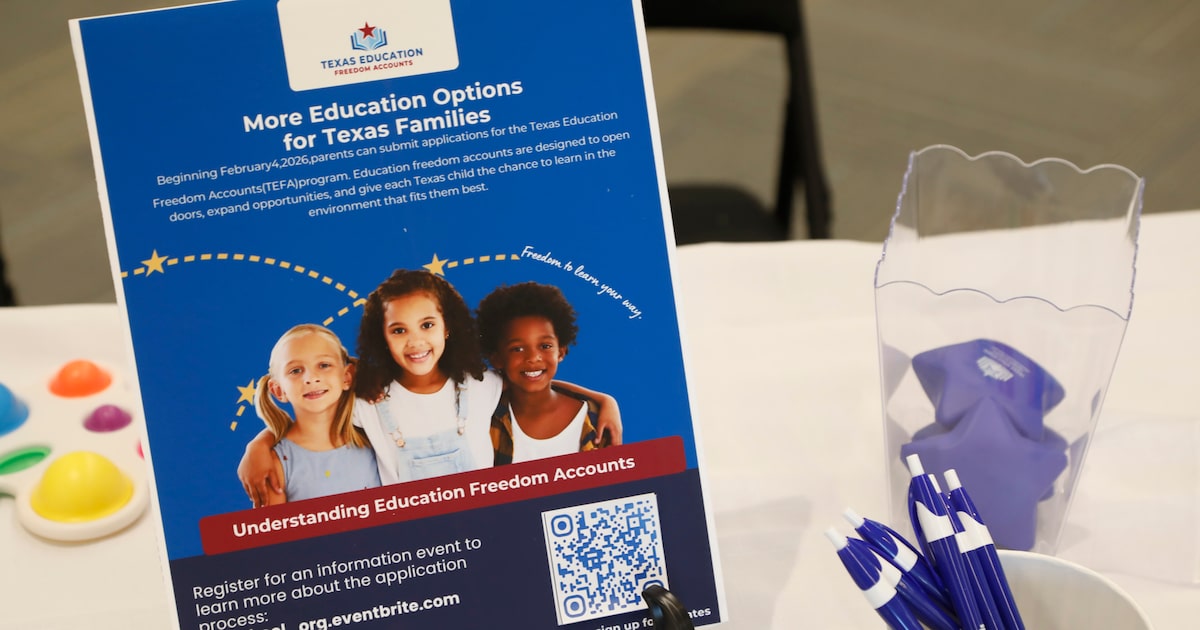
A federal judge ruled on Tuesday that Texas must make its new education savings account program available to a number of Islamic schools in the state after several alleged in a lawsuit they were shut out of the voucher-like program.
At least three North Texas-affiliated schools have now been approved to participate in the program, according to school representatives and the Texas Comptroller’s list of participating locations.
Here’s what to know.
Related
Breaking News
What is the Texas Education Freedom Accounts program?
Texas created a nearly universal, $1 billion school choice program in May to help pay for private schooling and homeschooling. Approved private schools can start accepting the funding for students in the upcoming 2026-27 school year.
Students can receive over $10,000 to help pay for private school expenses, including at religious-affiliated institutions. Schools that wish to participate must be accredited by the Texas Private School Accreditation Commission or an accreditor recognized by the Texas Education Agency.
Why do families want to participate in the program?
Similar to Christian private schools and Jewish day schools, Islamic private schools provide early learning or K-12 education alongside religious instruction, moral teaching and Muslim values, according to Mustafaa Carroll, the interim executive director of the D-FW office of the Council on American-Islamic Relations, or CAIR.
Islamic education can include Quranic studies and recitation as well as curriculum on Islamic principles, Carroll said.
Related

“But none of those principles are antithetical to the United States,” he said.
Ehsan Sayed, a board member and graduate of Brighter Horizons Academy in Garland, said Muslim families want the right to send their children to schools that match their values, in the same way that families from other religious traditions might. Muslim families want to be treated equally under the law, he said.
Sayed, who graduated from Brighter Horizons in 2007, said because the academy is a private school, students have smaller class sizes than they’d have in a public school.
Why were Islamic schools blocked from the program?
In January, Texas Attorney General Ken Paxton issued an opinion saying the comptroller’s office, which oversees the program, may block schools from participating based on political affiliations.
The acting comptroller, Kelly Hancock, had requested the opinion on whether to exclude schools based on alleged ties to CAIR, the nation’s largest Muslim civil rights advocacy organization.
Gov. Greg Abbott issued a proclamation in November that designated CAIR as a foreign terrorist organization. CAIR has vehemently denied the designation and is suing over it.
Related
 What Islamic schools were blocked?
The Houston Chronicle first reported in February that more than a dozen Islamic schools across the state had been shut out of the program.
Maria Kari, an attorney representing parents and schools in a federal lawsuit over the alleged shutout, said Thursday that 30 Islamic schools in the state should be eligible and want to participate.
Related
 Is the state now accepting Muslim schools?
Following a federal lawsuit filed by Muslim parents and schools, a court order issued Tuesday extended the application deadline to March 31 for the new education savings account program.
The order, issued by district Judge Alfred Bennett in the Southern District of Texas, also compelled the state to make the school application available to Muslim schools participating in the lawsuit. The order does not make the state accept the schools, only to consider them for admission.
As of Thursday afternoon, at least one online school, Bayaan Academy based in League City, and one brick and mortar school, Excellence Academy in McKinney, appear on the Texas Comptroller’s Office’s list of participating schools. Representatives from Brighter Horizons Academy told The News it has also been added to the program, but the school did not appear on the comptroller’s public list of participating campuses Thursday.