
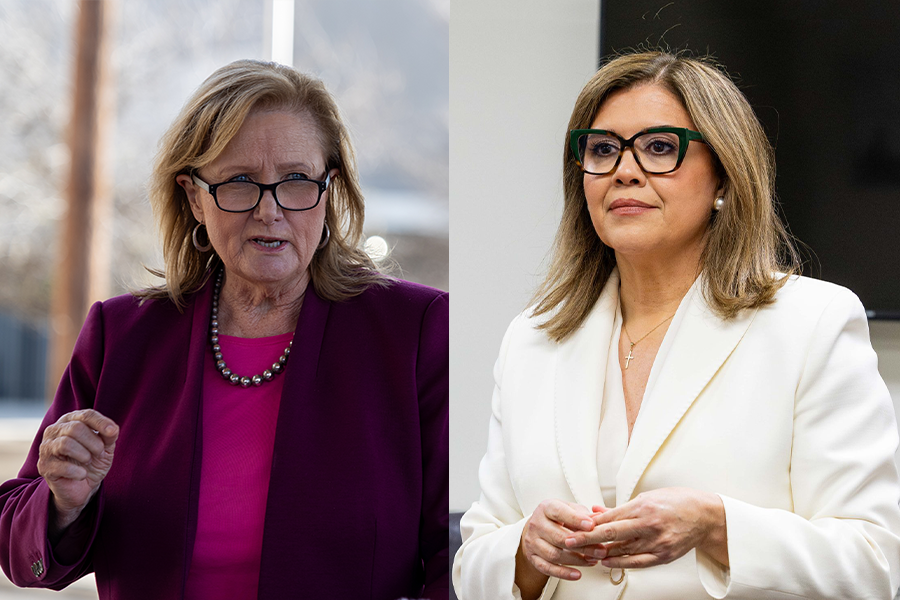
The race for Bexar County district attorney is beginning to take shape ahead of the May 26 Democratic runoff, as candidates eliminated in the March primary and political groups line up behind two finalists offering sharply different visions for the office.
Former Fourth Court of Appeals Justice Luz Elena Chapa and longtime prosecutor Jane Davis advanced to the runoff after finishing with 24% and 18% of the vote, respectively, in an eight-candidate primary that saw high voter turnout.
Now, the contest is emerging as a choice between two approaches: Chapa, an outsider with no prosecutorial experience who has never worked in the district attorney’s office, who is calling for a tougher stance on crime and stronger relationships with law enforcement; and Davis, a 40-year veteran of the office who currently leads the juvenile division, who is campaigning on the importance of experience and building on reforms already in place.
In the weeks since the primary, that divide has become clearer as endorsements begin to fall into place — with Davis quickly locking down support from much of the eliminated field, while Chapa builds a coalition anchored by law enforcement and political leaders.
All but one candidate eliminated in the primary — Meredith Chacon, a defense attorney who ran in the Republican DA primary in 2022 — have endorsed Davis, in an effort to unify voters from campaigns that collectively captured nearly half of the vote.
“Jane is the most experienced candidate remaining in the race,” said Jim Bethke, who captured the support of progressive outside groups in the first round. “She understands what needs to be corrected in the current administration. She believes in restorative justice, and she will be ready to lead the office on day one.”
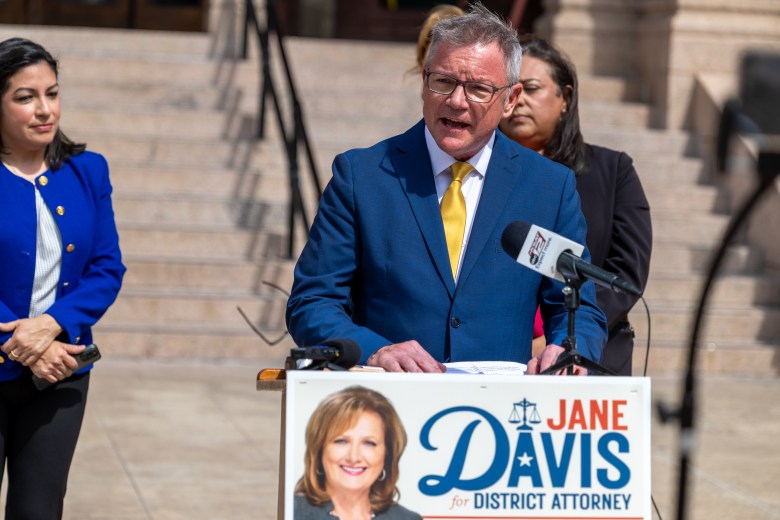 Jim Bethke, a former candidate for Bexar County district attorney who was previously endorsed by the Texas Organizing Project, speaks in support of Jane Davis ahead of the May 26 runoff election. Credit: Diego Medel / San Antonio Report
Reached for comment, Chacon said her recent appointment as a part-time associate judge in the criminal district courts prohibits her from endorsing a candidate.
Experience and reform
Former candidates echoed the importance of experience in leading the prosecutor’s office in the fourth-largest county in the state, urging their supporters to coalesce behind Davis as the most qualified option to oversee an office of hundreds of attorneys.
Shannon Locke, a defense attorney who finished third in the primary with 14% of the vote, said he chose to endorse Davis after meeting with both finalists to discuss policy. Only Davis, he said, was willing to engage with his progressive priorities — including holding federal law enforcement officers accountable when laws are broken, a key sticking point in his campaign.
“She recognizes the need for criminal justice reform. She recognizes the need to reform conditions at the Bexar County Jail, to hold law enforcement accountable when necessary,” Locke said at his endorsement announcement Thursday outside the Bexar County Jail. “She recognizes the need to create restorative justice and community-based criminal justice programs.”
 Jane Davis, left, stands with Shannon Locke after he endorsed her in the Democratic runoff for Bexar County district attorney following the March primary.
Davis has also picked up support from organized labor, with the San Antonio American Federation of Labor and Congress of Industrial Organization shifting its endorsement to her after backing Locke in the first round.
Her campaign has increasingly leaned into both experience and policy, outlining a platform focused on reducing jail overcrowding through diversion programs, reforming the bail system with risk-based assessments and improving case flow by tightening intake standards.
She has also called for expanding the office’s civil rights division, increasing transparency through data-driven decision-making and creating a citizen oversight council.
One major player, the bail reform group Texas Organizing Project — which backed James Bethke in the primary — has not yet weighed in on the runoff. A spokesperson said the group has not made a decision following the primary.
The race has also yet to see any influence from national justice reform groups, which had plowed big money into Bexar County’s recent DA races.
An outside perspective and law enforcement relations
Chapa, meanwhile, has built a coalition anchored by law enforcement groups and elected officials, positioning herself as a candidate who would shift the direction of the office.
She has received backing from the Deputy Sheriffs Association of Bexar County and endorsements from Bexar County Sheriff Javier Salazar and several local and state officials. The San Antonio Police Officers Association political action committee has also endorsed Chapa in the runoff.
“Her experience, temperament, integrity, and proven leadership are exactly what Bexar County needs,” the Deputy Sheriffs Association PAC said in a statement. “She will bring real and meaningful change to the DA’s office by tackling huge case backlogs, restoring trust and repairing strained relationships — particularly with the law enforcement officers on the front lines.”
Her campaign has focused heavily on rebuilding relationships with law enforcement and taking a tougher approach to repeat offenders, arguing that the current administration has not done enough to address crime.
Chapa has also emphasized increasing funding for the district attorney’s office, reducing case backlogs — particularly in domestic violence cases — and expanding support for crime victims, including trauma-informed training for prosecutors.
Though she has not served as a prosecutor, Chapa has framed her candidacy as an opportunity to bring outside leadership to an office she describes as dysfunctional.
“Clearly voters want change in the DA office from someone who is an outsider who can fix all of the problems and who hasn’t been part of the dysfunction in the office,” Chapa said.
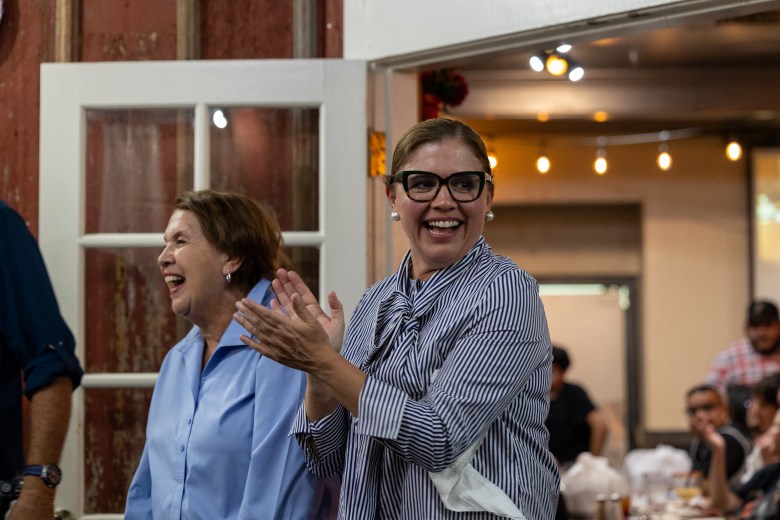 Luz Elena Chapa, a candidate for Bexar County district attorney, celebrates with her mother while thanking supporters on election night after finishing first in the primary. Credit: Diego Medel / San Antonio Report
A referendum on Gonzales’ legacy
The open-seat race follows District Attorney Joe Gonzales’ decision not to seek reelection, ending a tenure that began in 2018 as part of a national wave of progressive prosecutors.
During his time in office, Gonzales implemented policies aimed at reducing jail populations for low-level offenses, expanding diversion programs and creating a civil rights division to review cases involving police use of force. His administration also prioritized prosecuting violent crime while steering some nonviolent offenders away from incarceration.
Those policies have drawn both praise and criticism — shaping a runoff that is, in many ways, a referendum on whether that approach should continue.
Davis has aligned herself with much of that framework, arguing the office should build on reforms while improving internal operations, including reducing case backlogs and increasing staffing.
“I believe that we want progressive justice to continue, … The DAs office can protect us from people that have demonstrated their inability to conform to the laws of the land,” she said. “ But I think the DAs office has also done well to help those who have just stumbled and made a mistake to be rehabilitated and not be thrown into the criminal justice system and a pipeline toward prison.”
Chapa, by contrast, has made clear she intends to take the office in a different direction, emphasizing closer collaboration with law enforcement and a more aggressive approach to prosecution.
Gonzales hasn’t weighed in on the runoff yet, but penned an op-ed earlier this year indicating concern about Chapa’s lack of experience.
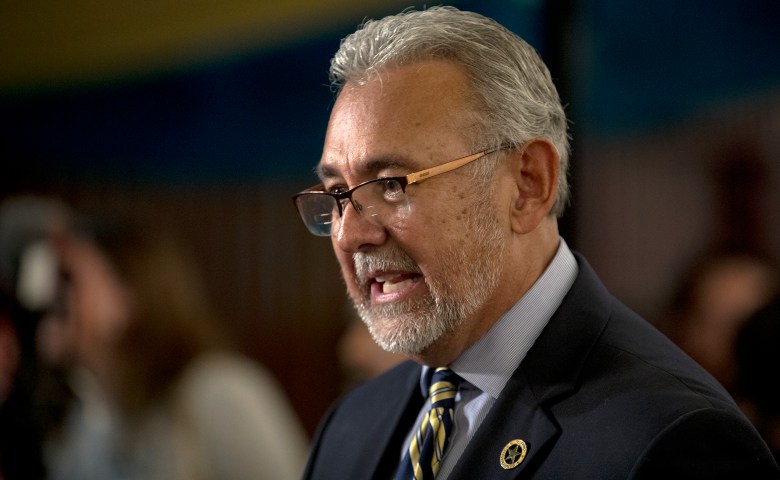 District Attorney Joe Gonzales has not weighed in on the race to replace him following his decision not to seek reelection. Credit: Nick Wagner / San Antonio Report
With the runoff set for late May, both candidates are expected to continue campaigning to build support among voters, local leaders and community groups.
The winner will become the Democratic nominee in a county that has reliably voted blue in recent election cycles and will be favored in November’s general election against Republican Ashley Foster, along with a potential independent candidate who may qualify for the ballot by collecting the required signatures.