
Researchers at the University of Texas at Arlington are exploring ways to better prepare neurodivergent drivers for life behind the wheel.
The study aims to inform the development of driver education programs for neurodivergent teens and young adults, officials said. The research is funded by a yearlong grant of nearly $172,000 from the Texas Department of Transportation.
Few driver education programs exist for neurodivergent youths, said Kate Hyun, an associate professor of civil engineering who leads the study. Those programs are broad for a population that does not all experience neurodivergence the same, she added.
“We did a little research, and we found there are like five, six programs nationwide targeted for them, but not necessarily very well customized to meet their needs because there are many different types of neurodivergence and there is a wide spectrum around it,” Hyun said.
The research focuses on 16- to 22-year-olds with conditions such as autism, ADHD and dyspraxia. Drivers in that population may experience the same challenges as their neurotypical peers — such as staying in their lane, parking and driving during the night — but at a heightened level, said Sital Parajuli, a first-year doctoral student.
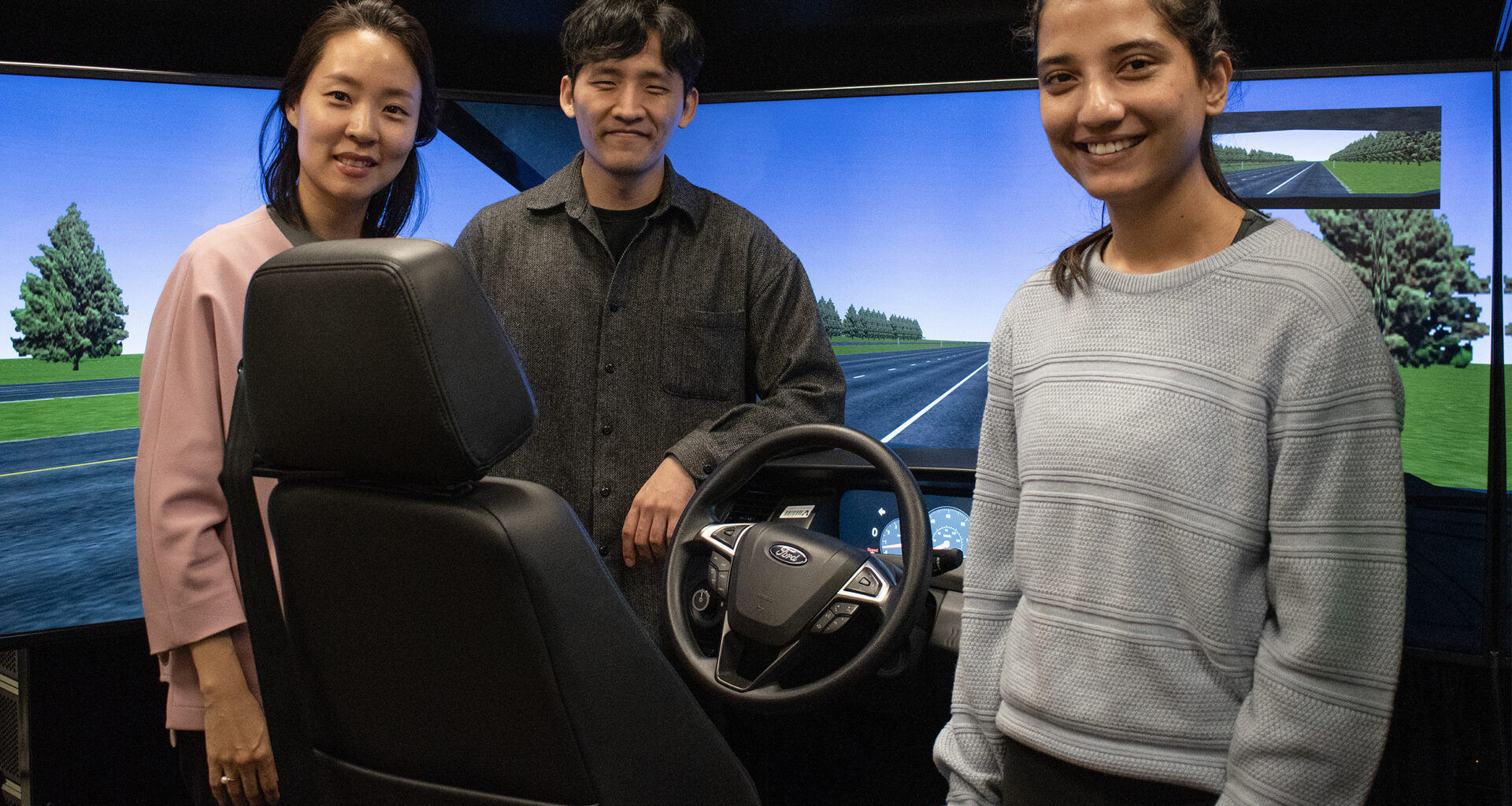
Key to the study is the driving simulator inside Hyun’s lab. The driver’s seat and center console of a Ford Focus are surrounded by screens that depict a road scene.
The rural setting shows a two-lane, divided highway with trees and wide-open spaces around it, while the urban layout depicts what someone might see in Dallas-Fort Worth, including pedestrians, office buildings and grocery stores.
Researchers can adjust the scenarios to reflect real-life complications drivers face, including rain, fog and nighttime darkness.
Neurodivergent drivers may face difficulties in navigating unexpected situations such as passing emergency vehicles and school buses, so those were included in the simulation, said Jeongyun Ryu, a second-year doctoral student also working on the project.
Researchers will first assess the participants’ real and perceived driving skills through surveys, interviews and by putting them through tests on the simulator.
Then, the young adults will go through an online education program that uses artificial intelligence to tailor the course to each participant. At the end, researchers will ask participants if the education was helpful and how it could be improved.
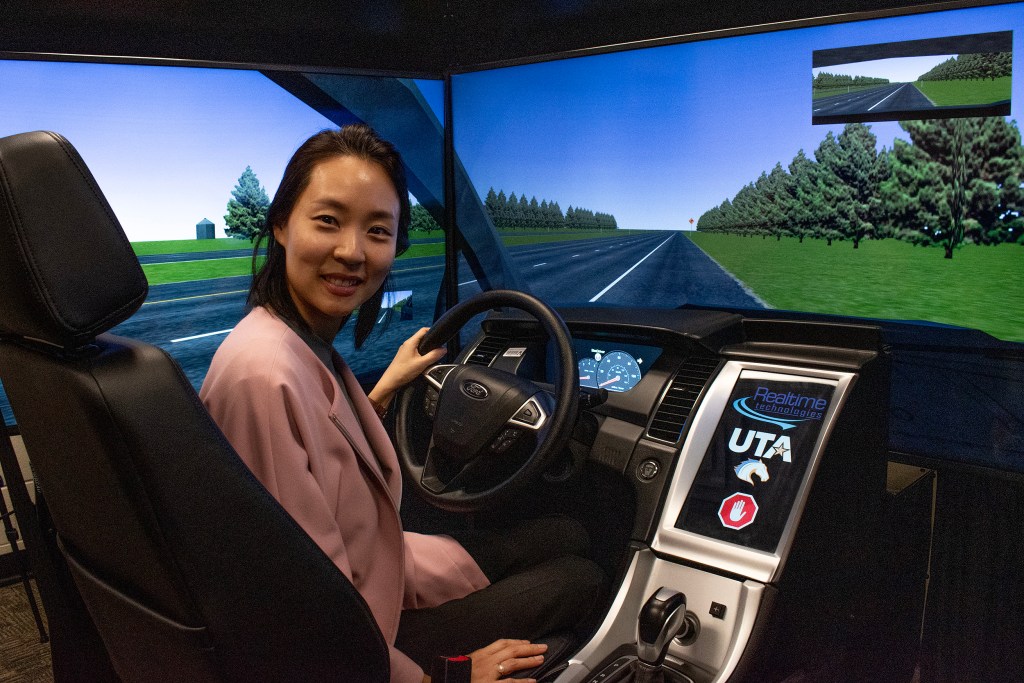 Associate professor Kate Hyun sits behind the wheel of the driving simulator on March 18, 2026, at the University of Texas at Arlington. (McKinnon Rice | Fort Worth Report)
The study is unique for its emphasis on real people in a field where many projects focus on computers, Hyun said.
She found an interest in human-focused research as a doctoral student. A project required her to interview low-income older adults about their transportation challenges, a departure from the typical research focuses of traffic congestion and accidents. Hyun described the experience as eye-opening.
“That’s when I started thinking about how I can contribute as a transportation engineer to really help our communities,” she said.
The researchers will work with others from UTA’s College of Nursing and Health Innovation, who will complete motor assessments of the participants. Those assessments will be combined with the engineering researchers’ work to better understand how different levels of conditions impact decision-making and coordination.
Hyun is particularly curious to see how the young participants’ self-assessments compare to their actual abilities.
Sometimes high school students come into her lab during tours, and although they verbally assert that they know how to drive, they do not always do as well when they take a turn on the simulator, she said.
“How they perceive risk, how they evaluate themselves, how they control themselves — those are the things that I’m wanting to know more about for these populations,” Hyun said.
The researchers are recruiting participants. Those interested can take an eligibility survey here.
McKinnon Rice is the higher education reporter for the Fort Worth Report. Contact her at mckinnon.rice@fortworthreport.org.
The Fort Worth Report partners with Open Campus on higher education coverage.
The Report’s higher education coverage is supported in part by major higher education institutions in Tarrant County, including Tarleton State University, Tarrant County College, Texas A&M-Fort Worth, Texas Christian University, Texas Wesleyan University, the University of Texas at Arlington and UNT Health Science Center. At the Fort Worth Report, news decisions are made independently of our board members and financial supporters. Read more about our editorial independence policy here.
This <a target=”_blank” href=”https://fortworthreport.org/2026/03/19/improving-driver-education-for-neurodivergent-teens-young-adults-focus-of-uta-research/”>article</a> first appeared on <a target=”_blank” href=”https://fortworthreport.org”>Fort Worth Report</a> and is republished here under a <a target=”_blank” href=”https://creativecommons.org/licenses/by-nd/4.0/”>Creative Commons Attribution-NoDerivatives 4.0 International License</a>.<img src=”https://i0.wp.com/fortworthreport.org/wp-content/uploads/2021/04/cropped-favicon.png?resize=150%2C150&quality=80&ssl=1″ style=”width:1em;height:1em;margin-left:10px;”>
<img id=”republication-tracker-tool-source” src=”https://fortworthreport.org/?republication-pixel=true&post=452700&ga4=2820184429″ style=”width:1px;height:1px;”><script> PARSELY = { autotrack: false, onload: function() { PARSELY.beacon.trackPageView({ url: “https://fortworthreport.org/2026/03/19/improving-driver-education-for-neurodivergent-teens-young-adults-focus-of-uta-research/”, urlref: window.location.href }); } } </script> <script id=”parsely-cfg” src=”//cdn.parsely.com/keys/fortworthreport.org/p.js”></script>