
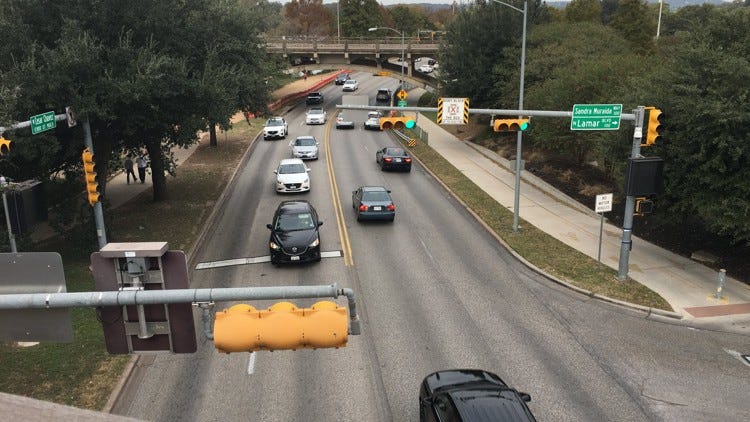
West Cesar Chavez Street. BEN WEAR / AMERICAN-STATESMAN
Austin American-Statesman
The debate over what to do with Cesar Chavez Street has moved quickly.

The day allegations of sexual misconduct against the late labor leader were published, Austin community leaders came together to call for the street to be renamed.
Article continues below this ad
El Concilio — the group that led the effort to rename First Street for Cesar Chavez in 1993 — voted to pursue reversing that change, asking City Council to restore the street’s original name. Three Hispanic city council members and the Travis County Attorney issued a joint statement calling for its renaming.
Here’s what the process of naming a street in Austin actually involves.
How a street gets renamed in Austin
Renaming an existing street in Austin isn’t something any single official can do unilaterally. The process runs through Transportation and Public Works, but the final decision belongs to Austin City Council, which must pass an ordinance, according to city code.
Article continues below this ad
Requests can be initiated by a property owner whose land touches the street or by a City Council member.
Property owner applicants must notify every person whose property abuts the street and get majority support. Without majority support from those owners, the request doesn’t move forward. However, council members do not require majority support to move forward.
If even one property owner objects, the city requires a public hearing before anything can proceed.
Article continues below this ad
The sidewalk near the Terrazas Branch Library along East Cesar Chavez Street.
Jay Janner / American-Statesman
The proposal also goes through police, fire, and EMS for review. Any objection from those agencies effectively kills the request before it reaches council.
If it clears all of that, council votes. If approved, the applicant is generally responsible for the cost of replacing street signs.
How new street names are chosen in Austin
In modern Austin, most new street names don’t originate at City Hall. They start with whoever is building.
Article continues below this ad
When a developer submits a new subdivision or site plan, proposed street names come along with it. Those names go to the city’s Address Management Services — also known as 911 addressing — which screens every submission before anything gets approved.
The city checks for duplicate names, similar-sounding names, spelling conflicts, and anything that could slow down or confuse an emergency response. A name that sounds too close to an existing street anywhere in Travis County can be rejected outright, even if it would otherwise seem perfectly reasonable.
Developers can reserve names in advance — typically for up to five years — but that doesn’t guarantee approval. The city retains final say.
What are Austin’s standards for street names
Under the city’s subdivision rules, new streets are supposed to carry forward existing names where they connect and avoid conflicts with identical or similarly spelled or pronounced names elsewhere in the planning jurisdiction.
Article continues below this ad
La estudiante de UT Eboni Ellinger camina por East César Chávez Street cerca de su lugar de trabajo en el este de Austin el miércoles 30 de mayo de 2018. JAY JANNER / ¡AHORA SÍ!
Austin American-Statesman
But city code also leaves room for names that go beyond navigation. There are eight valid reasons to rename a street, including honoring a person and enhancing a neighborhood through the association of a street name with its location, area characteristics, and history.
The city’s street naming standards say proposals that vary from the normal rules for the purpose of honoring a person or commemorating a place or event are considered on a case-by-case basis and sent to the 911 Addressing Committee for approval.
Why Austin street names reflect the city’s history
What Austin’s street map reflects, more than anything, is how the city was built — in layers, by different hands, across different eras.
Article continues below this ad
When the city was founded in 1839 as the capital of the Republic of Texas, planner Edwin Waller laid out what’s now downtown Austin.
A cyclist passes the front of III Forks Steakhouse near a manhole cover as workers clean the doors at the corner of Lavaca and Cesar Chavez streets in Austin on Thursday.
Austin American-Statesman
Waller’s 1839 grid gave downtown its bones. Late 19th and early 20th century developers added their own names when they platted new additions — some Hyde Park streets once carried names including Osiris, Isis and Karnak before later changes, according to a city historical buildings report. South Austin’s streets, including South First, were shaped by early subdivision development before the city folded them into its broader system.
Article continues below this ad
Now, the rules are tighter and more centralized. Developers still propose names, but the city screens, reviews, and approves. Council can step in. And Emergency services have veto power.