

For years, the Fort Worth district has struggled to fulfill the most fundamental responsibility of a school system: teaching students to read. However, our poor literacy outcomes are not inevitable.
Other schools, districts and states with similar or greater challenges are achieving dramatically better results. As a community, we are responsible for establishing high expectations in our district and providing the support necessary for success.
The Roma Independent School District is in the Rio Grande Valley, about midway between McAllen and Laredo. 89% of its students are English language learners — meaning they are acquiring it as a second language — and 90% are economically disadvantaged. Despite these challenges, 80% of Roma’s third-graders could read at grade level in 2025, a key benchmark for lifelong literacy.
By comparison, in the Fort Worth ISD, only 36% of third-graders could read that well.
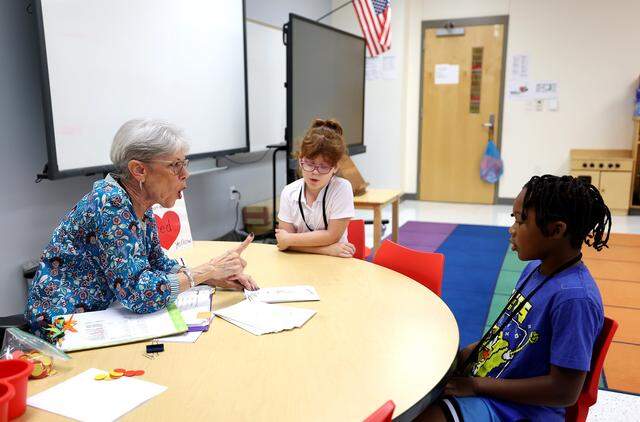 Retired teacher Martha Farr, left, tutors second-graders Gabriela Ringnald, center, Malachi Murkledove in reading at Westpark Elementary School on Thursday, Sept. 19, 2025. Amanda McCoy amccoy@star-telegram.com
There are examples of success within the Fort Worth ISD as well. Cesar Chavez Elementary School has challenging demographics (63% of students are English learners, and 89% are economic disadvantaged). In 2021, only 19% of third-graders in this school could read at grade level. Four years later, that jumped to 58%, an astonishing increase of roughly 10 percentage points each year.
To put that in perspective, the district celebrates when grade-level reading improves by low single digits. The school board set a goal of improving third-grade reading by just 3 percentage points per year, targeting just 53% hitting the mark overall by 2030. Overton Park and Tanglewood elementary schools, also in the FWISD, have never experienced a year in which fewer than 80% of their third-graders could read at grade level.
Mississippi implemented a statewide reading initiative about 20 years ago. It ranked 49th among states in fourth-grade reading in 2013 and jumped to ninth in 2024. Adjusted for poverty, Mississippi now leads the nation in reading. Texas, despite spending more per student than Mississippi, dropped from 26th in 2013 to 37th in 2024.
Given these facts, what should Fort Worth ISD constituents reasonably expect from our school district as we go through a transition of leadership in the next few months, due to the state taking over the underperforming district?
First, let’s briefly address the common explanations for our low reading rates. Some argue that the STAAR reading exam is unfair because it is too difficult. The students in Roma and in the successful FWISD schools listed above prove otherwise. If poverty or language differences make it unfair to expect schools to teach children to read, check with the folks at Roma ISD and at Cesar Chavez. If per-student spending is the obstacle, how do you explain the Mississippi phenomenon?
The community has power. I visited the School District of Indian River County in Florida last month. Fifteen years ago, community advocates in that district organized and set a goal of 90% of third-graders reading at grade level. As a result of the combined efforts of the community and employees, the district improved from 34th in the state in third-grade reading in 2019 to fifth in 2025.
The lesson is simple: When a community sets ambitious goals and aligns its schools, nonprofits supporters and civic leaders, rapid improvement is possible.
In the Fort Worth school district, we face a choice. We can continue explaining why our children are not learning to read and why we send more than 3,000 students to fourth-grade every year unprepared. Or we can unite as a community, establish and insist on high expectations for our students, and provide the support needed to achieve our goals.
Our city’s future rests in the balance.
Robert Rogers, a Fort Worth physician, is in his 11th year as a Reading Partners tutor and is president of The Reading League Texas.
 Robert Rogers Do you have an opinion on this topic? Tell us!
We love to hear from Texans with opinions on the news — and to publish those views in the Opinion section.
• Letters should be no more than 150 words.
• Writers should submit letters only once every 30 days.
• Include your name, address (including city of residence), phone number and email address, so we can contact you if we have questions.
You can submit a letter to the editor two ways:
• Email letters@star-telegram.com (preferred).
• Fill out this online form.
Please note: Letters will be edited for style and clarity. Publication is not guaranteed. The best letters are focused on one topic.
Related Stories from Fort Worth Star-Telegram