
Dane Penland/Smithsonian National Air and Space Museum
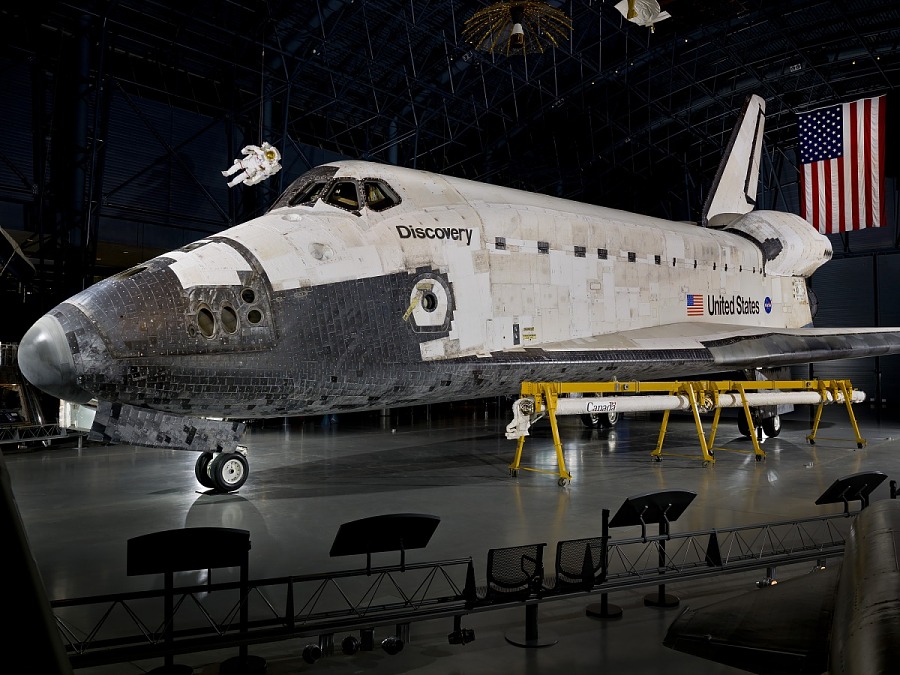
Space Shuttle Discovery on display at the Smithsonian.
NASA is beginning the process of potentially relocating Space Shuttle Discovery from the Smithsonian in Virginia to Houston. The federal space administration is requesting feedback from stakeholders and industry experts on a proposal for contract bids to move the historic spacecraft.
The proposal is a draft, not a finalized request for contract bids. NASA is asking for any feedback to tweak and clarify a final request for proposals.
The draft, which does not mention Discovery by name, would likely target the space shuttle. In 2025, Congress allocated funding in the Trump administration’s “One Big Beautiful Bill Act” to relocate Discovery from Virginia to the Space Center Houston, a nonprofit near NASA’s Johnson Space Center.
Sign up for the Hello, Houston! daily newsletter to get local reports like this delivered directly to your inbox.
Skip to PDF content
Representatives from NASA, the Johnson Space Center and Space Center Houston did not immediately return request for comment Friday.
“My law authorizing and funding the Space Shuttle Discovery’s movement to Houston is being set into motion thanks to NASA’s announcement, and I applaud [NASA] Administrator [Jared] Isaacman for keeping this process moving,” Sen. John Cornyn, a Texas Republican who has co-led the effort to relocate the space shuttle, said in a statement. “Today is real progress in our mission to bring Discovery home, and I look forward to welcoming the shuttle home to Space City soon.”
Discovery is one of just a few remaining vehicles from NASA’s Space Shuttle Program. Supporters of the move said its being at the Smithsonian meant the federal government had jurisdiction over its location, as opposed to the other space shuttles, which are located at nonprofit facilities across the country.
Last fall, the Smithsonian and NASA warned that moving Space Shuttle Discovery may “have to undergo significant disassembly to be moved” and that “disassembling the vehicle will destroy its historical value.” Senators Cornyn and Ted Cruz, another Texas Republican, both pushed back against the Smithsonian, even calling for a Department of Justice investigation into the museum.
The draft proposal for contract bids includes a line that gives the federal government the right to “require intact transportation concepts that avoid disassembly, cutting, structural breakout, or permanent alteration of the item being transported” because of the “national significance” of the artifact.
“When such requirements are identified in a task order,” the draft reads, “Contractors shall demonstrate how their approach preserves artifact condition and prevents transport-induced damage to structural hard points, exterior surfaces, thermal protection systems, or other historically significant features.”
Technicians and advocates criticizing the potential move have cited Discovery’s thermal protection system (TPS) as susceptible to damage. Each spacecraft has a TPS that keeps it from withstanding immense heat — as much as 2,300 degrees Fahrenheit — when it reenters the Earth’s atmosphere.
“It’s cutting-edge technology,” Olga Bannova, a professor at the University of Houston who researches space architecture, told Houston Public Media last fall. “Without it, the shuttle program wouldn’t happen, right? It wouldn’t be successful. So, it’s an absolutely critical component.”
The draft also includes a requirement that any successful contractor should come up with an Artifact Protection Plan, “describing environmental protection systems, protective coverings, corrosion protection measures, vibration mitigation methods, contamination control procedures, and handling precautions necessary to protect historically significant aerospace artifacts during transportation operations.”
The “One Big Beautiful Bill Act” was signed into law in July, allocating $85 million to move Discovery. Some critics of the deal, including Democratic Sens. Mark Warner and Tim Kaine of Virginia and Sen. Mark Kelly of Arizona, the latter of whom flew Discovery as an astronaut, have called for the Senate Appropriations Committee to block that funding.
In December, Isaacman, newly sworn in as NASA administrator at the time, cast some doubt on the prospects of relocating Discovery.
“My job now is to make sure that we can undertake such a transportation within the budget dollars that we have available and of course most importantly ensuring the safety of the vehicle,” he said. “And if we can’t do that, you know what, we’ve got spacecraft that are going around the moon with Artemis II, III, IV, and V. One way or another, we are going to make sure the Johnson Space Center gets their historic spacecraft right where it belongs.”
NASA is taking feedback on the draft through April 9.