
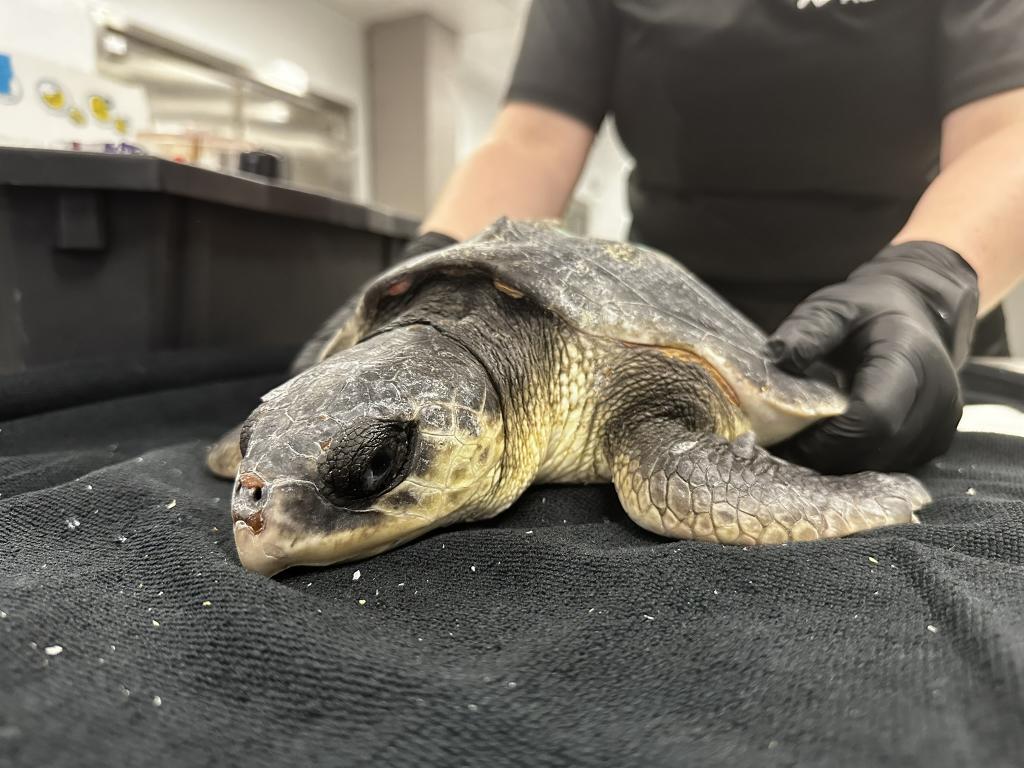
Let’s go back to those turtles for just a moment. Typically, what happens to those animals once you get them? And how fast do you have to respond?
If it’s a cold-stunning, it’s actually a really intense about seven or 10 days.
So the cold weather comes through, it takes about 24 hours for the turtles to become basically hyperthermic and they’re unconscious. We’ll go out, rescue those animals — along with our partners from the Texas Parks & Wildlife Department, the general land office — bring those animals in.
We warm them up just like you would see a human during a cold front. We let them swim. And if we see that they’re swimming actively, once the water in the Gulf is back up to about 58, 59 degrees Fahrenheit, we release them.
So it typically is seven to 10 days they’re here and we then get them back out.
» GET MORE NEWS FROM AROUND THE STATE: Sign up for Texas Standard’s weekly newsletters
Gotta get them past that stress point. Speaking of stress points, what’s your stress point? Do you have space for staff, coordination with partners? What’s the pinch point for you?
It’s always staff. It’s always the human side of what we try to do.
So we’ve got a rather large facility. We actually can make the whole program mobile. So, we can actually put this program on the road. We could go recover thousands of animals anywhere we actually have a road.
So, it’s intense, but there’s a lot of really good partners that we work with at the state and federal level. It’s a lot fun.
For someone listening far from the coast, I think that some may be asking themselves, well, okay, what’s the real-world impact of this work for me if I’m in Amarillo or Austin or someplace else? Why should I care about what’s happening there in the bay?
It’s a great question. So we went down a study, we worked with a firm that does some very, very interesting economic impact studies. And we worked with some experts on sea turtles and coastal fisheries and some different things.
And we came to find that a turtle that’s released from our program has a pretty significant economic value to the state of Texas for fisheries. The green sea turtle population keeps the seagrass beds healthy, which is where all the fish that we all fish for grow up.