
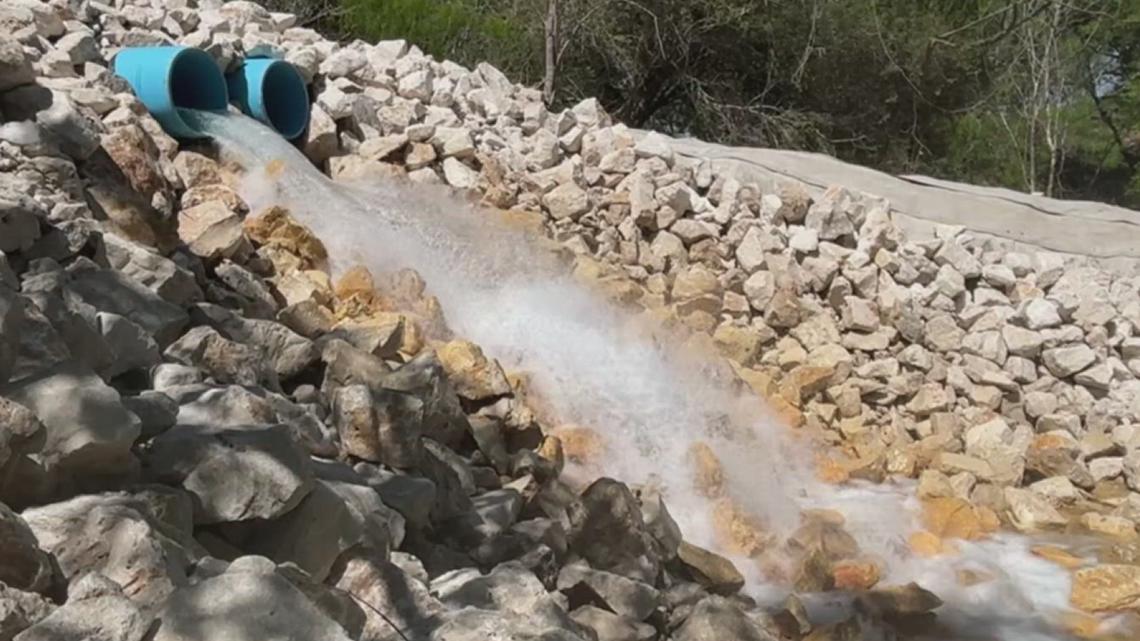
The City of Corpus Christi begins pumping groundwater deep from the Chicot and Evangeline formations.
CORPUS CHRISTI, Texas — Corpus Christi is turning to water that has been trapped deep underground for hundreds of millions of years as the region struggles through worsening drought.
RELATED: Governor Abbott’s office invokes disaster authority to fast-track Corpus Christi water permits
With lakes dropping and the water supply tightening, the City of Corpus Christi has started pumping about 4.5 million gallons of groundwater a day into the Nueces River from its newly activated western well field. The water then flows downstream to the O.N. Stevens Water Treatment Plant.
State officials allowed the move under emergency permits approved by Texas Governor Greg Abbott.
City leaders say the project could eventually deliver much more water if conditions continue to worsen.
The wells are located near Highway 624 and Highway 666 west of the city. Corpus Christi Water officials recently took 3 News’ Michael Gibson to the dusty site where the groundwater is being pumped hundreds of feet from underground formations.
The wells were built to reach deep layers of the Chicot and Evangeline aquifers.
Nick Winkelmann, the chief operating officer for Corpus Christi Water, said the wells target groundwater that sits far below the shallow aquifers that are typically replenished by rainfall.
Each well reaches an average depth of about 515 feet.
City Manager Peter Zanoni said hydrogeologists believe the water being tapped has been trapped in that geologic layer for extremely long periods of time.
According to Zanoni, the water has likely been sitting in those formations for hundreds of millions of years, meaning it does not recharge quickly like shallow groundwater.
The city plans to eventually pump up to 26 million gallons of water per day from the eastern and western well fields combined. Officials say the groundwater will then be treated at the O.N. Stevens plant using reverse osmosis to remove salt and other minerals.
The city is investing about $241 million in the well fields and the treatment upgrades.
Salinity remains a challenge.
Water from the western well field has a total dissolved solids level of about 1,600 to 1,700 parts per million. That level is significantly lower than what has been found in the eastern well field.
Water from the eastern site has proven much saltier, making it more difficult to treat and use.
For now, the city says water from the eastern wells is limited because of a water quality management plan overseen by the Texas Commission on Environmental Quality.
The plan requires the city to monitor salinity levels in the Nueces River to protect downstream water quality.
Because of those limits, the eastern well field is currently producing only about 4 to 5 million gallons of usable water per day.
Zanoni said city officials are now working with the Texas Commission on Environmental Quality and the governor’s office to modify that plan as the drought intensifies.
City leaders say the goal is to keep water flowing in the Nueces River and prevent the region’s reservoirs from running completely dry.
For now, the new wells are buying time for a city facing one of the most serious water shortages in its history.