
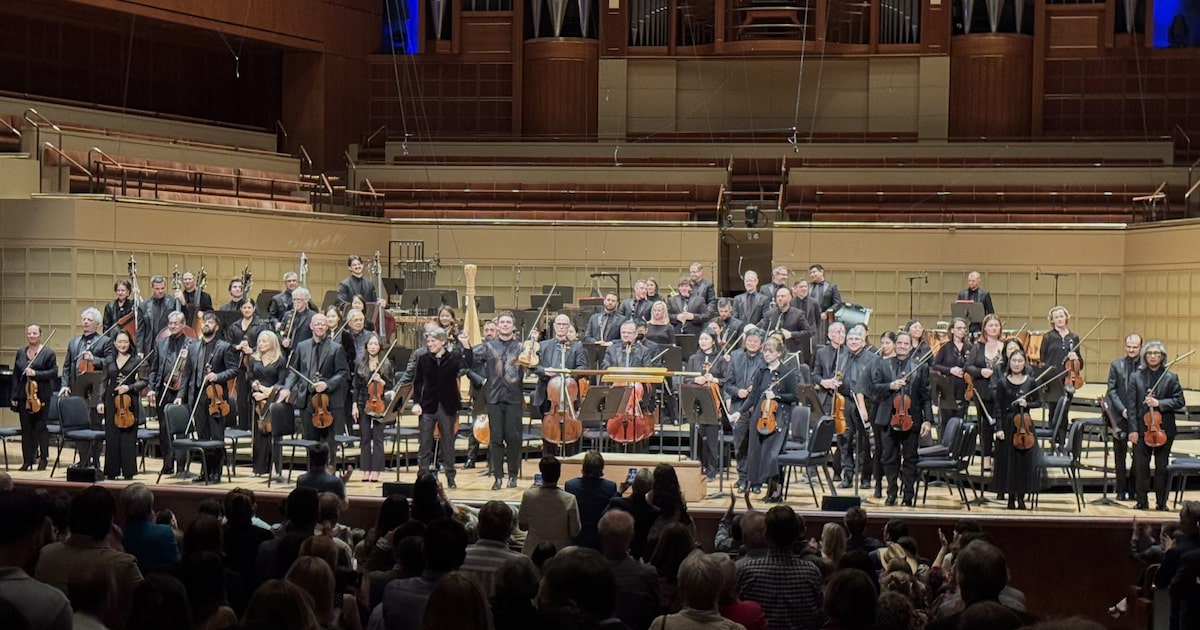
The Dallas Symphony Orchestra’s classical concerts this month are opening with works identified only after intermission. I’m pledged not to reveal them before repeat concerts, but in spoken comments Friday night guest conductor Daniele Rustioni noted a connection between the mystery work and Italian composer Alfredo Casella, whose sprawling Second Symphony occupied the concert’s second half. The concert’s first half included that last surge of high romanticism, Samuel Barber’s 1939 Violin Concerto, with soloist Alexi Kenney.
Casella, who lived from 1883 to 1947, was a force majeure in Italian music between the two World Wars. A pianist and conductor as well as composer, he was also a vigorous promoter of other composers’ works. He heard a lot of them during early years in Paris, including study at the Paris Conservatoire.
The second of Casella’s three symphonies dates from 1910, in an era blossoming with new masterworks: Rachmaninoff’s Second Symphony, Elgar’s First, Mahler’s Ninth, Ravel’s Daphnis et Chloé, Strauss’ Elektra and Der Rosenkavalier, Stravinsky’s Firebird and Petrushka.
Casella’s 50-minute Second Symphony, in five movements counting an Epilogue, suggests now Rimsky-Korsakov, now Mahler, now Strauss. But its textural and harmonic complexities are all its own.
News Roundups
Making each movement easier to grasp is a quasi-rondo organization, with key ideas recurring like structural pillars. The first four movements open with insistent rhythmic beats, whether slow treads or sinister poundings or a militant march.
A somber tread, with clanging chimes, is a recurrent signature of the first movement. In between, stormy music gets stirred up, with sonic light sometimes shining through.
Pounding rhythms announce the second movement’s danse macabre, with irreverent exclamations from the brass, but also suggestions of an Eastern European folk dance arranged by Bartók. Next is a deeply tragic slow movement, suggesting a more dissonant processing of Mahler and Strauss.
The finale’s sardonic march seems almost to anticipate Shostakovich. A gentler march section injects some hope, but militance gets the last word. Hushed strings and organ introduce the Epilogue, which gradually rises to a grandiose apotheosis, with organ pedal stops thundering beneath.
Although probably not something to hear every day, it’s quite an orchestral showpiece, evincing impressive craftsmanship from the then-27-year-old composer. Rustioni, now principal guest conductor at the Metropolitan Opera, was an elaborately demonstrative leader and coordinated an electrifying performance.
In the Barber, sporting a see-through tunic worthy of the Academy Awards ceremony, Kenney supplied flawless technique and generous expression. He was as attentive to pianissimos as fortissimos, the former unfortunately too often swallowed up in orchestral sounds not adequately balanced.
Trumpets were repeatedly too aggressive, and Rustioni whipped up big orchestral passages out of proportion to the violin solos. And just because you can play the finale that fast — which Kenney could and did — doesn’t mean you should. It whizzed by when it should have danced.
The surprise opener at the March 5-8 concerts, by the way, was the 2019 “Timber & Steel” from Bulgarian composer Dobrinka Tabakova’s Earth Suite.
Details
Repeats at 7:30 p.m. Saturday and 2 p.m. Sunday at Meyerson Symphony Center, 2301 Flora St. 214-849-4376, dallassymphony.org.
 How two Dallas groups are reimagining a Stravinsky masterpiece
Orchestra of New Spain and Avant Chamber Ballet are also presenting Manuel de Falla’s Andalusian-flavored “El amor brujo.”
 St. Vincent announces symphonic tour. Will she come to Dallas?
The Lake Highlands High grad is also dropping an adventurous new album.