
Mar 21, 2026, 10:27 PM ET
Which teams are moving on to the Sweet 16?
ESPN reporters across the country are recapping how each second-round game is decided Saturday.
How Illinois won: Another potential Cinderella saw its glass slipper shattered, as VCU’s run came to an end at the hands of a dominant Illinois team. Andrej Stojakovic had 21 points to lead the Illini, who turned a two-point deficit with 3:09 to go in the first half into an easy win, outscoring the Rams by 23 over the final 23 minutes. Tomislav Ivisic stole the show with a monster dunk in the second half that signaled an unofficial end to VCU’s hopes; he finished with 14 points and 11 rebounds. — David Hale
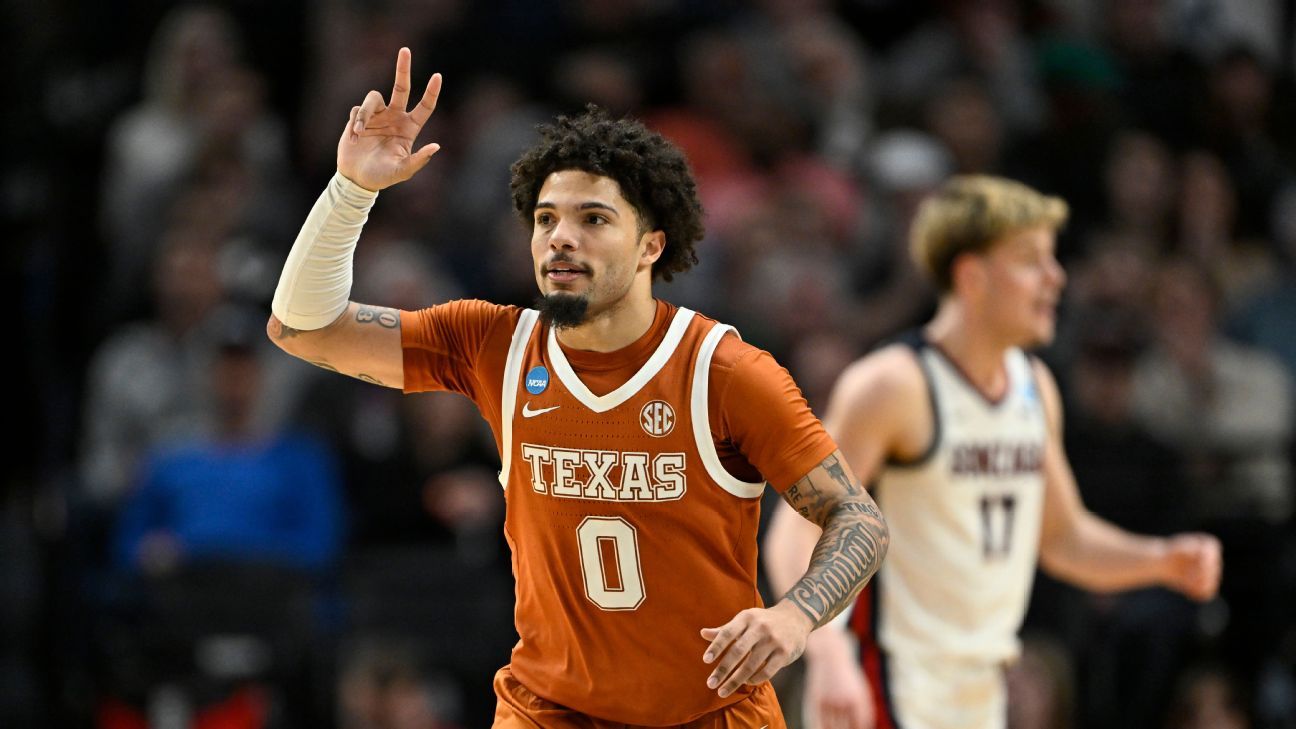
How Texas won: With 2:31 to go in regulation, Longhorns guard Jordan Pope hit a clutch 3-pointer from the top of the key, a shot that proved to be the difference-maker in Texas’ upset victory over Gonzaga. The Longhorns were held scoreless for two minutes after Pope’s basket. Camden Heide ended the drought with a 3-pointer, and Matas Vokietaitis‘ transition layup secured the win. Pope and Vokietaitis led Texas in scoring with 17 points each. For Gonzaga, Graham Ike led the game with 25 points. Texas has 11 NCAA tournament wins as a double-digit seed, the most of any program since seeding began in 1979. — Ryan McFadden
How Houston won: The last time Houston and Texas A&M met in the NCAA tournament (second round in 2024), the Cougars outlasted the Aggies in a high-flying classic in which the two teams combined for 195 points. This time, though, Houston won convincingly — thanks in large part to a 19-4 run that occurred after Texas A&M cut the Cougars’ lead to one point with 7:40 left in the first half.
Though Kelvin Sampson has lamented his team’s inexperience at times, Cougars freshman Chris Cenac Jr. continued to play well, finishing with 17 points and nine rebounds, as they outrebounded the Aggies 46-29. Freshman point guard Kingston Flemings unsurprisingly played a mature, balanced game with nine points, five rebounds, four assists and one turnover. And Big 12 all-defensive selection Emanuel Sharp put together a complete performance with a game-high 18 points, helping force the Aggies into 11 turnovers and just 35% shooting from the floor. — Brooke Pryor

 (1)
(1) How Duke won: It was the tale of two halves for Cameron Boozer. In the first: two points, 0-for-1 from the field and a plus-5 in 15 minutes on the court. In the second? Seventeen points on 7-of-9 shooting and a plus-20 in 19 minutes. TCU did a nice job early of denying his shots by playing a physical, attacking style underneath. But after Xavier Edmonds, Tanner Toolson and Liutauras Lelevicius all landed in serious foul trouble, things opened up for Duke’s superstar. The end result was a dominant second half in which the Blue Devils, after falling behind by two points with 16:15 to play, outscored the Horned Frogs 43-18 the rest of the way, finishing with a blowout victory to advance to the Sweet 16. — David Hale
Duke’s Sweet 16 opponent: Winner of (4) Kansas vs. (5) St. John’s
How the Blue Devils can advance to Elite Eight: Duke has two areas of advantage on every team in college basketball: its defense and having Cameron Boozer. When the Blue Devils turned up the heat defensively against TCU and began playing through Boozer on the offensive end, they began to dominate the Horned Frogs and completely changed the game. Boozer is the most productive player on the floor every time he plays, although it will be interesting to see if either Kansas’ Flory Bidunga or St. John’s Zuby Ejiofor could slow him down. Duke’s defense, the top-ranked unit in adjusted defensive efficiency at KenPom, has very few weaknesses, and neither the Jayhawks nor Red Storm are built in the ideal fashion to cause consistent problems for the Blue Devils. — Jeff Borzello
How Michigan State won: Jeremy Fears Jr. cemented his place in Michigan State history as the Spartans marched on to the Sweet 16 with a win over Louisville. With his 16 assists, Fears became the first Big Ten player in the last 50 years with 27 dishes over a two-game NCAA tournament span, passing Michigan State’s Magic Johnson (25 in the 1979 Sweet 16 and Elite Eight). Fears’ 16 assists also is the most by a Big Ten player in an NCAA tournament game in the last 50 years.
Forward Coen Carr also played a significant role in the win, recording his first career double-double (21 points and 10 rebounds). He joins Carson Cooper, who had 20 points and 10 rebounds against North Dakota State in the first round, to become the first Michigan State duo with 20-point double-doubles in an NCAA tournament since 1979 (Johnson and Greg Kelser).
The absence of guard Mikel Brown Jr. caught up to Louisville as Michigan State was able to limit the Cardinals’ offense, which had averaged 79 points per game without him (41.3% from the field). Louisville also sent Michigan State to the foul line a significant amount, with the Spartans making 14 of 19 (Cardinals were 4-of-6 from line). — Alaina Getzenberg
Michigan State’s Sweet 16 opponent: Winner of (2) UConn vs. (7) UCLA
How the Spartans can advance to Elite Eight: Personnel matchups generate the most headlines during the NCAA tournament, but coaching matchups are equally — if not more — impactful. Over the course of a head coaching tenure that began in 1995, Tom Izzo developed an uncanny ability to zero-in on an opposing team’s top players and create problems for them. That’s the Spartans’ ticket to another Elite Eight appearance.
Izzo is a master of removing the cape draped over the shoulders of NCAA tournament heroes. In the second round, J’Vonne Hadley and Isaac McKneely — who have both averaged double figures for Louisville — to a combined 4 for 17 clip. Last month, Purdue’s Braden Smith went 4-for-10 with four turnovers in a loss to Michigan State. Way back in November, Denzel Aberdeen and SEC Preseason Player of the Year Otega Oweh were a combined 5-for-20 in Kentucky’s loss to Michigan State. And Arkansas’ Darius Acuff Jr.? He went 5-for-16 against the Spartans in a loss early this season. Izzo, a man with few hobbies, is going to spend the days ahead devouring film, preparing to turn an opposing star into a bystander. Because that’s what he’s done best both this season and throughout his career. That’s also why he’s reached the Final Four eight times.
How Michigan won: Led by Yaxel Lendeborg, Michigan pulled away in the second half of its game against Saint Louis to advance to its 16th Sweet 16 with a 95-72 win. While the Billikens kept up with the Wolverines in the first half and early in the second, Michigan’s shooting (55.7% from the field) and defense forced Saint Louis to take a significant number of 3s, but it struggled to make them fall, going 10-for-32 from deep. Billikens center Robbie Avila went 3-for-10 from the perimeter but had five assists and left the court to “Robbie” cheers.
The Wolverines had nine blocks, their most in an NCAA tournament game since blocks were first tracked in 1985-86, and outrebounded the Billikens 42-27. Lendeborg scored 25 points and became the first Michigan player with 25-plus points and no turnovers in an NCAA tournament game since Glen Rice (1989). Michigan is now the first Big Ten team to record back-to-back NCAA tournament games with 90-plus points since title-winning 1989 Michigan. — Alaina Getzenberg
Michigan’s Sweet 16 opponent: Winner of (4) Alabama vs. (5) Texas Tech
How the Wolverines can advance to Elite Eight: When Michigan leans into its strengths — its frontcourt, size and ability to dominate the paint at both ends of the floor — there are few teams in the country capable of competing with the Wolverines for 40 minutes. Aday Mara is a force at the rim defensively, and is becoming a more consistent option on offense, while Yaxel Lendeborg has shown he can take over games on offense. Neither Alabama nor Texas Tech has the skill and talent up front to match Michigan. The other key for the Wolverines against either team will be whether Roddy Gayle Jr. and Nimari Burnett can slow down All-Americans Christian Anderson of Texas Tech or Labaron Philon Jr. of Alabama. — Jeff Borzello