
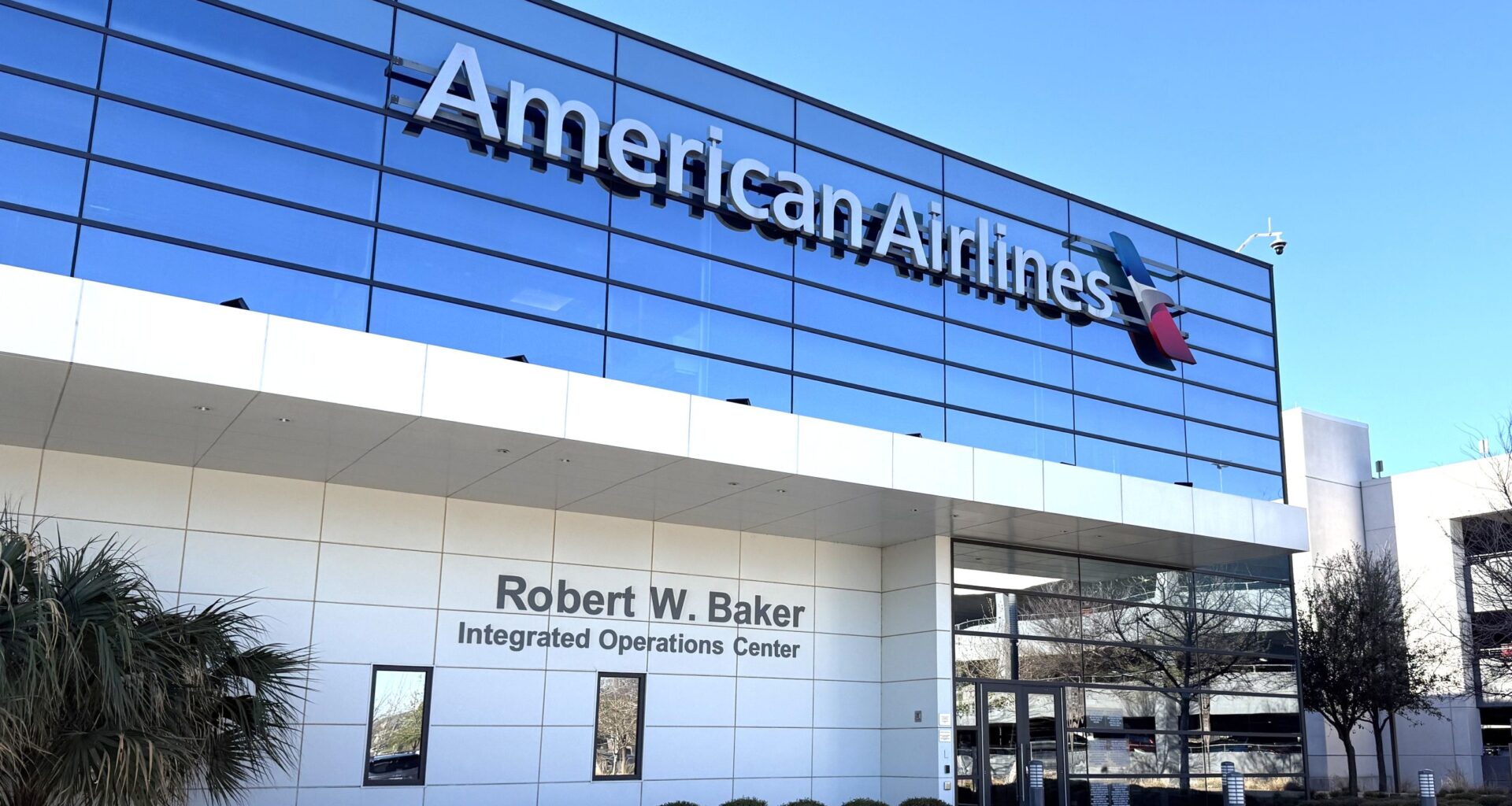
The connective tissue of the entire global operations for American Airlines operates from a sprawling facility in Fort Worth that plans and monitors all of its nearly 7,000 daily flights.
The Robert W. Baker Integrated Operations Center, or IOC, is housed in a building near DFW International Airport that is designed to survive an EF3 tornado. It is one of eight buildings that make up American Airlines’ sprawling 300-acre, 10,000 employee Skyview campus.
IOC vice president Jessica Tyler said the center supports American as the airline services 350 airports in 60 countries, transporting approximately 700,000 passengers daily. Tyler views that number as “customer promises” she and her team are responsible for delivering.
The main floor of the IOC is a cavernous space containing hundreds of workstations and where 20 different teams coordinate the dynamic, real-time operation of the airline. The center runs around the clock seven days a week and is staffed by more than 500 team members per shift out of a total of over 1,700 employees.
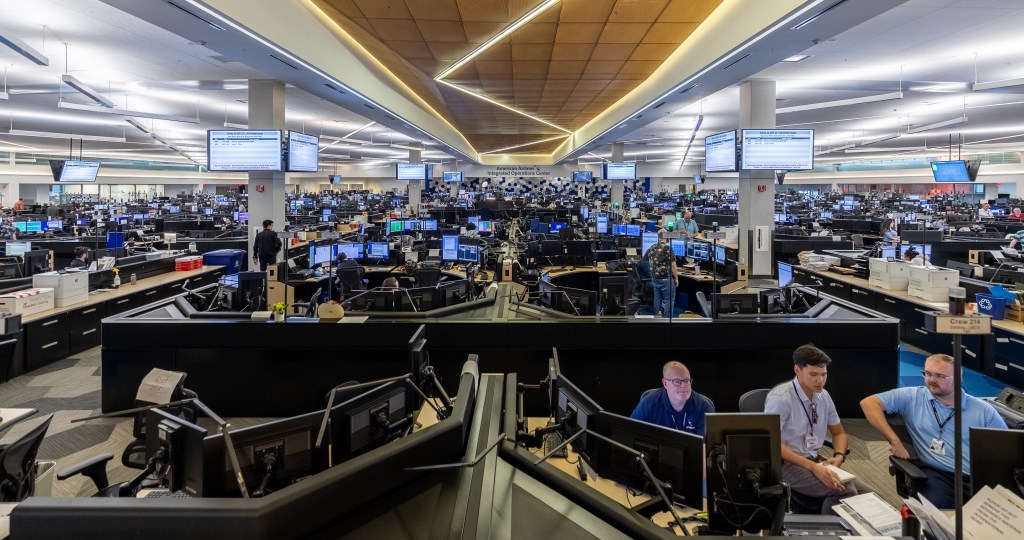 The heart of the Integrated Operations Center, where every American Airlines worldwide flight is managed. (Courtesy | American Airlines)
Creating a flight release plan
It is three hours until American Airlines’ daily departure from Oaxaca, Mexico, to DFW International Airport. While passengers have likely not even begun to arrive at Xoxocotlán International Airport, an IOC flight dispatcher — whose name is not disclosed because of the company’s security policy — is busy creating the release plan that will govern all aspects of this afternoon’s flight.
One display shows the status of more than 20 flights for which the dispatcher is currently responsible. Some are in the planning phase, such as the Oaxaca-DFW flight; some are taxiing out; some are in-flight; and some have just landed at their destination.
The first job is to look at the weather and determine if an alternate destination airport needs to be included in the flight plan. On this day, the weather in North Texas is clear.
The second step is to define the route. For this particular flight, there is one unique consideration: a volcano southeast of Mexico City that is represented by a red symbol on the dispatcher’s map.
The ash plume from Popocatépetl — a 17,883-foot active volcano that’s been erupting on and off since 2004 — is always a concern. Volcanic ash can cause severe damage or catastrophic failure to a jet engine if ingested. The dispatcher plots a path a safe distance from the forecasted plume.
Weather en route is also a consideration. All clear to DFW, so a direct and efficient path is plotted.
Next is determining how much fuel is needed. In general, dispatchers plan for planes to land with about 90 minutes of reserve fuel on board to allow for any diversions that might be necessary.
Finally, the altitude profile is established. As fuel is burned, a plane’s weight decreases, making it inclined to climb. It is the dispatcher’s job to restrict that tendency. That means consulting with the IOC’s meteorology team for predictions on air turbulence, as well as with the maintenance team to ensure the aircraft is safe to fly and that any outstanding maintenance items have been resolved.
The basic flight release process between the pilot and the dispatcher is common to all airports that American services, although each has unique runway configurations and airspace constraints.
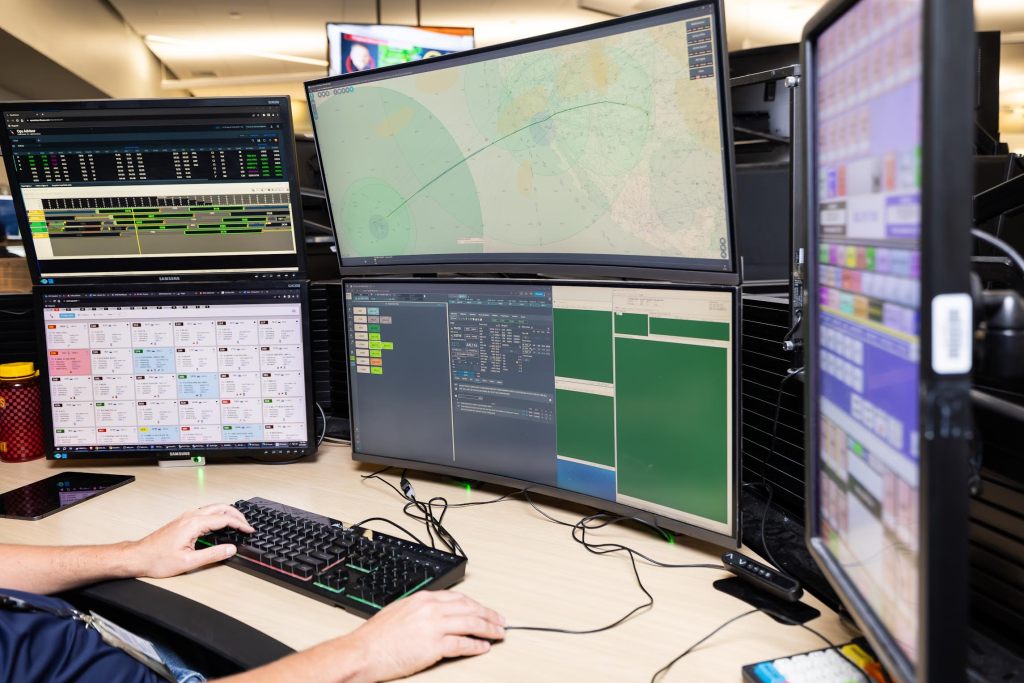 Dispatchers work to create a flight release plan in the Integrated Operations Center. (Courtesy | American Airlines)
Dealing with disruption
A dispatcher’s job becomes much more complex in the case of a disruption — such as bad weather, internet cloud outages or even geopolitical events — especially if one or more of American’s hub airports are affected.
That was the case in January when a winter storm shut down multiple hubs between Texas and New York, resulting in an estimated 9,000 flight cancellations — the most in American Airlines’ history.
To proactively deal with large-scale weather events, American uses an advanced efficiency tool to model systemwide adjustments that might involve flight delays, repositioning of aircraft and crews, or cancellations. Operations leaders then huddle to discuss the scenarios and decide the best course of action.
Tyler has instituted a ‘plan, execute, recover’ approach to ensure her team is continually learning from disruptive events. She holds debriefs to assess what could have been done differently, and then a smaller group meets the following day to operationalize the best suggestions.
To improve customer communication about disruptions, for example, American announced on March 16 that messages on its mobile app and on aa.com will provide clear explanations in the event of delays or cancellations.
Time to fly
When crew members arrive at their aircraft, the dispatcher transmits the flight plan electronically to the captain for review. Once agreed upon, the plan is electronically signed by the captain and the dispatcher, creating a binding contract in accordance with federal regulations.
The dispatcher stays in touch with the captain throughout the flight to monitor fuel, aircraft performance, weather, air turbulence and to coordinate any changes in altitude or route.
An immense responsibility
 Jessica Tyler is vice president of American Airline’s Robert W. Baker Integrated Operations Center. (Courtesy | American Airlines)
When asked about her biggest challenge as IOC leader, Tyler responds, “An operation of our scale and scope, it’s the coordination and the technology used to support that coordination.”
She adds, “It is our role to keep this entire organization moving in the right direction to deliver for our customers.”
That includes replacement of a 53-year-old mainframe computer that still runs many of the airline’s operational tools. “We’ve got the commitment from our board to make this investment and get into a more modern infrastructure.”
Tyler and her team members are aware of the immense responsibility on their shoulders.
“They know that if it goes wrong, we’re in the middle of all that,” she said. “But if we can go home knowing that we helped 700,000 people get to a wedding, get to a funeral, get to the birth of their grandchild, or get to an important business interview or meeting, that’s pretty fulfilling.”
Doug Wilhelm is a member of the Fort Worth Report Documenters crew and a freelance writer.
At the Fort Worth Report, news decisions are made independently of our board members and financial supporters. Read more about our editorial independence policy here.
This <a target=”_blank” href=”https://fortworthreport.org/2026/03/22/behind-the-scenes-at-fort-worths-worldwide-american-airlines-integrated-operating-center/”>article</a> first appeared on <a target=”_blank” href=”https://fortworthreport.org”>Fort Worth Report</a> and is republished here under a <a target=”_blank” href=”https://creativecommons.org/licenses/by-nd/4.0/”>Creative Commons Attribution-NoDerivatives 4.0 International License</a>.<img src=”https://i0.wp.com/fortworthreport.org/wp-content/uploads/2021/04/cropped-favicon.png?resize=150%2C150&quality=80&ssl=1″ style=”width:1em;height:1em;margin-left:10px;”>
<img id=”republication-tracker-tool-source” src=”https://fortworthreport.org/?republication-pixel=true&post=454605&ga4=2820184429″ style=”width:1px;height:1px;”><script> PARSELY = { autotrack: false, onload: function() { PARSELY.beacon.trackPageView({ url: “https://fortworthreport.org/2026/03/22/behind-the-scenes-at-fort-worths-worldwide-american-airlines-integrated-operating-center/”, urlref: window.location.href }); } } </script> <script id=”parsely-cfg” src=”//cdn.parsely.com/keys/fortworthreport.org/p.js”></script>