
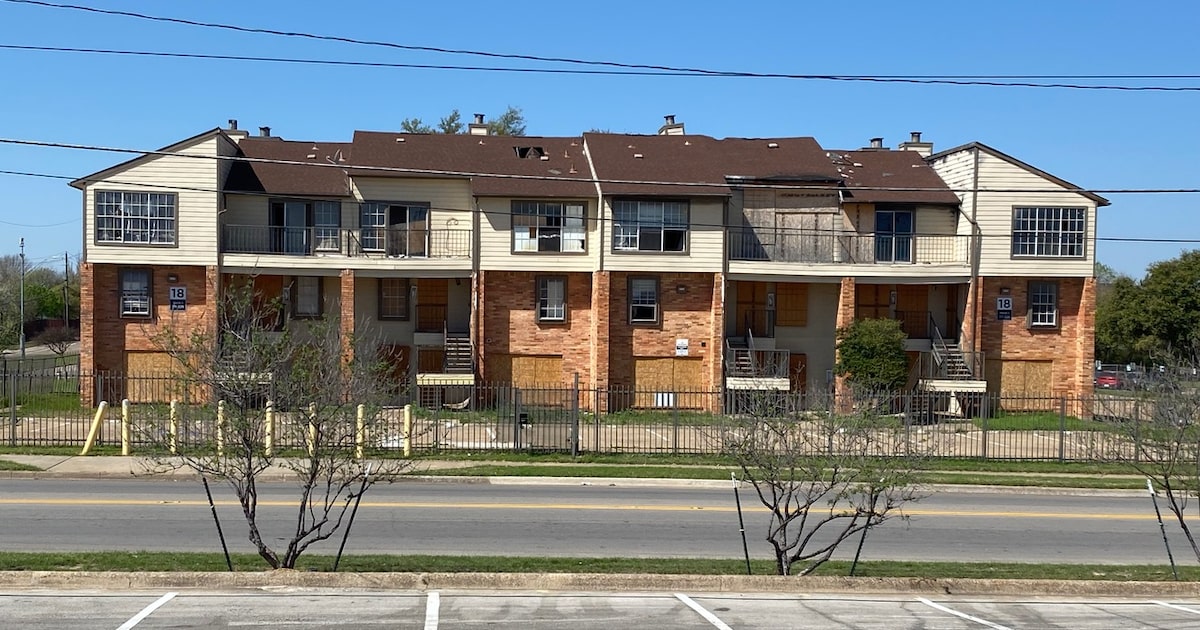
These are the nightmare apartments you don’t want to live in or have as a neighbor.
The Declan on John West Road in Dallas is vacant, boarded up and watched over by a highly observant security team. About two miles southwest along Ferguson Road, several dozen tenants still live in the Estancia Estates and Villas del Tesoro complexes, scattered among hundreds of boarded-up apartments.
Together, the developments include more than 1,000 units. Built between 1964 and 1984, they are the kind of apartments that housing experts expect to become “naturally occurring affordable housing” as they age. Their rents are supposed to drift downward as newer, nicer, pricier multifamily developments are built.
The complexes might look cheap by Uptown standards, but they aren’t inexpensive. An Estancia Estates resident said she pays $1,400 per month for the one-bedroom apartment she shares with her husband. And Vikki Martin, who leads the area’s neighborhood coalition, said that in recent years, the apartment complexes haven’t qualified as safe or decent housing.
Opinion
“What’s most upsetting is how those with the least number of resources, those in poverty, are victimized by these types of owners,” Martin, executive director of the Ferguson Road Initiative, wrote in an email. “Furthermore, when a resident breaks a lease, it messes up their rental history, making it more difficult to find another apartment. The impact on low wage earners and the elderly is tremendous.”
The owners of these complexes argued in court documents that it tried to rehab the Dallas apartments “despite significant roadblocks.” But all three complexes are now in receivership, meaning a court has appointed a neutral third party to take control of them as part of an ongoing legal dispute. Lenders are suing the owners; Dallas filed a lien against the owners for almost $222,000 in unpaid water, storm water and sewer charges; and creditors also allege the owners failed to pay almost $269,000 in property taxes. It could be months or years before the properties’ fate is clear.
But local governments, nonprofits and neighborhood groups should feel a sense of urgency about these aging apartment complexes. Dallas has many multifamily developments built four, five or six decades ago. Think about the acres of garden-style apartment buildings in Vickery Meadow and Lake Highlands, southwest Oak Cliff and near Bachman Lake in northwest Dallas. They all need diligent management and maintenance to avoid becoming blight. Local jurisdictions need the property taxes they pay.
Dallas also has a serious lack of inexpensive rental housing. The Child Poverty Action Lab estimated that Dallas is short about 46,000 affordable units, apartments with rents of $1,400 per month for a family of four making $51,500 annually. It is more efficient to maintain existing rental units than to build new ones, so the city must try to keep these older apartments in its housing stock.
The Declan, Estancia Estates and Villas del Tesoro are part of a particularly galling saga, one extensively reported in The Real Deal, a publication that covers the real estate industry.
In 2016, Jon P. Venetos founded a real estate investment company called Lurin, according to its still-active website. The plan was to raise money from banks and other investors, use it to buy older multifamily properties, then renovate and manage them to produce a rental stream that would cover operating costs, repay investors and make a profit.
Lurin’s website says the company owns 46 apartment complexes, comprising about 10,000 units, in Alabama, Arkansas, Louisiana, Florida and Texas. It bought most of its Dallas-area properties between 2019 and 2022.
But deals such as Lurin’s can be vulnerable to larger economic forces like changes in interest rates, said Karl Zavitkovsky, a former banking executive and city economic development director who serves on the Ferguson Road Initiative’s board. That appears to be what happened with Lurin.
In court documents, creditors claim Lurin defaulted on loans and allowed some properties to decay into squalor. In court filings, Lurin’s attorneys rejected allegations of nonpayment and stated the company had worked to improve underperforming properties. Some creditors requested that complexes be placed into receivership.
One Lurin property, Evana Grove Apartments, is in Plano. Conditions there grew so dire that the city went to court last fall and won an emergency temporary restraining order. The water lines leaked so badly that the complex was one of Plano’s biggest water users, said Curtis Howard, director of neighborhood services. Sewers backed up and overflowed into a creek. Broken windows stayed broken.
“Apartments were just unlivable,” he said.
The restraining order allowed Plano to close the complex, which required evicting the remaining tenants. But the city had planned for that. It worked with local nonprofits and the school district to minimize dislocation and ensure no one ended up on the street.
“It was really a full community effort…to do what we could,” Howard said, adding that the city is assessing how to better prepare for any future occurrence.
That’s a good model for other cities, including Dallas: decisive action combined with assistance for displaced tenants.
Along Ferguson Road, a new property manager, hired by the receiver, oversees the semi-vacant complexes. Christina Castillo, who moved into Estancia Estates in 2019, said the new manager responds promptly to repair requests. The grounds are free of trash and the grass mowed.
Leaders of the Ferguson Road Initiative would like to see the complexes redeveloped, which may be necessary depending on their condition. Even with the area’s natural beauty — hilly topography and mature trees — Martin and Zavitkovsky don’t think luxury apartments would be economically viable. They just want to find a responsible developer who will build solid, decent, affordable apartments and make sure they’re maintained.
It may be too late to rehabilitate these complexes, but Dallas has plenty of others that could still be saved.
We welcome your thoughts in a letter to the editor. See the guidelines and submit your letter here.
If you have problems with the form, you can submit via email at letters@dallasnews.com