
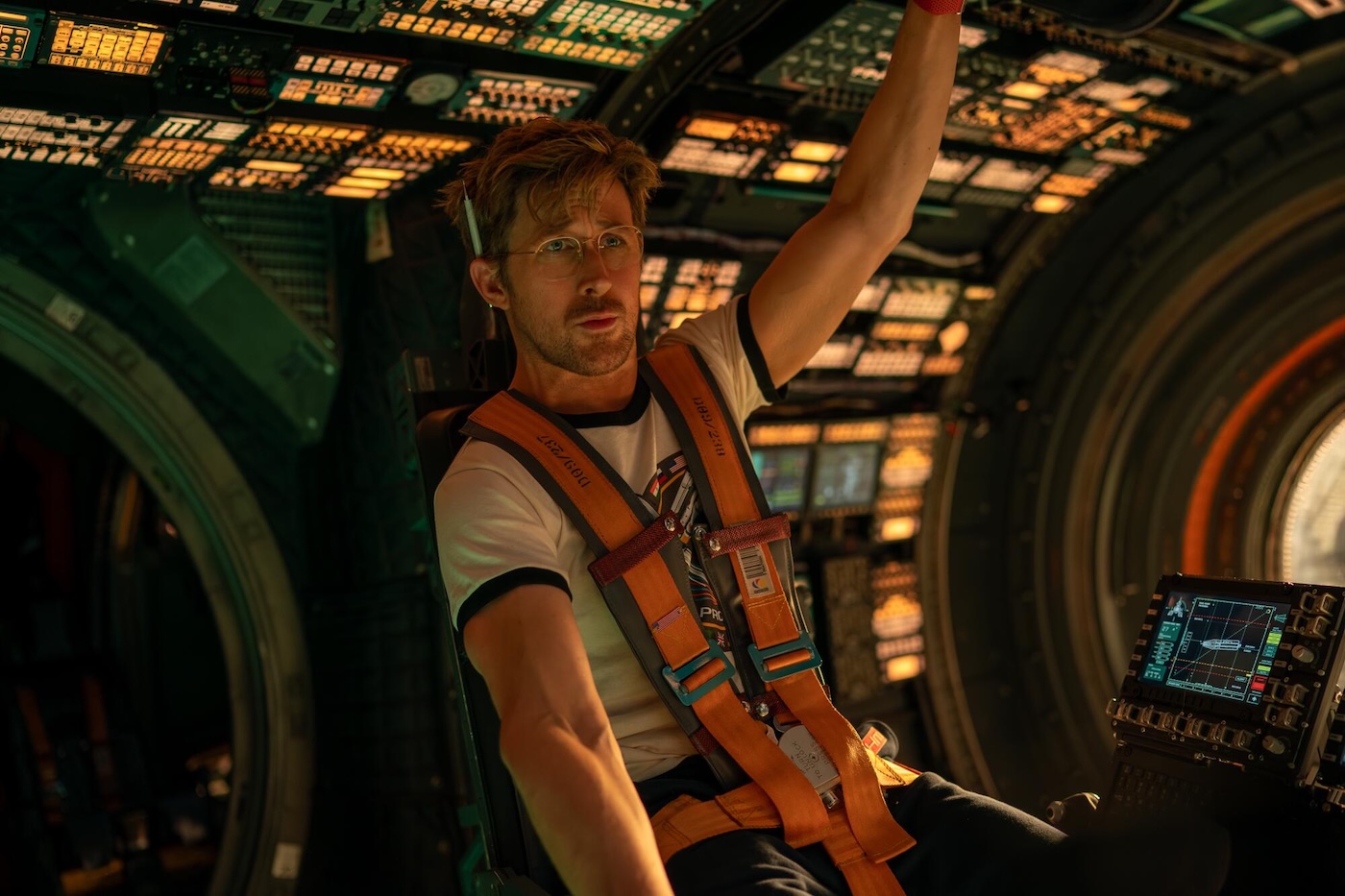
E.T. and Elliot, Kirk and Spock, Chewbacca and Han Solo. We love a good science fiction story where humans and aliens buddy up. In “Project Hail Mary,” Ryan Gosling once again plays a middle school teacher, although this time, he’s not on crack (as in “Half Nelson”), but he is trying to crack the mystery behind our dimming sun. Like Major Tom floating in a tin can, he’s jettisoned into space to save Earth, where he meets a loveable alien (he nicknames Rocky) on a mission to also save his planet Erid. It’s been ten years since “Arrival,” so the timing is right for xenocooperation, with more laughs and feel-good vibes this time around.
Based on Andy Weir’s 2021 novel and adapted by Drew Goddard, the two teaming up again after working together on 2015’s “The Martian,” starring Matt Damon, “Project Hail Mary” likely feels familiar to the writers. Both stories feature a lone wolf in space trying to survive a hostile environment through scientific problem-solving and humor. While Ridley Scott considers his 11-year-old film to be a comedy, I’m not sure I agree when compared to Gosling’s charmingly funny sci-fi adventure, directed by Phil Lord and Christopher Miller.
There’s a plethora of scientific terms in “Project,” but the most important one is Astrophage, a microscopic organism that chomps on energy like a stellar Pac-Man. Similar to mold, it grows on a star’s surface, dimming the affected star. As it munches on our yellow dwarf star, aka the Sun, the Earth cools, and in thirty years, we’ll be back in the ice age with a woolly mammoth, a sloth, and a saber-toothed tiger saving babies. So, we need to develop a microscopic version of Blinky, Pinky, Inky, and Clyde to stop the Pac-Man-like Astrophage — enter Taumoeba, the second scientific term to remember.
Now let’s add some irony. Astrophage could accelerate humanity’s downfall. However, scientists also found that the organism works as an excellent accelerant, which could power the Hail Mary spaceship and push it to near-light speeds. So yes, it could also save us—if the spacecraft doesn’t explode from the volatile, supercharged explosive.
How does a middle school science teacher fit in? You see, before Ryland Grace (Gosling) was teaching kids about sound waves, he was a molecular biologist whose ideas were considered too fringe for the mainstream scientific community. That’s exactly why high-ranking international official Eva Stratt (a very good Sandra Hüller), in charge of the Project Hail Mary mission, seeks out Grace. She needs someone who thinks outside the box.
Gosling is a versatile actor whose comedic skills have been showcased in “Barbie,” “The Nice Guys,” “The Fall Guy,” and his recent stint as a host on Saturday Night Live. His charm and goofball personality are a perfect fit for the role of Grace. Add a loveable alien into the mix, and we have a family-friendly comedy with enough smarts to appeal to sci-fi enthusiasts.
When Grace is asked to join the three-member crew on a suicide mission to save Earth (there isn’t enough fuel for a return trip), he declines, stating, “I put the ‘not’ in astronaut! I’ve never done a spacewalk; I can’t even moonwalk.” Funny? Yes! But unfortunately, that’s not the answer Stratt was looking for. Grace wakes up from an induced coma aboard the Hail Mary spacecraft, headed toward the Sun-like star Tau Ceti, 11.9 light-years from Earth, to figure out why it has not been affected by Astrophage. To complicate matters, Grace has temporary amnesia. He’s disoriented and panicky after discovering his crewmates didn’t survive the journey. Slowly, his memory begins to come back.
The film opens with Grace waking up on the spacecraft and then unfolds through a series of flashbacks as he begins to regain his memory, allowing the audience to piece the story together. This creates an inconsistency in tone, as the story shifts from lighthearted moments to cutesy scenes of alien goodness and then to tense, dangerous situations, reminding us that this is serious stuff.
The flashback scenes help establish that Gosling isn’t tasked with carrying the film, as in “Cast Away” or “All Is Lost.” Once his extraterrestrial costar arrives, he steals a bit of Gosling’s spotlight.
Meet “Rocky.” He looks like a rock with spider legs and no face. Initially, I was turned off by the alien’s design upon viewing the trailer, but my sentiment quickly changed after getting to know the space visitor from the planet Erid, and now all I want is a Rocky plushie—which I’m sure is exactly what Amazon MGM Studios wants to hear.
Rocky (given the nickname by Grace after the Sylvester Stallone movie) is an engineer, and like Grace, the sole survivor of his spaceship (Blip-A), whose planet faces a similar outcome to Earth thanks to Astrophage. The two meet when Grace encounters Rocky’s ship upon arrival at the Tau Ceti system, and Rocky rolls out a tunnel made out of xenonite connecting the two ships.
Props to Lord and Miller for using practical effects rather than digital ones to create Rocky. Puppeteer James Ortiz (a legend on Broadway) brought the alien created by legendary creature shop creator Neal Scanlan to life. While some CGI was used for more advanced motions, the majority of Rocky’s interactions with Gosling are a blend of Bunraku puppetry and animatronics.
Since Rocky communicates with whale-like sounds, Grace gives him a voice by creating a translation system on his laptop that uses waveform analysis to develop a vocabulary. Rocky speaks in broken English while sounding like Mr. Moviefone meets Siri (voiced by James Ortiz), giving the creature a retro vibe.
Despite its 2h 36m runtime, the film is a streamlined version of Andy Weir’s novel, removing some characters and adjusting the ending’s tone while quickly moving through the story’s speculative science. However, the physics, math, and orbital mechanics make sense, and the astronomy is based on real nearby star systems. Does any of that matter? No. We’re here to see Ryan Gosling and his new alien friend become BFFs. Mission accomplished.
(3 ½ stars)
Now showing in theaters
This <a target=”_blank” href=”https://fortworthreport.org/2026/03/22/project-hail-mary-review-ryan-gosling-shines-bright-as-a-single-star-in-a-big-sky-involved-in-a-rocky-bromance/”>article</a> first appeared on <a target=”_blank” href=”https://fortworthreport.org”>Fort Worth Report</a> and is republished here under a <a target=”_blank” href=”https://creativecommons.org/licenses/by-nd/4.0/”>Creative Commons Attribution-NoDerivatives 4.0 International License</a>.<img src=”https://i0.wp.com/fortworthreport.org/wp-content/uploads/2021/04/cropped-favicon.png?resize=150%2C150&quality=80&ssl=1″ style=”width:1em;height:1em;margin-left:10px;”>
<img id=”republication-tracker-tool-source” src=”https://fortworthreport.org/?republication-pixel=true&post=457492&ga4=2820184429″ style=”width:1px;height:1px;”><script> PARSELY = { autotrack: false, onload: function() { PARSELY.beacon.trackPageView({ url: “https://fortworthreport.org/2026/03/22/project-hail-mary-review-ryan-gosling-shines-bright-as-a-single-star-in-a-big-sky-involved-in-a-rocky-bromance/”, urlref: window.location.href }); } } </script> <script id=”parsely-cfg” src=”//cdn.parsely.com/keys/fortworthreport.org/p.js”></script>