
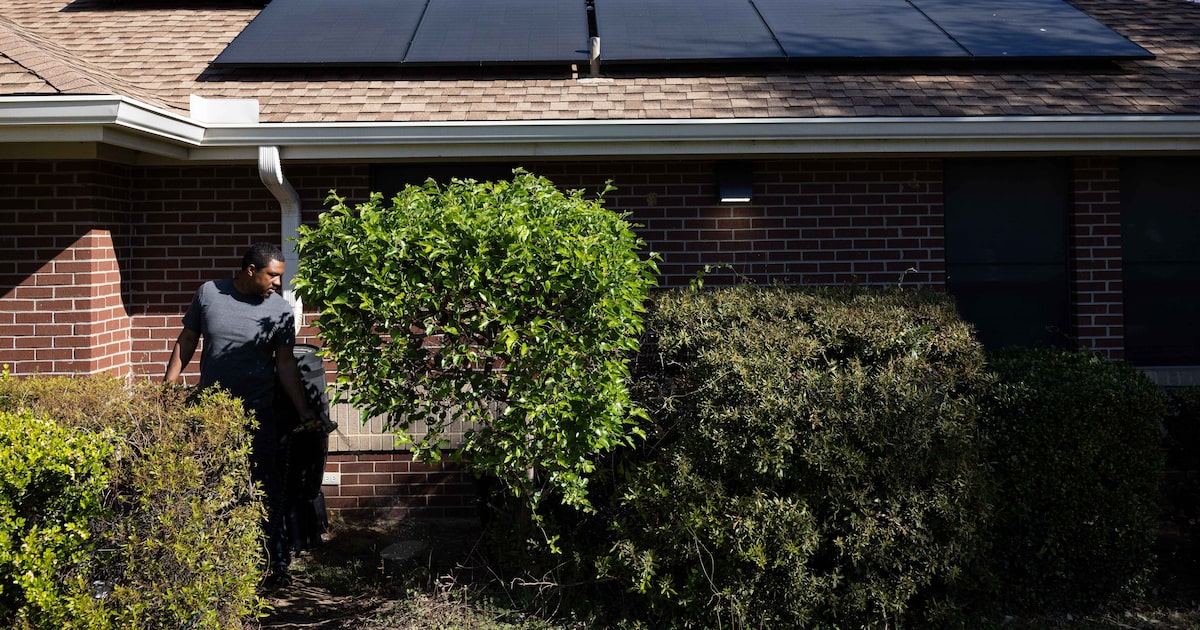
ARLINGTON — Two affordable apartment complexes in West Arlington recently turned the switches on at their “community resilience hubs,” a first-of-its-kind project in North Texas.
The constructs, which included the installation of solar panels and commercial-sized battery energy storage systems, are designed to provide backup power in high-need neighborhoods during an outage.
The Texas Energy Poverty Research Institute partnered with affordable multifamily housing developer Foundation Communities to develop the Arlington hubs. Grapevine-based Holistic Utility Solutions engineered and constructed the project.
The funding for the project largely came from a $1 million contribution from Google, which recently made a $30 million commitment to scale critical energy affordability initiatives throughout Texas —even as it spends lavishly on data center initiatives in the region.
Breaking News
Related

Autumn Gallardo, sustainability coordinator with Foundation Communities, said these hubs are the “missing middle piece” that falls between individual homes having small battery storage, and the much-larger utility-sized BESS.
“We hope this model will prove up an opportunity for benefiting low-to-moderate income residents being able to access these kinds of technologies,” Kathy Jack, TEPRI director of programs, added.
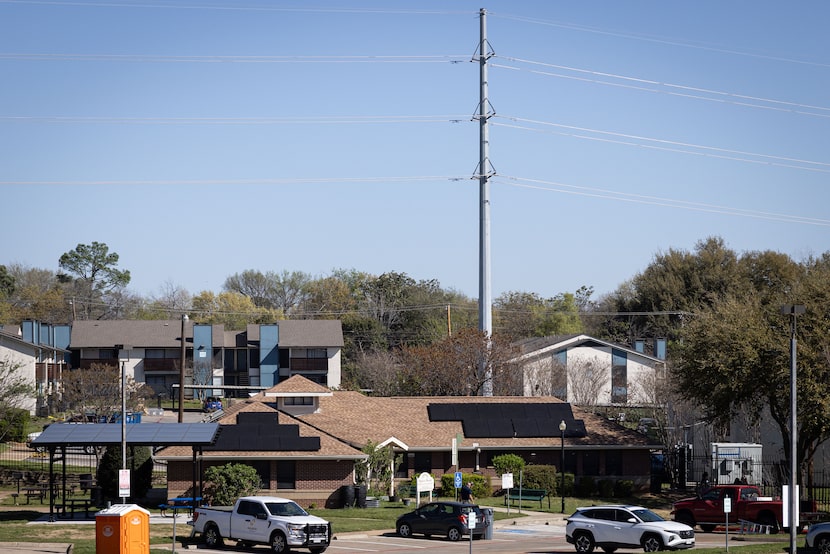
An Oncor transmission line stretches over the Shadow Brook Resilience Hub and Learning Center on Friday, March 20, 2026, in Arlington. Solar panels are seen on the roof and double as a shaded awning for benches to the left of the building. On the right, cabinets store lithium-ion batteries. The hub serves as an emergency shelter for apartment residents in the event of a prolonged power outage.
Angela Piazza / Staff Photographer
Many Texans are facing compounding financial challenges, including rising electric costs and worries of grid stability. Hotter weather, more frequent storms, and the boom in data centers, are adding to consumer affordability worries with respect to electricity costs.
Recent data from TEPRI showed 87% of low-to-moderate income households are concerned about weather-related power outages and 46% reported they would stay home during the emergency. These hubs are intended to provide a safe place for those vulnerable communities, Gallardo and Jack said.
A scalable model?
The hubs are located at the learning centers of Sleepy Hollow and Shadow Brook apartments, containing 128 and 403 residential units respectively.
The solar and storage will provide at least 24 hours of backup power and on-site services, like air conditioning and heating or device charging, during an outage.
When there isn’t an emergency, the hubs are designed to reduce energy costs and strain on the local grid. They are also planned to integrate distributed power plant, also called virtual power plant, technologies that will increase savings and support the larger electric grid.
TEPRI will analyze the hubs for two years post-installation to make any moderations needed. The group hopes these hubs can be replicated elsewhere.
“We see this as a model to replicate across Texas,” Jack said.
Earlier this month, the groups held an event celebrating the completion of the hubs with Shadow Brook resident Betty Warren in attendance.
“[The] ceremony means so much more than new solar panels and a battery system—it represents stability, dignity, and opportunity,” Warren said. “I come from very humble beginnings, and I’ve seen firsthand how access to quality facilities and supportive programs can truly change someone’s life.”
This reporting is part of the Future of North Texas, a community-funded journalism initiative supported by the Commit Partnership, Communities Foundation of Texas, The Dallas Foundation, the Dallas Mavericks, the Dallas Regional Chamber, Deedie Rose, Lisa and Charles Siegel, the McCune-Losinger Family Fund, The Meadows Foundation, the Perot Foundation, the United Way of Metropolitan Dallas and the University of Texas at Dallas. The News retains full editorial control of this coverage.