
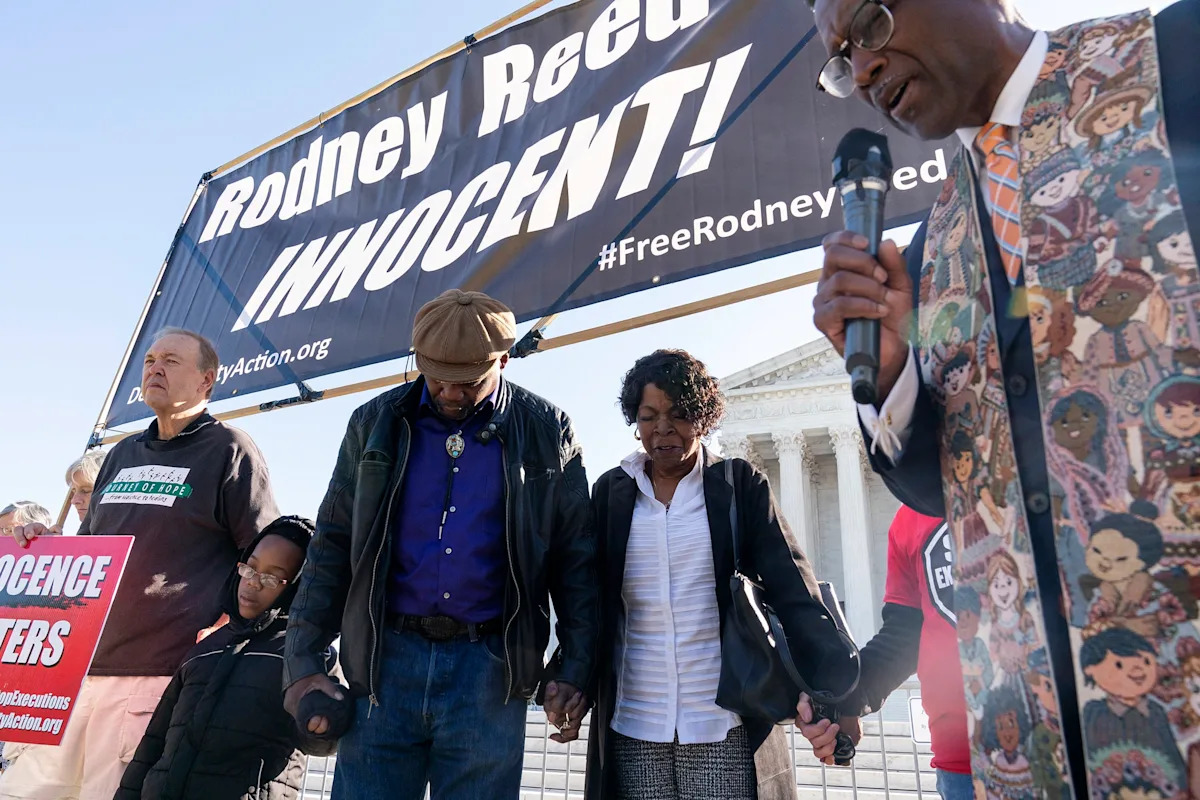
The Supreme Court’s refusal to hear Rodney Reed’s appeal means Texas will likely execute him without knowing whether his or another person’s DNA was on the murder weapon, Justice Sonia Sotomayor wrote for the court’s three Democratic appointees on Monday. She made that stark observation in a dissent from the court’s refusal to review Reed’s petition in his long-running effort to prove his innocence.
It takes four justices to agree to review an appeal, so the court fell one vote short of possibly remedying what Sotomayor deemed an “inexplicable” situation in this capital case. Even if the dissenters had attracted a fourth vote for review, a majority of the nine justices would have needed to ultimately rule in Reed’s favor to grant him relief.
In her dissent, the Obama appointee’s “inexplicable” remark applied to the Bastrop County District Attorney’s Office’s refusal to allow DNA testing of the belt used to kill Stacey Lee Stites, “despite the very substantial possibility that such testing could exculpate Reed and identify the real killer.” She also said it applied to the lower courts’ failure to evaluate Reed’s claims more carefully, especially when that lack of care may lead to the execution of an innocent man.
She said the federal appeals court that covers Texas failed to address a potentially winning argument that Reed raised in support of his effort to prove his innocence. Nonetheless, the high court refused to step in.
Reed was convicted in 1998 of killing Stites. He has suggested that her fiancé, Bastrop County police officer Jimmy Fennell, was the one who killed her because Stites and Reed were having an affair.
The Supreme Court’s denial of Reed’s petition means the state will likely executive him “without the world ever knowing whether Reed’s or Fennell’s DNA is on the murder weapon, even though a simple DNA test could reveal that information,” Sotomayor wrote.
Joining her dissent were Justices Elena Kagan and Ketanji Brown Jackson.
The dissent appeared on Monday’s order list, a document that contains the court’s latest action on pending appeals. It consists mostly of denials that emphasize the Republican-appointed majority’s power in shaping the court’s docket.
Monday’s list also showed Sotomayor leading the Democratic-appointed trio in a dissent in a qualified immunity case, in which she called out the majority for giving officers “license to inflict gratuitous pain on a nonviolent protestor even where there is no threat to officer safety or any other reason to do so.”
In yet another case on the list, Sotomayor dissented — this time all by herself — from the court’s refusal to hear a separate qualified immunity appeal. In that one, she said the court made a “grave error” with its refusal to consider a case involving the arrest of a reporter. By denying the petition, the court “leaves standing a clear attack on the First Amendment’s role in protecting our democracy,” she wrote.
Subscribe to the Deadline: Legal Newsletter for expert analysis on the top legal stories of the week, including updates from the Supreme Court and developments in the Trump administration’s legal cases.
The post The Supreme Court might be helping Texas execute an innocent man in Rodney Reed appeared first on MS NOW.
This article was originally published on ms.now