
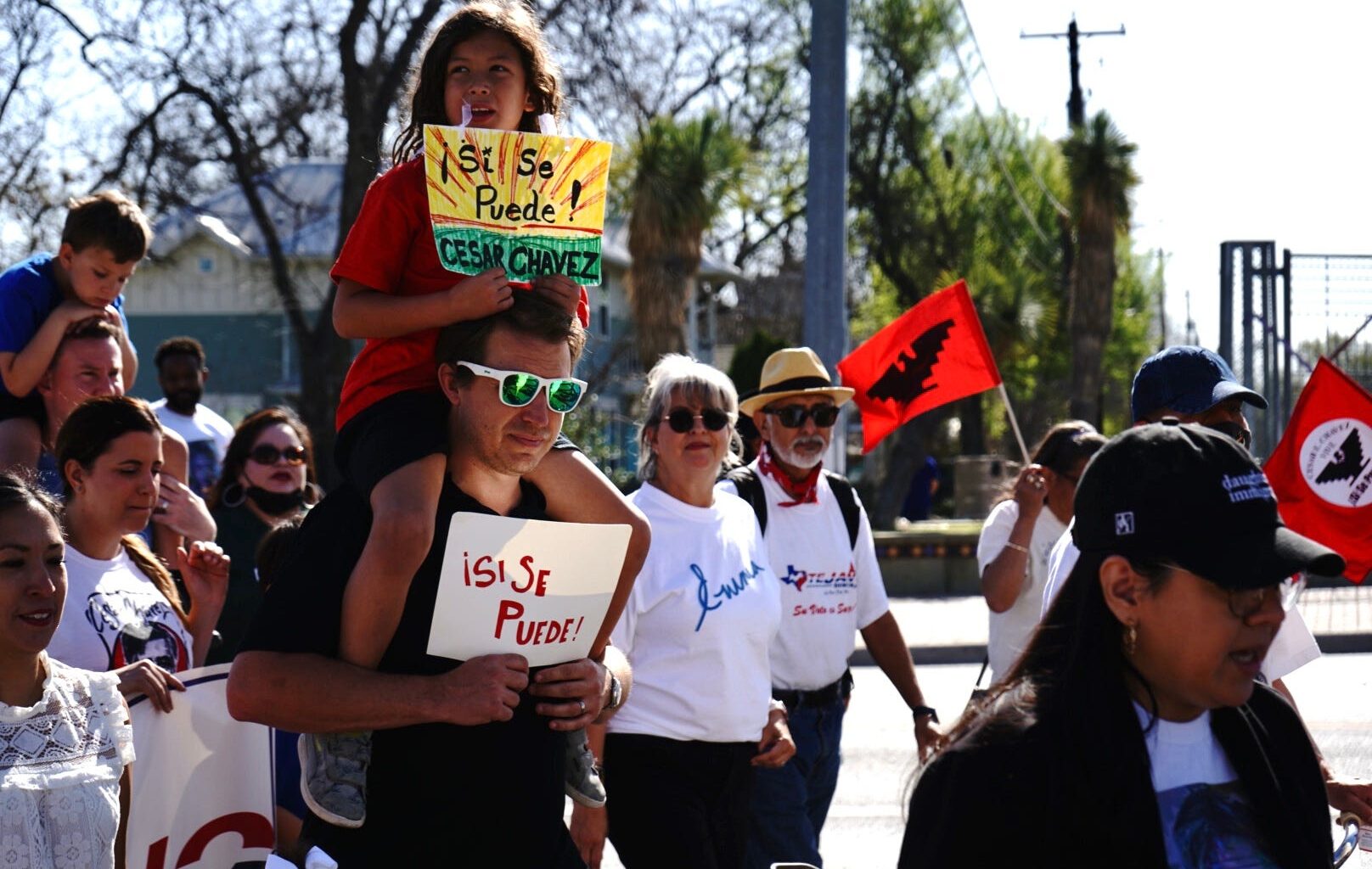
More than 100 people marched in a 2022 event in Austin honoring César Chávez and the farmworker rights movement. Now that allegations of abuse have surfaced against Chávez , maturity as a civic community lies not in erasing complexity, but in facing it, J. Michael Solar writes.
Madi Donham
Austin is once again confronting a familiar American dilemma: what to do when a revered public figure is accused of serious moral wrongdoing.

Recent reporting has raised troubling allegations about César Chávez, the labor leader whose name marks one of the city’s principal streets. In response, organizations tied to his legacy have reconsidered or canceled celebrations, and Austin is now weighing whether to do the same — perhaps even renaming César Chávez Street.
Article continues below this ad
That may feel like the central question. It is not.
I write as a Tejano who came of age during Chávez’s rise and who knew him. For many of us, he was not an abstraction or a symbol. He was a presence — disciplined, purposeful and deeply committed to improving the lives of farmworkers who had long been invisible to the nation. His work mattered. It still does.
That truth does not insulate him from scrutiny.
If the allegations now surfacing prove true, they would represent a profound moral failure — one that cannot be dismissed simply because of the good he accomplished. But neither should his contributions be erased because of the possibility, or even the proof, of wrongdoing.
Article continues below this ad
RELATED: Rename César Chávez Street for the movement, not the man
Americans have long lived with this tension. George Washington led a revolution for liberty while enslaving others. Thomas Jefferson gave voice to equality while violating it in his own life. Abraham Lincoln preserved the Union while navigating complexities that resist simple moral narratives.
We did not resolve those contradictions by pretending they did not exist, nor by erasing them from memory. We learned — imperfectly — to live with them.
Now Chávez stands in that same uneasy space.
Article continues below this ad
First, pause. A city has no obligation to celebrate a figure whose legacy is under serious question. Suspending parades or official observances while facts are examined is prudent and respectful to all concerned, especially to anyone who may have been harmed.
Second, resist the rush to symbolic cleansing. Renaming a street may offer the appearance of moral clarity, but it often substitutes gesture for judgment. It suggests that history can be corrected by removing a name, when in fact it must be confronted by telling the truth.
Third, apply the same standard across past and present. If we are prepared to revisit the legacies of the dead, we must also be willing to examine the conduct of the living with equal seriousness. Moral judgment loses its force when it is applied selectively.
Article continues below this ad
ALSO READ: Allegations shake César Chávez’s legacy, but the movement marches on
Austin does not need to decide today whether César Chávez belongs on a street sign. It needs to decide whether it is willing to engage history honestly.
That means acknowledging both the dignity Chávez helped bring to farmworkers and the gravity of what is now alleged. It means allowing space for truth to emerge without rushing to either canonize or condemn. And it means recognizing that maturity as a civic community lies not in erasing complexity, but in facing it.
I knew César Chávez. He was a man who changed lives for the better. If these allegations are true, he was also a man who failed in ways that demand accountability, even now.
Article continues below this ad
Austin’s responsibility is not to simplify that reality. It is to confront it — with fairness, with consistency and with the courage to tell the whole story.
J. Michael Solar is an attorney in Houston.