
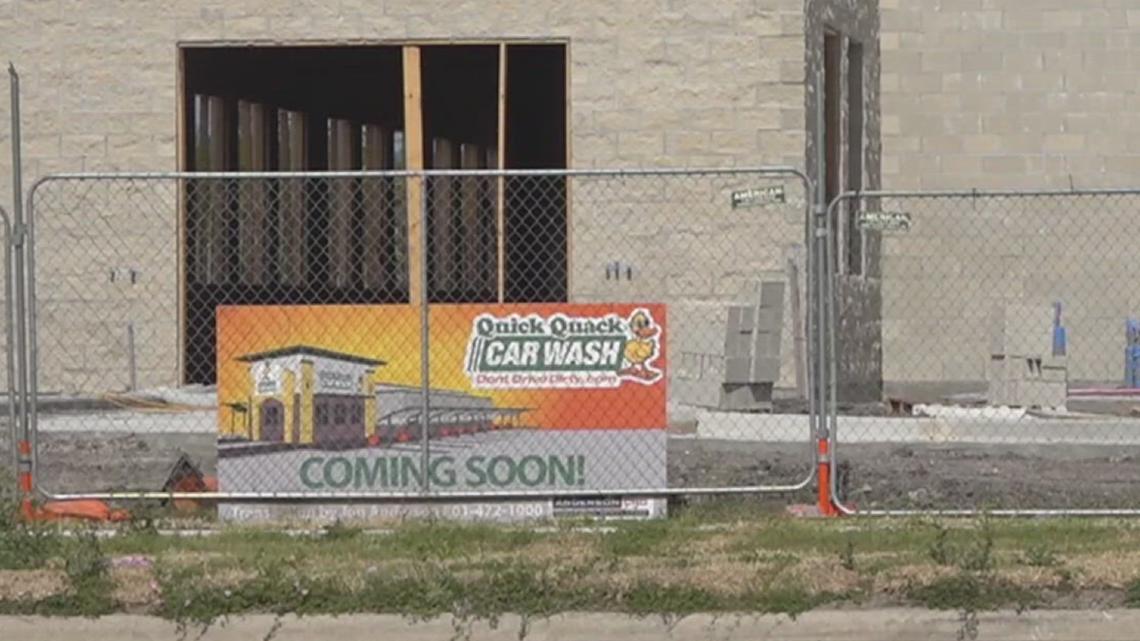
A new car wash being built along Rodd Field Road sparked the question, “how are projects like this are still being approved during current drought conditions?”
CORPUS CHRISTI, Texas — A 3NEWS viewer question about a new car wash under construction has led to a broader conversation about water use in Corpus Christi as the city continues to deal with drought conditions.
The question came after a viewer spotted a new Quick Quack Car Wash being built along Rodd Field Road near Williams Drive, asking how projects like this are still being approved during a water crisis. After looking into it, city records show that location is part of a larger trend.
Since 2022, there are seven new car washes across Corpus Christi, including multiple Quick Quack locations, as well as Annaville Car Wash and Ringers Car Wash. The newest location on Rodd Field Road was permitted in 2025 and is expected to open in 2026. The previous Quick Quack location on South Alameda opened in 2023.
Even as drought conditions persist, city leaders say they cannot prevent these types of businesses from opening if they meet the necessary requirements. Corpus Christi City Councilman Eric Cantu said, “We can’t stop the permit process. I mean, it’s, it’s open to any business that wants to open in Corpus Christi.”
City Manager Peter Zanoni echoed that explanation, saying a car wash is treated like any other new development that requires water service. “A new car wash… is a new business that needs water to operate similar to a hotel or a restaurant,” he said. “The city has not put a moratorium on new meter connections, whether it’s for a new home, a new car wash, a new hotel, a new restaurant.”
Zanoni also said new state laws have made it more difficult for cities to limit new water connections, even during drought conditions. “If we want to try to do it, we have to follow the new state law that we still have to vet through,” he said, adding that whether it’s a home or a business, the same legal process applies and would require additional steps and city council action.
Some newer car washes say they are designed to reduce water usage by recycling it. Quick Quack Car Wash systems, for example, include multiple reclaim tanks and filtration systems that recycle about 90 percent of the water used, with an average of 28 gallons of fresh water needed per vehicle. However, not all facilities publicly share detailed data on water usage.
Cantu said he has questions about how much water these businesses are actually using. “They do claim that they save a lot of water, up to 60-70%. How true that is I have no clue. I have not seen any documentations or any numbers,” he said, adding that he may request public records to review usage more closely.
The discussion comes as Corpus Christi remains under Stage 3 drought restrictions, which already limit outdoor water use. If conditions worsen, even stricter measures could be put in place.
During a media briefing Friday, Zanoni said that under the city’s drought contingency plan, reaching a Level 1 water emergency would trigger broader restrictions. “If we hit a level one water emergency… no water should be used… to wash any motor vehicle,” he said. That restriction would apply across the board, including commercial car washes.
At the same time, some city leaders say the conversation should also include how water use is distributed among industries. Cantu said he believes small businesses should not be disproportionately impacted compared to larger industrial users. “Why should they be the ones to cut back as a small business than a big old corporation… I just don’t feel it’s right,” he said.
City leaders say discussions about water policy, including whether to limit new water connections in the future, are expected to continue with city council in the coming weeks. For now, projects that have already been approved, like the car wash on Rodd Field Road, are continuing forward.