
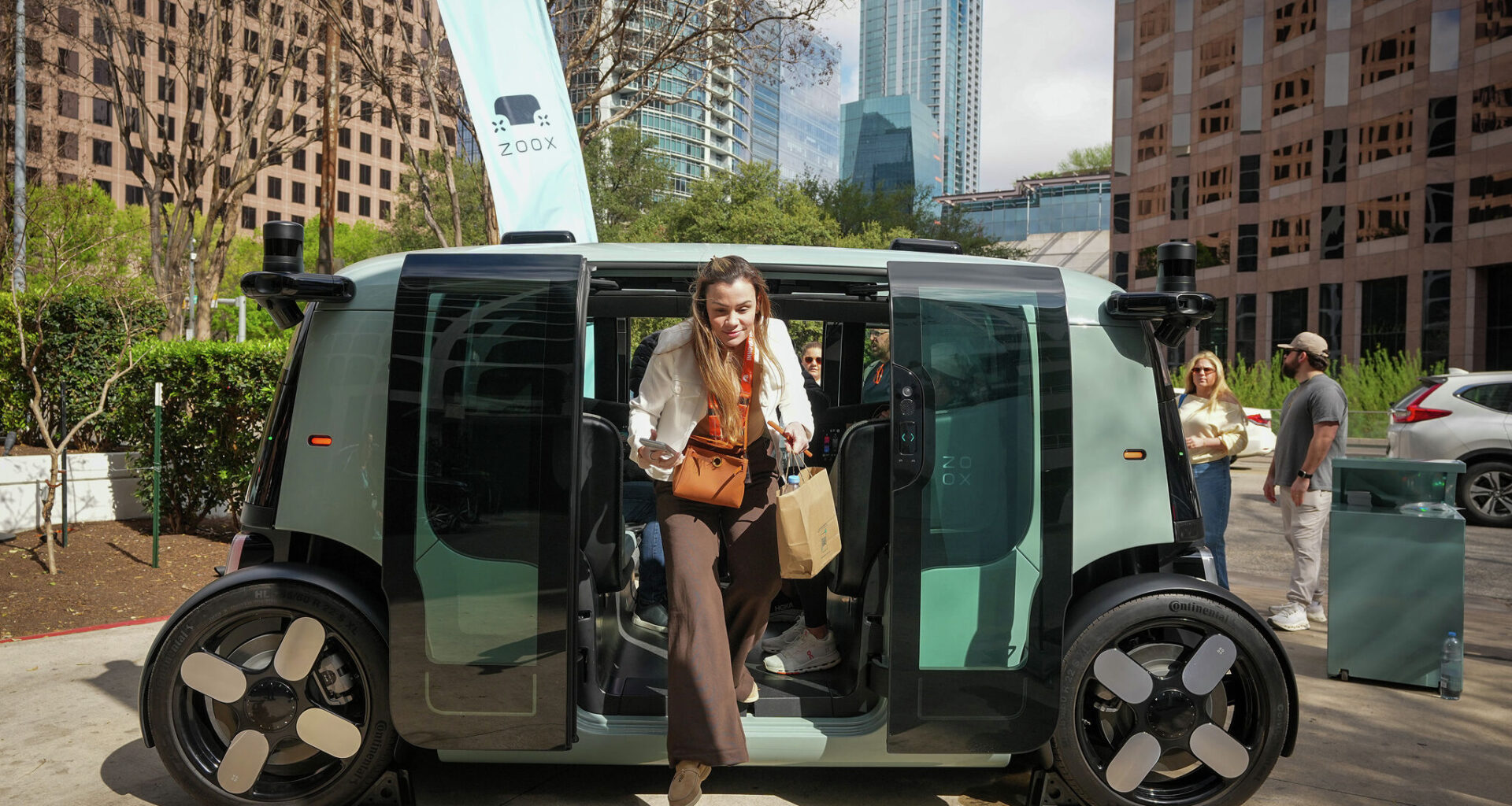
Camila Scop of Brazil steps out of a Zoox fully autonomous robotaxi that was displayed at The Line Hotel during the South by Southwest Conference and Festivals on March 14. The company announced that it will begin testing and limited rides in Austin this year.
Jay Janner/Austin American-Statesman
Austin will soon see another driverless robotaxi on the streets, but this one will look very different.

Zoox Inc. announced Tuesday that it is bringing its purpose-built, autonomous robotaxi to Austin. The company will begin testing its robotaxis, which feature neither a steering wheel nor pedals, this week.
Article continues below this ad
In a few weeks, Zoox employees, as well as their family and friends, will be able to call rides in Austin, a spokesperson for the company told the American-Statesman. The company plans to open up its waitlist and begin offering early rides to a limited audience by the end of this year.
Rides will be available via the Zoox app.
The company has been mapping areas of Austin since June 2024. But the company’s robotaxis look entirely different from the Toyota Highlander SUVs that are currently roaming parts of downtown and East Austin.
RELATED: Rivian to launch driverless robotaxi services in 25 cities in partnership with Uber
Article continues below this ad
The autonomous vehicles are bidirectional and symmetrical, meaning they have no front or back. They have sliding glass doors on both sides and a skylight above. Inside are four inward-facing seats, similar to a ferris wheel or train car, with chargers, ports and a control panel for support, music and climate control.
James Distefano and Payton Cavin of Austin sit in a Zoox driverless robotaxi that was displayed at The Line Hotel during the South by Southwest Conference and Festivals on March 14. The robotaxis open with sliding glass doors on either side and has four seats that face each other.
Jay Janner/Austin American-Statesman
The robotaxis are a stark departure from Waymo’s Jaguar robotaxis, which largely resemble standard cars with large sensors attached.
But the technology is similar. Both Waymo and Zoox vehicles rely on cameras, radar, lidar, infrared and machine learning. Sensors are visible on all four corners.
Article continues below this ad
Zoox showed off its robotaxi in Austin earlier this month during the South by Southwest Conference and Festival, with a small activation outside The Line Hotel on East Cesar Chavez Street that gave Austinites a sneak peek inside one of the vehicles.
As part of its initial launch, Zoox robotaxis will operate in “popular ride-hailing neighborhoods,” a company spokesperson said, including downtown, West and East Sixth Street, East Cesar Chavez Street, Riverside Drive and Rainey Street. The company declined to share the exact size of its service area but said it plans to expand as it opens to more riders.
Zoox is a subsidiary of Amazon, which acquired the company in 2020. Zoox’s robotaxis launched in Las Vegas and San Francisco last year. Along with expanding into Austin, Zoox is also going to bring its robotaxi for testing in Miami and also recently announced that it would begin mapping in Dallas and Phoenix.
With Tuesday’s announcement, Zoox also announced new features for its robotaxis, including the ability to connect devices via Bluetooth to play music.
Article continues below this ad
“This expansion marks a significant step forward for Zoox and is driven by the insights from our early deployments,” Zoox CEO Aicha Evans said in the announcement. “This is our year of growth. We are actively implementing learnings to confidently and safely scale our robotaxi service across the country and bring our differentiated experience to even more riders.”
The “sensor pod” on a Zoox driverless robotaxi is displayed at The Line Hotel during the South by Southwest Conference and Festivals on March 14. The company uses camera, radar, lidar, infrared and machine learning sensors to run autonomously.
Jay Janner/Austin American-Statesman
The announcement comes as Austin has grown to be more and more of a hotspot for autonomous vehicles. Waymo launched publicly in the city during SXSW last year, and Elon Musk’s Tesla rolled out initial robotaxi rides in June. Both services have since expanded across Austin.
But the launches haven’t been entirely without bumps in the road.
Article continues below this ad
Tesla is under several investigations related to its autonomous vehicle technology, with reports that its vehicles have run red lights, driven erratically and crashed. Tesla, which operates a fleet of fewer than 40 cars that often still have human safety monitors, has reported 15 robotaxi crashes since June.
MORE: Federal regulators escalating probe into Tesla’s Full Self-Driving system
Waymo, which operates a fully driverless fleet of 200 cars, has reported 60 since June. The company’s operations in Austin have been under heightened scrutiny after one of its vehicles was seen blocking an Austin-Travis County EMS ambulance responding to the mass shooting on West Sixth Street earlier this month.
Waymo, owned by Google parent company Alphabet Inc., had drawn attention after Austin ISD asked it to halt operations during school bus hours because robotaxis were seen illegally passing school buses more than 24 times since the start of the school year in August. A National Transportation Safety Board investigation recently found that, on at least one occasion, a human remote assistance agent directed a Waymo robotaxi to pass a stopped school bus in Austin while students were boarding.
Article continues below this ad
Waymo said it had issued a software updated and has been in contact with school officials to resolve the issue.
The South by Southwest Conference and Festival attendees check out a Zoox driverless robotaxi in front of The Line Hotel on March 13. The robotaxis will begin testing in the coming months, with rides available to a limited audience by the end of this year.
Sara Diggins/Austin American-Statesman
A Zoox spokesperson told the American-Statesman during SXSW that the company has already held training sessions with local law enforcement in Austin, with more planned before its robotaxis launch in the city.
If a Zoox vehicle runs into an issue, law enforcement can scan a QR code or contact a remote support agent for next steps, a protocol similar to Waymo’s. Riders can also use microphones to speak outside the vehicle or with remote agents, the spokesperson said.
Article continues below this ad
The limited rollout will be available on the Zoox app, where Austin residents can join a waitlist.
A Zoox spokesperson said the company has no current plans to partner with another ride-hailing service in Austin, such as Lyft or Uber, though it plans to launch with Uber in Las Vegas and Los Angeles next year.