
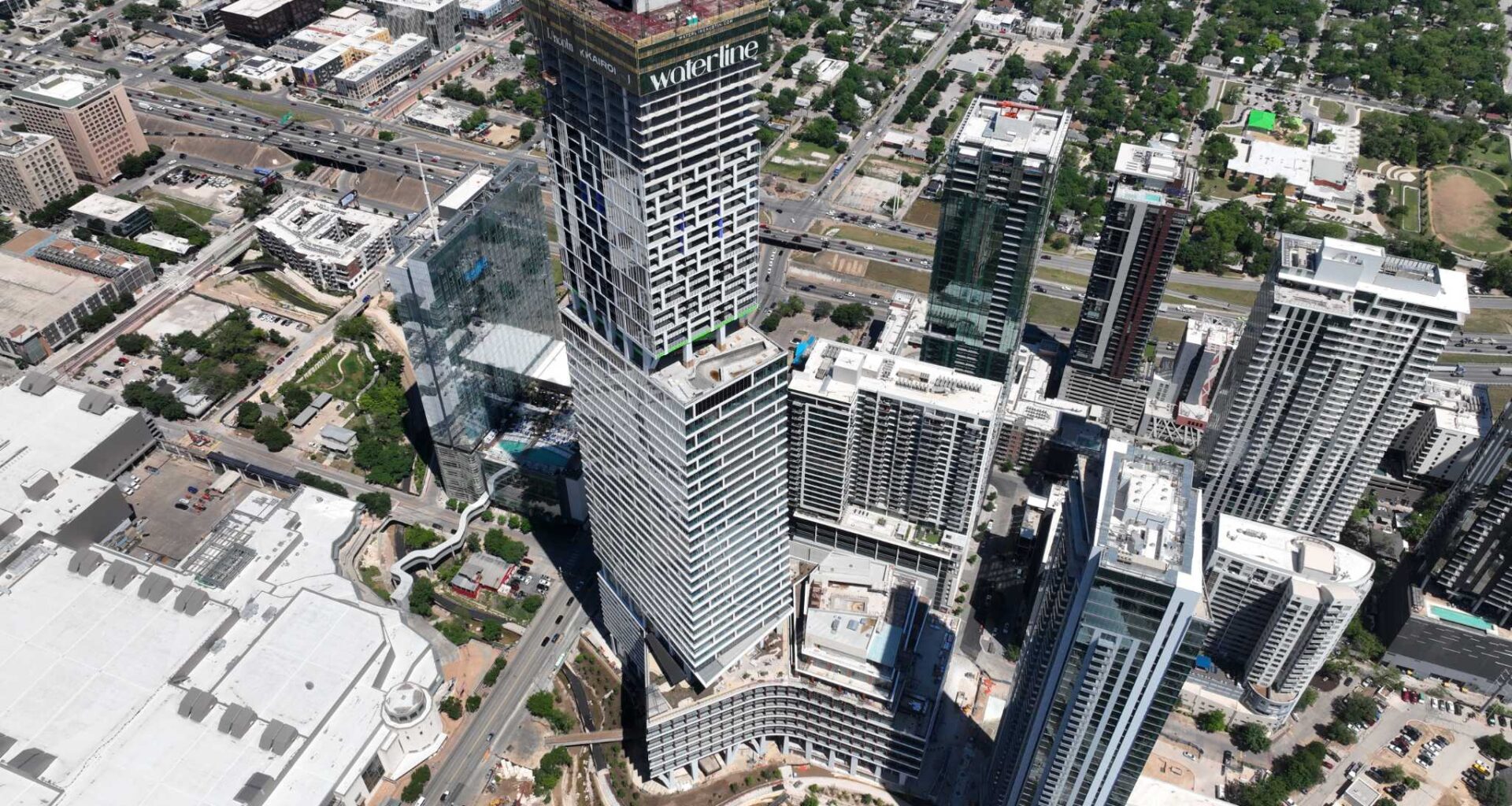
The topping out of Waterline tower near Waller Creek is a major milestone for Austin. At 1,025 feet, it is now Texas’ tallest building. More importantly, it represents one of the state’s most ambitious mixed-use projects and a model for how private real estate investment can align with city investment in the urban realm.
Downtown Austin has come a long way in the last 25 years. At the start of the millennium, the city’s urban core was a single-use office district with surface parking lots and empty streets. Today, it is a thriving mixed-use neighborhood where a younger generation of Americans want to live, work and gather. Austin’s planners and citizens deserve credit for transforming what was a typical Central Business District into a unique and vibrant mixed-use Central Social District.
The question now is how Austin should build on this momentum over the next 25 years.
We think Austin should build more buildings that provide a mix of uses, link to citywide investments in infrastructure and public realm, and are literally “green” in their architecture. The city could create a stronger foundation for this kind of development in three concrete ways:
A public realm vision for downtown: A plan to transform Congress Avenue into a high-density, tree-lined boulevard is already in place and will continue to attract development. But it’s important to get this right. As the corridor densifies, it is vital to the city’s continued success that it retains and encourages a diversity of uses and building types.
Planners should promote — and developers should pursue — projects like Waterline that integrate a lively ground plane and a mix of commercial, residential, hospitality, retail and dining uses, while preserving the smaller-grain details that make Austin unique. A good model isn’t New York’s largely single-use Park Avenue, but Miami’s Brickell Avenue, where a tree-lined corridor with a diverse mix of uses has catalyzed an urban renaissance.
More development tied to green space: Austin’s commitment to establish parks within a 10-minute walk of every resident is a strong initiative that could spur a sustained private market response over the next 25 years. To capture this investment and magnify its impact, the city could consider allowing increased urban density adjacent to parks and open space, and streamlining the approval process for these nearby projects.
Building more housing units near parks will allow more people to use green space without driving, boost access to common areas and create a virtuous cycle for use, maintenance and expansion of the public realm.
Greenery in high-density transit areas: Despite the benefits of densification, such change can feel jarring. One pragmatic solution is to “soften” high-density development by incorporating greenery into buildings through sky gardens, green walls, and roof terraces, as was done at Waterline.
As parts of Austin densify around future transit hubs, the city could consider offering development bonuses for projects that incorporate large, publicly accessible green spaces into their buildings. Such incentives are already working in cities such as New York and Singapore, and tax revenue from the extra development rights could support more public infrastructure.
Over the last quarter century, Austin has shown a remarkable ability to adapt. Better coordination between the city’s public upgrades and strategic private investment will help ensure the next 25 years are as transformative as the last. Waterline may be the city’s tallest tower, but its real legacy should be a renewed commitment to aligning public policy with high-density development for the benefit of all Austinites.
Forth Bagley is a principal at KPF, the global architecture firm behind the Waterline mixed-use skyscraper in downtown Austin.