
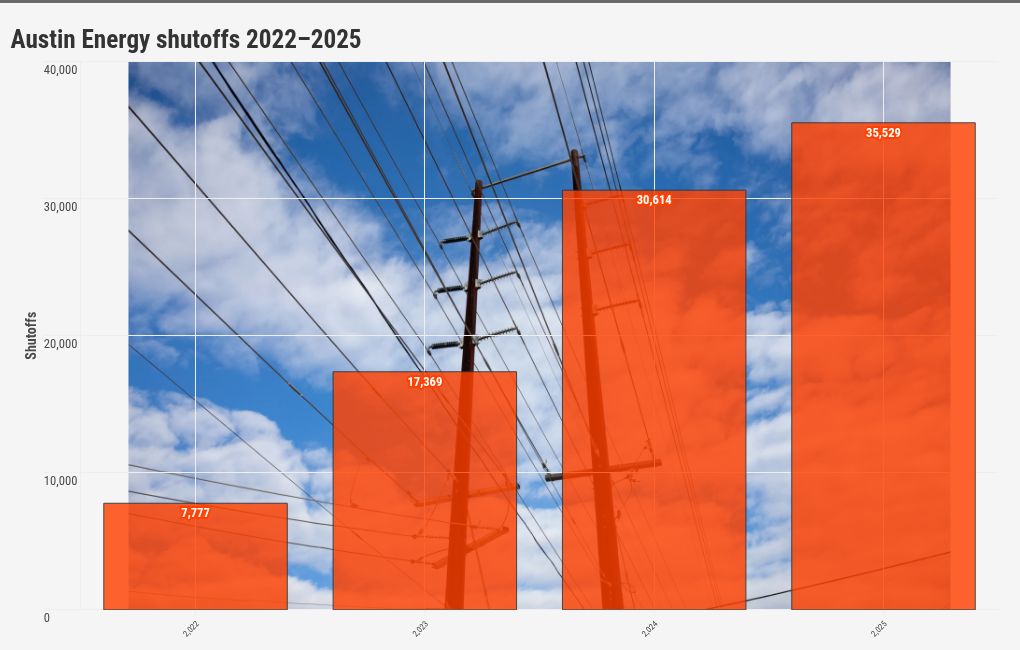
As Austin keeps getting hotter, Austin Energy shutoffs for nonpayment have increased by more than four-fold over the last four years.
Data from the publicly owned utility shows shutoffs skyrocketed from 7,777 in 2022 to more than 35,000 last year. But the increase in shutoffs comes as the utility has made big strides helping struggling customers pay their bills.
Part of the reason that the number of shutoffs are increasing is because it’s more expensive to get energy to customers, so bills are going up.
For years, the utility has been operating at a loss. It hasn’t had adequate operating revenue since 2019. Then, the pandemic hit and Austin Energy lowered rates and paused shutoffs and offered deferred payments to help struggling residents. Natural gas prices spiked in 2022, putting the utility further in the hole. On top of that, costs for things like transformers — those big, trash can-looking things on power lines that help wire electricity from the grid into your home — have gone up.
Austin Energy has to pay off that debt, and this year it’s facing a roughly $44-million deficit.
Those cost increases are reflected on your bill. The flat fees you pay like the customer service charge or the so-called community benefit charge have also gone up.
Then, there’s the cost of the electricity itself — the biggest moneymaker for Austin Energy. That, too, has gone up consistently across the state, but it varies depending on how much electricity you use.
How many people are struggling to pay their bills?
Last fiscal year, Austin Energy shut off the electricity of more than 35,529 customers. That number has been increasing steadily since 2022, when the utility shut off access for just 7,777 customers, according to Austin Energy data.
Matt Mitchell with Austin Energy said those shutoffs are the result of the utility’s increase in rates. The utility has increased what it charges for electricity every year since 2022 because of its shortfall. It has been operating at a deficit for years, but the double-whammy of inflation and the high natural gas prices in 2022 put Austin Energy in a deeper hole.
Those have been tough decisions, Mitchell said, but, ultimately, Austin Energy has to “keep the power flowing” while balancing its debt.
“We have to thread a very fine needle in terms of keeping our rates as affordable as possible while also recovering costs,” he said. “So all of those considerations have to be taken into account.”
Mitchell points out that the utility does occasionally have temporary moratoria on shutoffs — like when the city freezes or when temperatures get dangerously hot — but it hasn’t done that in the last couple of years.
How does Austin Energy decide how much to raise rates?
Historically, city law requires the utility reevaluate its rates every five years. It’s an ordeal. There are attorneys involved, public input and a judge who presides over the back and forth between the utility and people advocating for customers.
But last year, the city pulled that process out of the public square, when Austin City Council approved a 5% raise in the utility’s rates during its budget process.
John Coffman, an attorney who has previously advocated for Austin Energy customers in prior rate reviews, said that goes against the intent of city law.
“When the city puts the electric utility rate changes in the budget itself, it’s part of a process that’s already pretty crowded,” he said. “And I think it doesn’t get the same level of scrutiny that it deserves.”
Austin Energy officials said at a recent Electric Utility Commission meeting that customers will likely see an increase next year — and that increase could again be approved as part of the city’s budget.
But the utility has committed to a formal rate review process in 2027.
More people are getting assistance
The city’s utility runs a program to help customers struggling to pay their bills, known as the Customer Assistance Program, but for years it wasn’t being utilized by people who needed it.
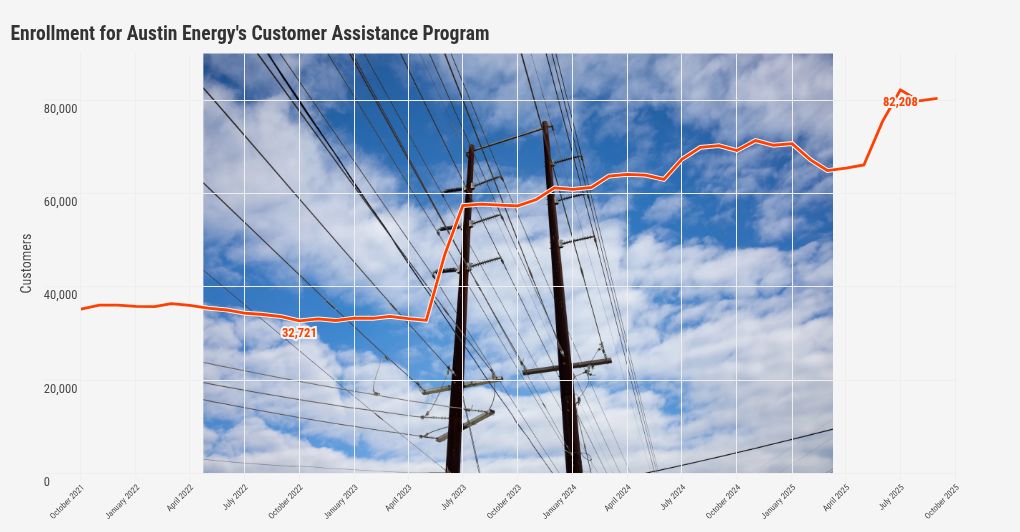
At the end of the last fiscal year, the number of customers receiving assistance from the utility was more than 80,000. Currently, the program’s recipients are up around 85,000 — 90% of the customers who are eligible for CAP are getting benefits.
A 2022 review found that the program was drastically under-enrolled, with just 35,000 — or 38% — of eligible customers receiving assistance. During the last formal rate-hike, City Council pushed Austin Energy to help more customers.
Matt Mitchell with Austin Energy said the push to get people enrolled was both a product of trying to do right by its customers — and a practical move for a utility that’s facing a multi-million-dollar deficit.
The utility would have to pay for the electric service, whether people were using it or not.
“You want to keep them on as much as you can, not just because that’s the right thing to do as a community-based organization, but it’s also … [because] this how we recover costs,” Mitchell said. “So, if people can’t afford their power service, then we’re paying for something that they’re not using.”
Kaiba White, a member of the Electric Utility Commission and a climate policy specialist with Public Citizen, said she’s glad to see more people taking advantage of the program, but the utility’s push to raise rates — without public input or meaningful discussion — isn’t good for customers in the long run.
“Austin Energy’s argument is that they they want the consistency in revenue, and I understand that that’s convenient and the easiest path for them,” she said. “But it isn’t necessarily the path that is best for affordability.”
White said that is going to be especially problematic in the future, as Austin continues to have hotter summers.
Recent research from the UT-City Collab suggests Austin’s summer heatwaves could double within the next century.