
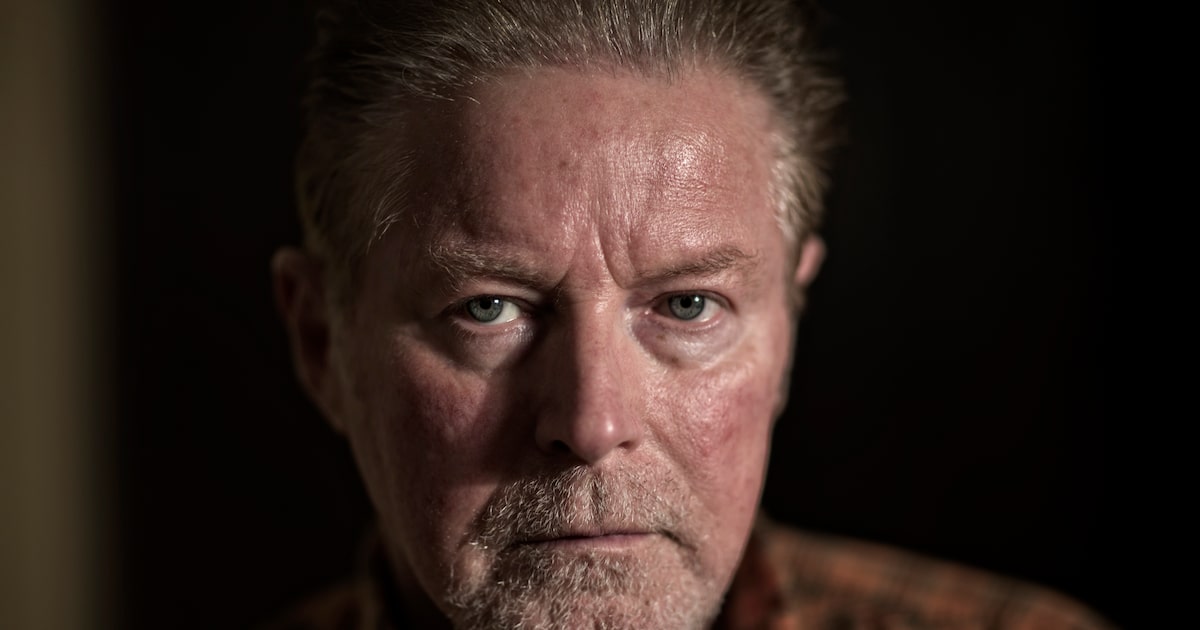
Today, few artists in rock can match Don Henley’s staying power and impact. But in the late ‘60s, the future Eagle was a broke college kid who quit North Texas State University and moved home to East Texas to help his ailing father.
That’s when he discovered Henry David Thoreau (1817-1862), the transcendentalist author who’s the subject of a new 3-hour PBS documentary. Henley and Ken Burns executive produced Henry David Thoreau, which airs March 30 and 31.
“Thoreau really spoke to me at a very difficult time in my life,” Henley says. “He spoke to me about mortality, man’s relationship to the natural world, about how we behave as citizens and who we are as a nation.”
Ever since, the author’s words have inspired Henley’s life and lyrics.
News Roundups
He’s channeled Thoreau’s philosophies into songs ranging from the Eagles’ “The Last Resort” and his solo hit “The End of the Innocence.” Guided by Thoreau’s devotion to nature, Henley founded the Walden Woods Project in 1990 and co‑founded the Caddo Lake Institute in 1993 to protect the wetlands near his hometown of Linden.
Today, the 78-year-old singer-drummer spends much of his time in Dallas, his home base since the ’90s. He spoke to me by phone from California, where he was getting ready for the latest Eagles concert at the Sphere in Las Vegas. (The band will play its first North Texas show in six years on May 16 at Globe Life Field.)
Our conversation has been edited for length and clarity.
How did you wind up reading Thoreau in the late ’60s?
Thoreau was riding a wave of popularity back in 1968, [when] there was a big movement to go back to the land and live in nature. There were also a lot of protests going on. And Thoreau wrote a famous essay about peaceful protest, “Civil Disobedience,” which was read by Martin Luther King Jr. and Mahatma Gandhi and Leo Tolstoy. So those two pillars of Thoreau’s philosophy — nonviolence and nature — had a big influence on that generation at that time. And I was one of them.
As a kid, did you notice the natural beauty of East Texas?
I did and I didn’t. When I was a kid, I spent a lot of time in nature, roaming for miles in the woods with my dog. And my father always had a huge vegetable garden, and he would make me get out there in the July heat and work in that garden. I didn’t appreciate it then, but I appreciate it now that I have a big garden myself.
I didn’t start figuring out [the importance of nature] until later, when I was 21. Smoking a little pot and staring at the trees probably helped.
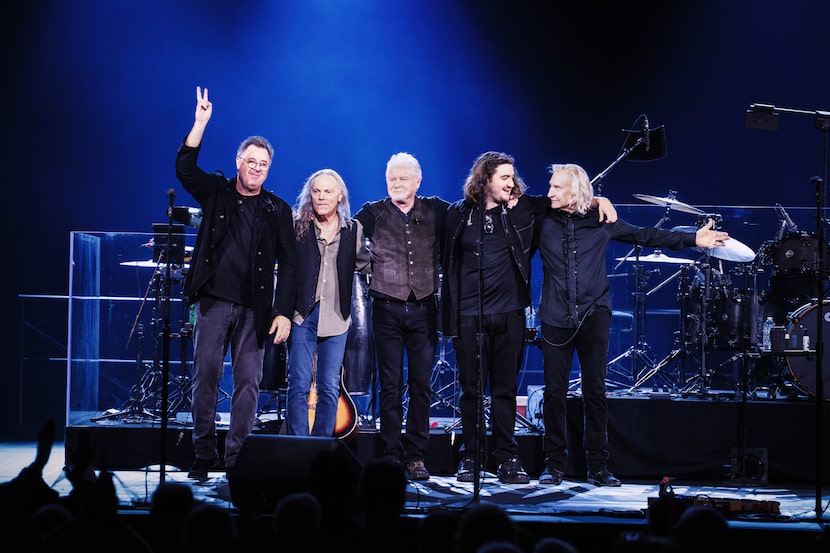
Don Henley (center) with the Eagles at the Sphere in Las Vegas.
Chloe Weir
As a Texan, how did you end up founding the Walden Woods Project to protect the land Thoreau made famous with his book Walden?
In 1989, living in Los Angeles, I was in my kitchen one day with the TV on, tuned to CNN, and I heard somebody say “Walden Woods” and “commercial development.” So I dropped whatever I was doing. I stood very close to the television and I saw a group of locals there in Concord, Massachusetts, talking about trying to stop this proposed development.
So I just got involved. I’d never been to Walden. I ended up flying up there with a couple of friends and we crunched our way through the snow in Walden Woods and saw Thoreau’s original cabin site and the site of the proposed development. The next thing I did was go to Sen. Ted Kennedy’s office — and it turns out that his mother had taken him and all of his siblings there to swim when they were kids, so he was very empathetic. [Kennedy’s staff member] Kathi Anderson said, “I can help you establish this thing and run it.” She’s still at the helm of the Walden Woods Project today, and we’re now in our 36th year.
We’re still trying to buy one last 36-acre parcel of land to preserve the original Walden Woods, but the town of Concord refuses to sell it to us. So one of my hopes for this film is that it will finally persuade them to let us preserve it. If we can’t preserve the cradle of the modern environmental movement, what does that say about all the other places we are trying to preserve?
I laugh and I say sometimes that [the Walden Woods Project] is one of those instances in life where you’re glad you really didn’t know what you were getting into, because it turned out to be so hard, like parenting or show business. I was initially not welcomed up there. I was seen as an interloper and a dabbler, you know? Some people accuse me of doing it to enhance my career.
If anything, it took away from my career. It took away a lot of the time that I would’ve spent recording or writing songs or touring. It took us about eight or 10 years for folks around there to realize we were serious and we weren’t going anywhere. Edward Kennedy and Sen. Paul Tsongas believed in me from the beginning, and I had support from President Clinton and Sen. John Kerry. We finally won everybody over.
People in the music business and people in film helped me a lot, too, which is kind of ironic, in the way Hollywood is thought of back East … you know, “la-la-land” and navel-gazing and hedonism and shallow, and all that sort of thing. But you know, I held a lot of fundraising concerts and the list of [Hollywood] people who participated in those is quite long.
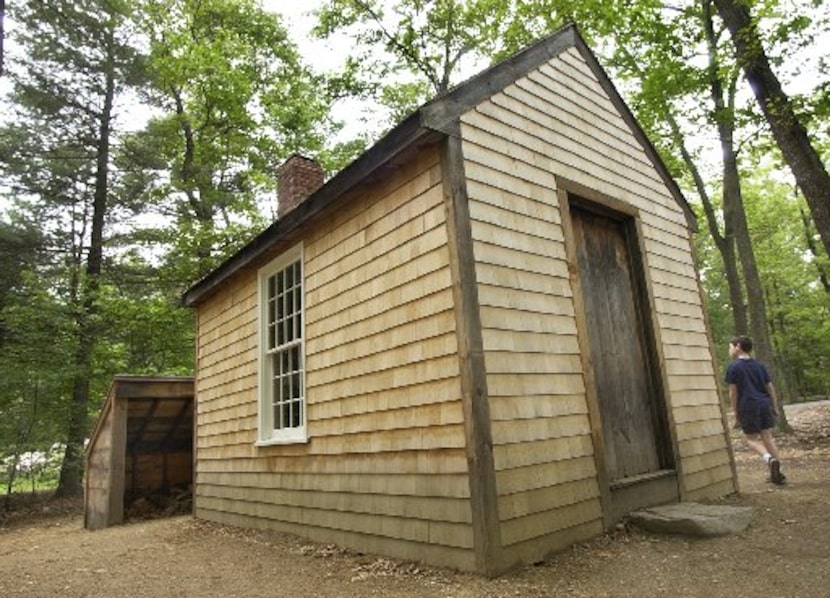
A replica of Henry David Thoreau’s one-room cabin at Walden Pond in Concord, Mass.
The Associated Press / 2003 File Photo
How did you team up with Ken Burns to executive produce the Thoreau documentary?
I started bugging Ken Burns about this a decade ago. Of course, Ken always has four or five projects in the works at once, so it’s been really hard to nail him down. I actually met him through his protégés [directors Erik and Christopher Loren Ewers] who agreed to work with Ken to make a film for a new visitor center at Walden Pond, and then this film.
Thoreau was born [three decades] after the official end of the American Revolution and died one year into the Civil War, so he bridges that timespan between those events. It was an extraordinary time that’s been called “The Flowering of New England.” His contemporaries and friends like [Ralph Waldo] Emerson, Louisa May Alcott, Nathaniel Hawthorne and Margaret Fuller were doing all this incredible thinking in writing. They’re all still very relevant today, including Thoreau.
Related
The film talks about Thoreau’s skepticism of “dangerous prosperity.” How does that phrase fit into today’s society and culture?
We have the billionaire class now, and a lot of those billionaires are digital gatekeepers who have a big influence on what goes onto the internet, including music and streaming and YouTube. Frankly, there’s not enough regulation for digital media — or for nature. We’ve had governments in these past several years who have successfully demonized the idea of regulation, and we’re paying the price for it. We are witnessing the undoing of more than 50 years of environmental progress and 60 years of progress in social justice and civil rights.
What Thoreau was seeing in the Industrial Revolution and the magnates who got rich during that time is being dwarfed now by today’s tech barons, who have a frightening amount of control. We held out for a long time about putting our music on Spotify. But finally, when all your peers do it, you just throw up your hands and go, “Oh, OK.” It’s hard to fight the system. I mean, I’ve been trying to get artists organized for 30 years and it’s impossible, because a lot of them just don’t know how the business works and their managers won’t tell ’em because they don’t want to rock the boat. They want the golden goose to focus on songwriting and touring and not on the politics or the machinations of how the system works.
Related
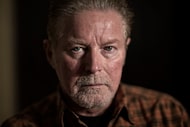
You’re an incredibly successful artist. In your own life, how do you view Thoreau’s ideas about simple living versus “dangerous prosperity”?
Thoreau said, “A man is rich in proportion to the number of things he can afford to let alone,” and I’m aware that I’m … I don’t know if I’m in the 1% anymore, but I’ve done well. And I donate a lot of it to good causes. I’ve spent a lot of my own money on this film and raised a lot from other generous people. I recycle. I think the city takes it straight to the dump, but I put it in recycling anyway just so I feel better. I garden organically. I’m aware of what I purchase and where it comes from and who made it and who’s getting paid for it. I buy mostly organic products in terms of food. I support small farmers. I’ve been a longtime supporter of Farm Aid and I support the Trust for Public Land.
Our public lands are more endangered now than they have been in recent history. They’re being whittled away by our current president, who — I shouldn’t say this in a Texas newspaper — but he’s gonna let oil companies come in and drill. A lot of it will go to the courts, but you know, people need to realize that they own the national parks and national forests, lakes, rivers, all of it. We pay taxes for those parks where the staffs are getting fired and the parks are in disrepair. The parks belong to all of us.
How is Thoreau’s writing relevant in today’s tech-centric world?
It’s clear we are becoming a more urbanized society. We are all pretty much addicted to our screens. And engaging with a screen is a two-dimensional experience, which often leads to a one-dimensional life. What we need are three-dimensional experiences.
When I go hiking in East Texas or in the Santa Monica Mountains, I see a lot of people out there, which is encouraging. I can’t abandon all hope. I mean, I have children and grandchildren. I have to think about what kind of world they’re gonna live in and point them toward being good stewards of the wild places. Because Thoreau was dead right when he said “In wildness is the preservation of the world.”
Related
Any other thoughts on Thoreau?
Thoreau can be a tough read, [especially] Walden, with all that florid 19th-century prose. But his essay “Walking” is the most accessible thing he wrote, and it more or less encompasses his whole philosophy.
Thoreau was a flawed individual, like a lot of our great historical figures. He was a little narcissistic and self-righteous and self-contradictory. But it doesn’t diminish his legacy one bit because of what he wrote, which thoroughly resonated with Martin Luther King Jr. and Gandhi and Supreme Court justices and people from all over the world who come to Walden Pond.
The pond is just an ordinary pond, and the woods have probably been cut down three or four times since Thoreau’s time. It’s not a pristine wilderness, which, as E.L. Doctorow said, is precisely the point: Thoreau made himself everyman. He made Walden his everywhere. And he made Walden a symbol of American possibility.
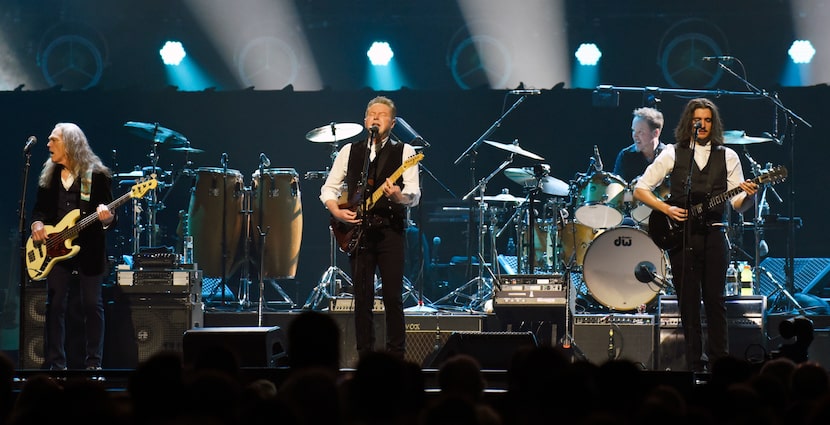
Don Henley (center) performed with other members of the Eagles at the American Airlines Center in Dallas on Feb. 29, 2020.
Ben Torres / Special Contributor