
Story Links
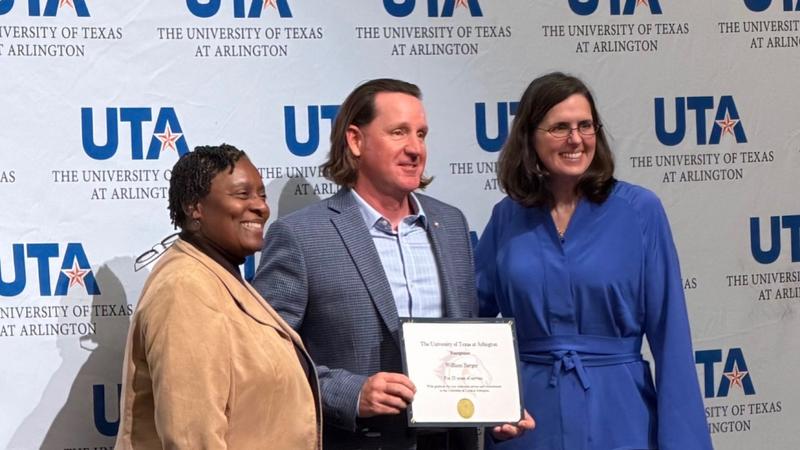
ARLINGTON, Texas – This year, Associate Head Track & Field coach, Brandon Berger is celebrating 25 years of working at UTA.
A former UTA student-athlete from 1996-99 under head coach John Sauerhage, Berger competed in both the decathlon as well as the 110m and 400m hurdles. As a collegian, he helped the Mavericks win three indoor conference team championships and two outdoor league titles.
A 2000 graduate of UT Arlington with a degree in biology, he became a student assistant, coaching multi-event and field event athletes while also coordinating travel. From 2001 to 2007, he also served as an assistant events manager at Maverick Stadium.
Berger is married to former UTA track standout Mishael Bertrand-Berger, who now serves as an associate athletic director in UTA Athletics. The couple has two children, Ava and Noah.
UTAMavs.com recently caught up with the former UTA decathlete to reflect on his time with the program.
What has it meant to you to build your career at your alma mater?
“It’s been great! After college, I graduated with a biology degree. I just stayed around the sport, never really left it. I was good friends with one of my coaches [Wayne Cunnings] and we’re still good friends, and I felt I learned a lot through him, then Coach Sauerhage gave me an opportunity. I was able to figure things out and realized I did like this [coaching], and I could see myself doing this from here on out. Being able to do it at UTA and stay a part of the community has been a valuable experience.
When you think back to your first season on staff, what are some of the biggest changes you’ve seen in the program over the years?
“There have been a lot of changes – so many changes for the better. The university has grown immensely. It’s almost doubled in size. As an athletic department, we have staff members to help the student-athletes and make the university grow.
“Coaching—we had three coaches when I started, now we have five. It’s really helped build our team. Our budget has grown—the resources available to our program have improved significantly. I remember when we had basic gear and resources. Now we have strong partnerships and the support needed to travel, train and compete at a high level. It’s been exciting to see the program continue to grow and evolve.”
Is there a moment, athlete or accomplishment that stands out as especially meaningful during your time as a coach?
“I’ve had the privilege to work with a lot of high-level talented athletes, including multiple All-Americans. One moment that stands out for me was Alexus Henry winning a national championship in high jump (2018)—that was really a big moment. That was a special moment for our program. She became the first female national champion in UTA history and just the third overall, which was huge.”
How has being a former Maverick student-athlete shaped the way you coach today’s athletes?
“I had a good coach when I was here. Being a former student-athlete here definitely gives me a strong sense of pride in the program and the university. I understand the experience our athletes are going through, since I went through it myself. That perspective helps me connect with them and reminds me how important it is to represent UTA well and continue to build on the success of the program.”
What advice would you give to current UTA student-athletes who hope to stay involved in athletics after graduation?
“Continuing to do a sport past the college-level is a great opportunity. Clearly you have to be fully dedicated to it, work hard, make connections with other coaches or athletes to try to grow your knowledge, whether or not the opportunity gets presented. If you want to be a coach at the next level, being a graduate assistant is a good opportunity. In order to continue to be an athlete or coach athletes, it takes hard work and dedication.”
After 25 years, what continues to motivate you heading into each season?
“What else can we achieve? What else can we do to gain more recognition for the student-athletes, for the university? It’s just trying to keep growing and evolving at the best we can to see what other accomplishments we can get and achieve—get that next conference title, get that next triple crown, so winning is always a motivator but seeing the athletes grow and develop in the university, as alumni…all those things are great, but there’s always motivation to do better. We know we can do something better each day to improve ourselves and the program. We just have to figure out what it is and get to the next step.”
FOLLOW ALONG
Follow the UTA track and field and cross-country teams on X (@UTAMavsTFXC), Instagram (@UTAMavsTFXC) and Facebook (/UTAMavsTFXC).