
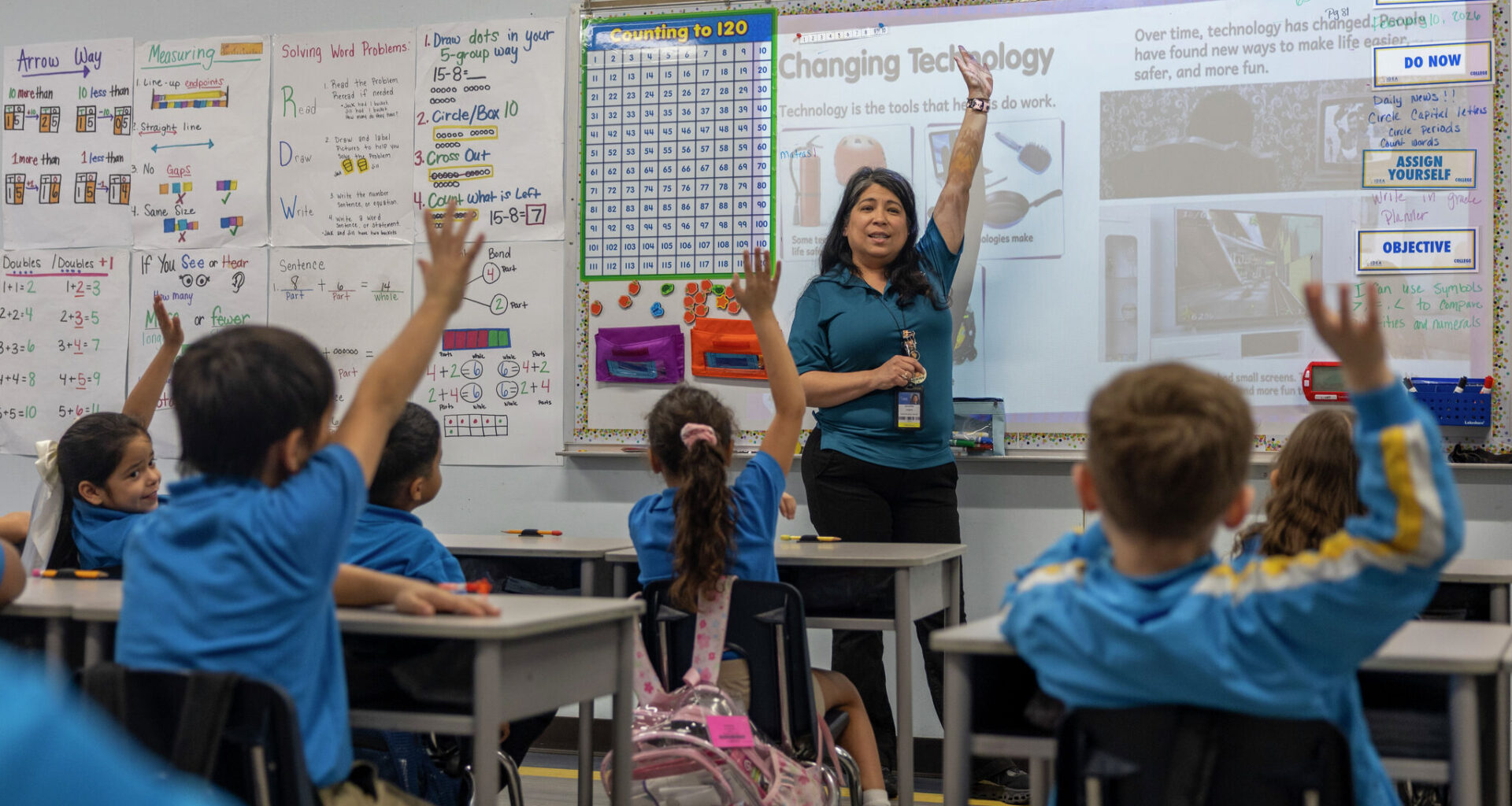
Jennifer Lopez asks her students a question in her first-grade classroom at IDEA Carver Academy. Whether students attend an independent school district, an innovation campus or a public charter school, every child in San Antonio deserves access to a world-class education.
Andrew J. Whitaker/San Antonio Express-News
Daiana Lambrecht is executive director of Futuro San Antonio.
Courtesy of Futuro San Antonio
Recent media coverage of public charter school growth in San Antonio has revived a familiar storyline: Charters are expanding, school districts are shrinking, and traditional public education is under attack.

Beneath the headlines, however, is a more urgent reality.
Article continues below this ad
According to the Texas Education Agency, 50,104 public school students — roughly 20% of San Antonio’s public school population — were enrolled in D- or F-rated campuses during the 2024-25 school year.
READ MORE: Why San Antonio public schools are closing — and it’s not just enrollment
These ratings reflect persistent gaps in academic growth, proficiency, and college and career readiness. Those gaps fall disproportionately on students from historically underserved communities.
Those of us who care about education, the workforce or simply children’s well-being should be alarmed by the number of students, particularly students of color, in poorly rated schools in our city.
Article continues below this ad
Whether students attend an independent school district, an innovation campus or a public charter school, every child in San Antonio deserves access to a world-class education.
Choice is flowing in more than one direction across our education ecosystem. Families cross district boundaries to attend specialized magnet programs. Thousands of students living outside of San Antonio Independent School District choose to enroll in those schools. Districts themselves have embraced open enrollment policies, in-district charters, and career academies to attract and retain students.
Approximately 25% of San Antonio students now attend public charter schools or 1,882 in-district choice campuses. In 2024-25, a higher share of charter schools earned A and B accountability ratings. Meanwhile, traditional ISDs have seen enrollment decline as charter and innovation campuses grow.
Parents are navigating complex decisions in real time. Some seek stronger academic outcomes. Others want specialized programs in STEM, performing arts or career pathways. Some are looking for smaller environments or different approaches to student support.
Article continues below this ad
Today’s families research schools the way they research doctors, neighborhoods or colleges.
This cultural shift is not a threat to public education. It is a call to action.
Students transition to their classrooms at Roy Benavidez Elementary School. South San ISD has had the distinction of outperforming other school districts on recent STAAR exams.
KIN MAN HUI/SAN ANTONIO EXPRESS-NEWS
In a diverse and competitive education landscape, excellence must be the standard everywhere — district, innovation and charter alike. No campus should rely on tradition alone. Every school must earn the trust of families through results.
Article continues below this ad
Protecting systems cannot take precedence over serving students.
What if San Antonio became a city truly focused on outcomes? What if we put students over politics and families over institutional turf battles? What if we celebrated the full range of public school options available — district, innovation and charter — and committed to ensuring excellence across all of them?
A student-centered vision would hold every public school to high expectations. It would expand campuses that demonstrate strong academic growth and intervene swiftly where students are falling behind. It would ensure families have transparent, accessible information about school performance so they can make informed decisions with confidence, and it would encourage collaboration across systems instead of territorialism.
There are challenges facing our education landscape, but there is opportunity. If we align around a shared commitment to student success rather than institutional preservation, San Antonio can lead with clarity and purpose.
Article continues below this ad
Choosing a school is one of the most important responsibilities a parent holds. That decision should be met with support.
If we move beyond the false binary of “ISD versus charter” and rally instead around the students and families at the heart of this debate, we will do more than improve school ratings.
We will strengthen our workforce, cultivate the next generation of civic and industry leaders, and secure the long-term vitality of our city.
Article continues below this ad
The question is not which system wins. The question is whether our students succeed.
Daiana Lambrecht is executive director of Futuro San Antonio.
Sign up for the ENsights opinion newsletter
Get the latest influential editorials, hard-hitting commentaries and thought-provoking opinions from the Alamo City in your inbox. Click here to sign up.