
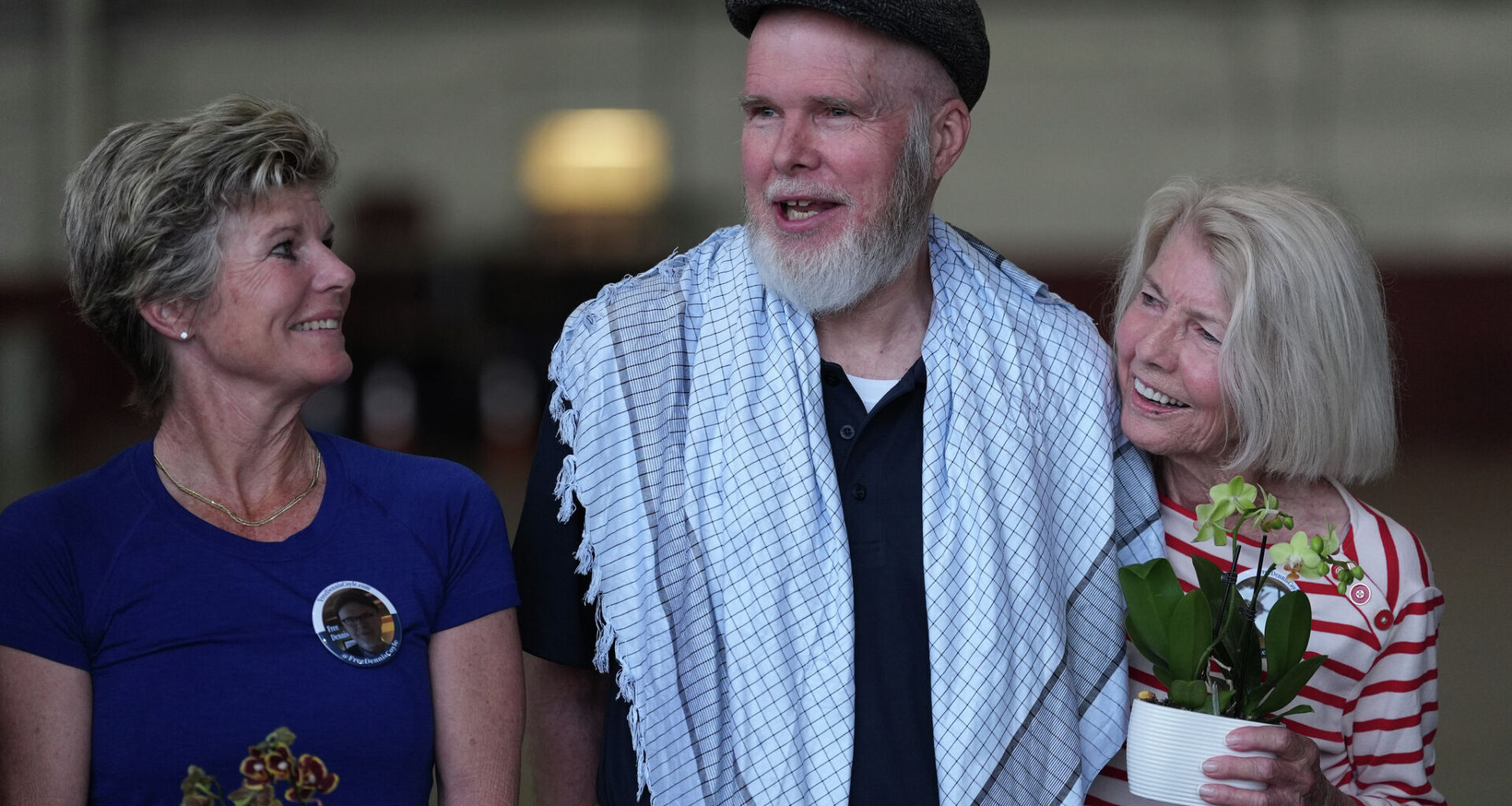
Dennis Coyle, center, an American academic, was released by Afghanistan’s Taliban government after more than a year in captivity. After reaching the U.S., he was flown to San Antonio to enter a reintegration program for ex-prisoners at Brooke Army Medical Center.
Eric Gay/Associated Press
Dennis Coyle, center, an American academic, was released by Afghanistan’s Taliban government after more than a year in captivity. After reaching the U.S., he was flown to San Antonio to enter a reintegration program for ex-prisoners at Brooke Army Medical Center.
Eric Gay/Associated Press
An American researcher freed from captivity in Afghanistan was flown back to the United States on Wednesday — and brought straight to San Antonio to enter a program at Brooke Army Medical Center that helps ex-prisoners reintegrate into society.

Dennis Coyle, 64, worked in Afghanistan for more than 20 years studying languages. He was taken into custody by the country’s Taliban leaders in January 2025 and held in what his family described as “near-solitary conditions.” He was never charged with a crime. Afghanistan’s leader, Sheikh Haibatullah Akhundzada, ordered him freed on Tuesday.
Article continues below this ad
Earlier this month, Secretary of State Marco Rubio designated Afghanistan a “state sponsor of wrongful detention” and accused the Taliban government of “kidnapping individuals for ransom or to seek policy concessions.” U.S. officials warned the Taliban of possible American military action if Afghanistan did not release Americans held in captivity.
RELATED: WNBA star Brittney Griner was treated at Army reintegration center in San Antonio
A spokesman for Brooke Army Medical Center confirmed that Coyle, who is originally from Colorado, had been brought to the military hospital at Fort Sam Houston.
It’s standard U.S. government practice for former POWs, freed hostages and others released by hostile governments to go to BAMC for evaluation, counseling and recovery.
Article continues below this ad
BAMC’s reintegration program is staffed by physicians, psychiatrists, physical therapists and other specialists. It dates to the end of the Vietnam War, when returning POWs needed help coping with the trauma they’d endured.
Former captives who have gone through the program include Wall Street Journal reporter Evan Gershkovich, who spent 16 months in a Russian prison; “Hotel Rwanda” hero Paul Rusesabagina, who was kidnapped and imprisoned by the Rwandan government for more than two years; WNBA star Brittney Griner, a Houston native and two-time Olympic gold medalist who was held in a Russian penal colony; and Pvt. Travis T. King, a GI who was detained by North Korea for 70 days after illegally entering that country.
What’s the aim of the treatment?
It seeks to help former POWs and hostages overcome the debilitating effects of captivity and isolation and return to their professional, community and family lives with as few complications as possible.
Article continues below this ad
“This is a very complicated joint operation involving hundreds of people,” according to an Army document describing the program. “Operational planners, aircrews, medical professionals, security officers, attorneys, chaplains, and specialists in finance, personnel, public affairs and logistics are involved in these operations. Family members also assist in the process, at first through phone contacts and later during family reunions.”
“The process is about helping the returnee gain control of his emotions,” a Pentagon spokesman, Army Col. Steve Warren, has said. “One of the methods the psychologists use to help the returnee is to allow him to tell his story.”
How does it work?
According to the Army, there are three phases. The first, Initial Recovery, begins when the hostage or POW is returned to U.S. custody. They’re given a medical examination and a psychological assessment.
Article continues below this ad
The second phase, Transition Location, happens once they arrive at BAMC. They undergo a more thorough medical exam, have formal debriefings and are guided through “psychological decompression.”
In phase three, called Home Base, the former captives meet with their families to “address significant closure issues that may have arisen from their captivity,” according to the Army.
Who else has been treated there?
Perhaps the most famous of the facility’s alumni is Sgt. Bowe Bergdahl, the sole American prisoner of war held by the Taliban in Afghanistan. He was treated at BAMC in 2014.
Article continues below this ad
Bergdahl was captured by the Taliban after walking off his post. He spent 1,797 days in captivity, and testimony revealed that he’d been chained for long periods to a box spring.
At BAMC, Bergdahl was encouraged to talk about his ordeal. He was later booted out of the Army for desertion.
In August 2024, Gershkovich and two other U.S. citizens — former Marine Paul Whelan and radio journalist Alsu Kurmasheva — were brought to BAMC after being freed from imprisonment in Russia.
Gershkovich, Whelan and Kurmasheva, an editor for Radio Free Europe/Radio Liberty, gained their freedom in an elaborate prisoner swap involving seven countries and the release of 24 prisoners in all, 16 held by Russia and eight by Western governments.
Article continues below this ad
In 2008, Marc Gonsalves, Thomas Howes and Keith Stansell — employees of defense contractor Northrup Grumman — went to BAMC after being held captive in Colombia by a guerrilla group for more than five years.
Gonsalves, Howes and Stansell were captured by the revolutionary group FARC after their plane went down in Colombia’s southern jungle on Feb. 13, 2003. They were constantly under guard, slept on the ground or in crude beds and ate whatever their captors fed them. After their release, they were flown to BAMC.
In their book, “Out of Captivity: Surviving 1,967 Days in the Colombian Jungle,” the three former hostages said their caregivers at BAMC rarely allowed them to be alone.
Article continues below this ad
Griner also wrote a memoir about her captivity in Russia. She was convicted of drug possession after Russian authorities found cartridges of cannabis oil in her luggage. She was freed in exchange for the release of Russian arms dealer Viktor Bout, known as “the merchant of death,” who was serving a U.S. prison sentence for crimes that included conspiracy to kill Americans.
“Fear is one thing,” Griner wrote in “Coming Home,” describing the moment an inspector seized her passport. “But uncertainty, the unknown, a free fall into mystery — that’s much stronger than fear; it’s terror.”