
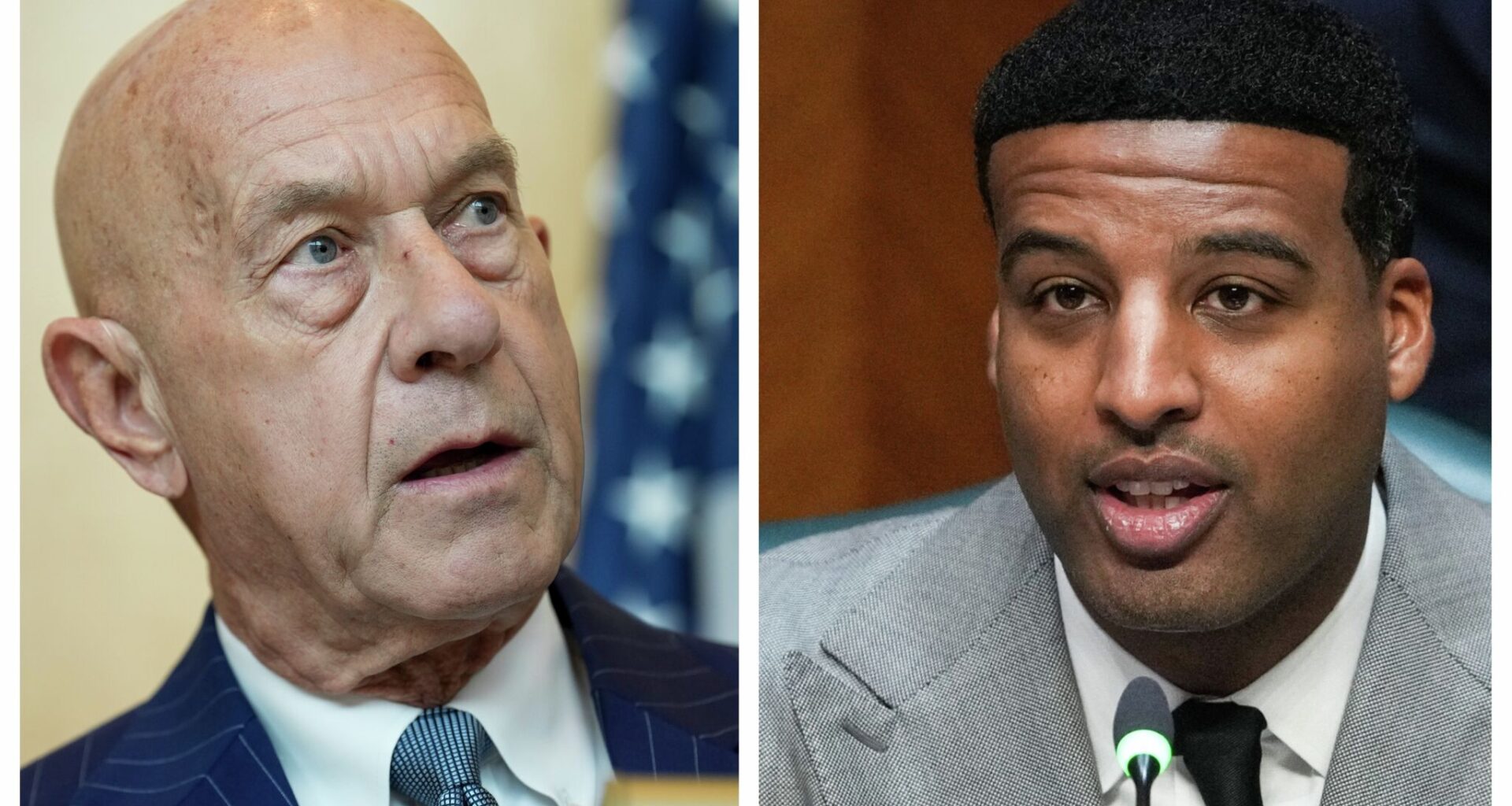
Houston Mayor John Whitmire, at left, and City Council Member Edward Pollard are clashing once again over Pollard’s use of overtime funds for Houston Police Department patrols in his district.
Houston Chronicle
Someone check to see if Beelzebub is strapping on ice skates or if wild hogs are providing an alternative to flying out of IAH, because a near political impossibility happened at City Hall: Mayor John Whitmire has been arguing against more funding for the Houston Police Department.
Yes, law enforcement dollars should be narrowly focused on proven programs, but City Hall isn’t having a debate about optimal policy. It’s about politics. And that doesn’t make anyone safer.
Last week, the Houston City Council was set to vote on an application for grants from Gov. Greg Abbott’s office that would provide overtime funds and equipment for a gang suppression unit. Houston City Council Member Edward Pollard raised a reasonable objection: Why is the city applying for overtime funding for a unit in his district, but denying his request to spend overtime funds on a proven community policing unit in his district?
Article continues below this ad
For five years, Pollard has used his district funds to bankroll a program that should be a model for fostering trust between neighborhoods and police officers.
The District J patrol he established in 2020 includes six ATV units — fully equipped Houston Police Department Polaris vehicles — that respond to residents’ complaints about low-level, quality-of-life offenses, such as trespassing, loitering, illegal parking and homeless encampments.
It’s an initiative borne out of a “broken windows” model of policing, in which neighborhoods that are visibly safer with better upkeep deter criminal activity, and criminal actors know they face a high risk of getting caught. The patrols work primarily overtime shifts and Pollard says it is one of the big reasons why his district, which includes neighborhoods like Sharptown and Gulfton that have regularly grappled with crime, has seen marked improvements in public safety. District J had the second-largest drop in violent crime of any Council district in Houston, with a 25% reduction from 2024 to 2025. The visibility and swift response times from the unit’s officers also helped to build relationships between residents and HPD that had previously been non-existent.
“Individuals that participated in this program from HPD, from the stations, were invited to neighborhood events that they probably wouldn’t go to in the past or even be invited to,” Bert Ruiz, a former District J Patrol Task Team chairman, told the editorial board.
Article continues below this ad
Yet beginning in November, HPD told Pollard they would no longer accept his overtime dollars to fund the unit. Pollard told us that the department’s new leadership under Chief Noe Diaz “didn’t believe in the program,” and used the overtime funds for their own patrols rather than responding to residents’ complaints through the District J patrol online portal.
“They started saying we were doing things that were inappropriate and this wasn’t the best use of funds and they’re calling it a pet project,” Pollard said.
The conflict came to a head during last week’s City Council meeting, when Pollard asked Whitmire directly why HPD wasn’t accepting his request to continue funding District J patrol. Rather than engage on the merits of Pollard’s question, the mayor waved him off and accused him of “politicizing law enforcement” by touting the patrol units as part of his “J City” rebrand for his district.
“You’re very familiar with your conversation and your demands upon the department to politicize the department in your area with your decals and make-believe city,” Whitmire said. “I’m just not gonna have this dialogue. Everyone knows how important police overtime is, we appreciate your offerings and I would urge you to continue to work with the leadership at HPD.”
Ever since Whitmire took office, Pollard has been one of the few City Council members willing to challenge him publicly. City Hall observers speculate that Pollard has mayoral ambitions, making it easy to question whether HPD’s decision to dismantle Pollard’s district patrol is rooted more in the mayor’s political agenda rather than policing strategy. That question only becomes more obvious given that Whitmire has approved district funds for a similar program in Council Member Mario Castillo’s district.
Article continues below this ad
At the same time, it’s fair to question Pollard’s decision to tag the grant application, delaying the vote until this week’s Council meeting. Pollard certainly made his point by questioning Whitmire’s apparent hypocrisy in denying his district funds, but delaying the grant application is also not in the best interest of public safety. The application was tagged again on Wednesday by Council Member Tiffany Thomas, as Pollard was out of town.
Houstonians deserve public officials who prioritize community safety above political gamesmanship.
The mayor is correct on one point: We are well aware of how important police overtime can be. We’re also aware of how costly and wasteful it can be to taxpayers when that money is not spent wisely. The Chronicle reported in August that police overtime spending reached a new high of $74 million in the last fiscal year, a 26% increase driven mostly by traffic enforcement officers.
Even with crime rates improving across Houston, we worry that trust between residents and HPD has frayed. The mayor’s flip-flopping message about HPD’s cooperation with U.S. Immigration and Customs Enforcement has inflamed relationships with citizen activists and immigrant communities. The department’s closure of the community affairs division, a crucial liaison between neighborhoods and officers, has only exacerbated those tensions.
Article continues below this ad
Rather than scuttle an effective patrol unit in a high-need Council district, Whitmire should seek to expand on its success. We all suffer when the public loses faith in law enforcement.