
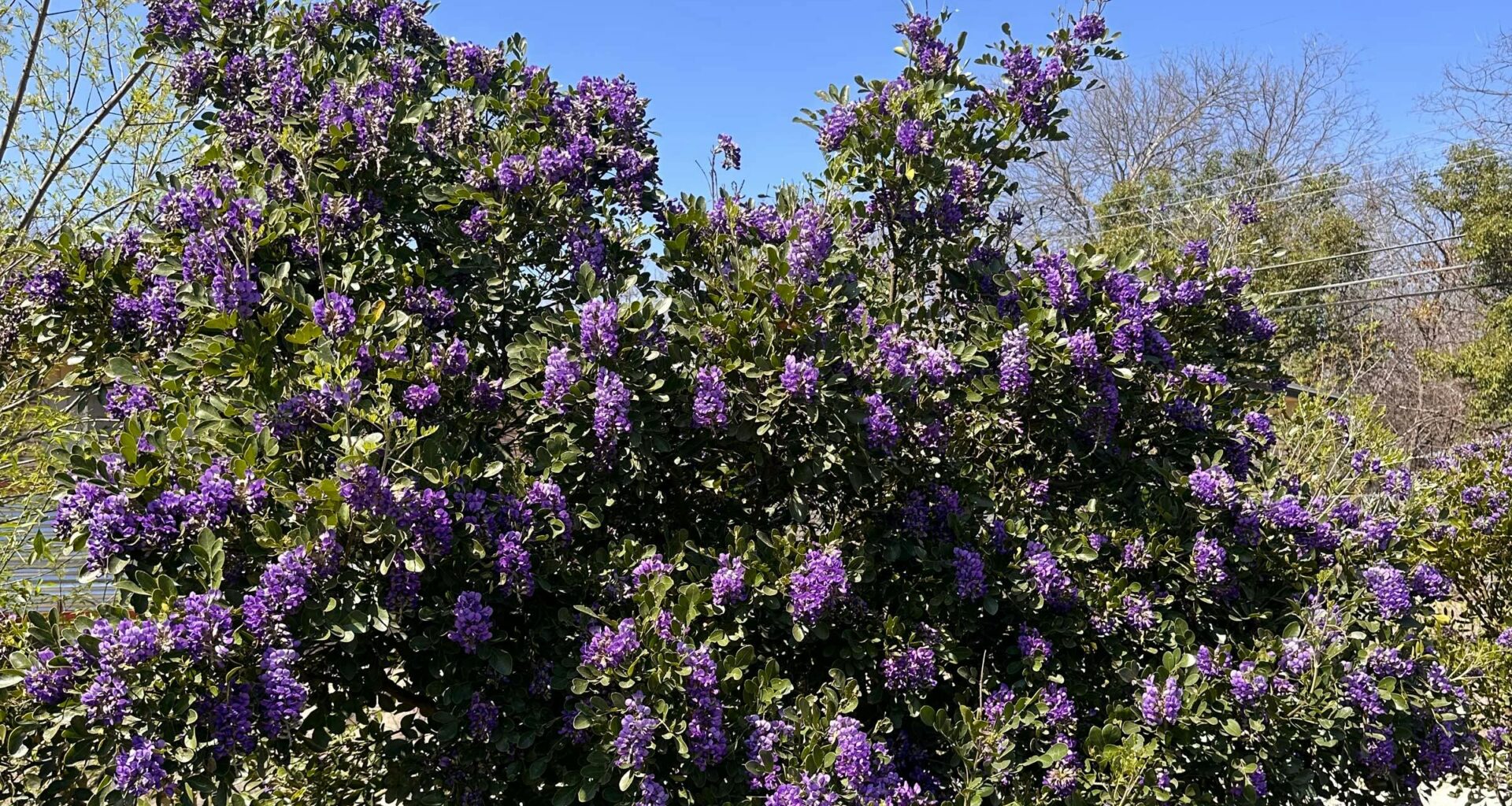
When Sebastian Wren thinks about the thousands of Texas mountain laurels out in the Hill Country, where he grew up, he wonders how many of the trees were planted by his mother. Julie had a habit of driving the country roads near their property with her window down, flinging neat packages of laurel seeds wrapped in wet newspaper at the craggy landscape. She’d prepare the seeds ahead of time by painstakingly removing them from their pods, then scoring each individual bean’s hard outer shell and soaking it to best ensure its chance of sprouting.
“Oh, nobody understood what motivated my mother to do anything,” Wren said when I asked what spurred her guerilla seed bombing. “She was an eccentric. Who knows. It was clear she took a liking to these plants.”
In Texas, where seasonal change is subtle and short-lived, indicators that something distinct is taking place in between all that summer are sacred. In the early weeks of spring, it’s bluebonnets, of course, and also wine cups, black-eyed Susans, and pink evening primrose dotting roadsides and rendering whole highways, for once, beautiful. There are azaleas in Southeast Texas. Budding mesquite trees in West Texas. And, for swaths of Central and South Texas, there’s the spectacle put on by mountain laurel blooms. These native trees are known for their ornate purple flowers that hang heavily between shiny, dark-green leaves, and their signature smell, which is commonly likened to any number of artificially flavored grape treats: grape bubblegum, grape Kool-Aid, grape soda. A friend once described it as “grape snow cone if it had a smell.” The flowers’ scent might remind you of the saccharine cloud you’re hit with when walking into a candy store, too sweet to be natural. When in full bloom, a spray does, in fact, resemble a cluster of dangling grapes. Laurel petals are a concentrated purple that can appear, if only for a day or two, almost indigo when the sun hits them right.
This year, Central Texas mountain laurels put on a particularly impressive show—and we might have these past few bone-dry months to thank. About 82 percent of the state is currently experiencing some sort of drought conditions, according to the U.S. Drought Monitor, with 23 percent of that constituting an extreme or exceptional drought. Texas mountain laurels pay the lack of rainfall little mind; they have a famed ability to effortlessly tolerate (and even thrive under) drought conditions. Andrea DeLong-Amaya, horticulture educator at Austin’s Lady Bird Johnson Wildflower Center, says that because of this defining characteristic, there isn’t a lot a Texas gardener needs to consider when deciding whether to plant a mountain laurel. A little shade isn’t a bad idea if you’d like to maximize bloom time, but the biggest issue a laurel is at risk for is overwatering. The trees thrive with infrequent but deep waterings, especially after initial planting, which DeLong Amaya recommends Texans do during the fall. She suggests planting a sapling in a sunny spot in your yard—a more measured approach to going rogue and pitching seeds out your car window, but to each their own.
Wren, who helps run an early literacy program at the University of Texas at Austin and is my neighbor, is responsible for the trees that perfumed blocks of our Central Austin neighborhood earlier this month. He planted the trees more than ten years ago and has kept a watchful eye on them from his house across the street ever since. He raised a concern with the city sometime in 2015 about a stretch of street with no sidewalk and a steep drop-off into a creek on one side. In response, both the city and Treefolks, a nonprofit that advocates for reforestation in urban areas, offered to provide Wren with saplings if he’d agree to plant them himself. He received about a dozen gallon-sized pots and spent that spring burying the young trees and hauling buckets of water across the street to help them root. Today, the mountain laurels sit in a neat line along the road, serving as a natural barrier between pedestrians and the shallow creek bed below.
Beyond an occasional trim, he’s long since taken his hand off the wheel when it comes to caring for the small trees he affectionately calls “glorified bushes.” Not because he doesn’t care, but because they don’t require much beyond a little initial watering. He was particularly pleased with this year’s bloom, venturing to claim it’s the best he’s seen so far. “It’s the mystery of mountain laurels,” he laughed. “I thought that they needed showers to bloom, but it’s been incredibly dry, and they bloomed like crazy. It was amazing.”
After first smelling them from my porch, I did the exact thing Wren aimed to prevent and wedged myself between the tangled, abundant blooms, perched precariously above the creek. Upon closer inspection, the big purple flowers buzzed and swayed slightly: Bees swarmed the plant, weaving between boughs as though running errands. The pollinators show up for the blooms in full force, though the season is but an annual flash in the pan, often occurring sometime in March or April but occasionally as early as February, depending on the weather. In years when higher temperatures and full sun in the early spring mean fewer flowering days, you could leave town for a week and return to a green mountain laurel, none the wiser to the display orchestrated in your absence. But for those who count down the days until spring has arrived in Texas, their fleeting nature is all part of the appeal. “We have them to enjoy when they’re here, and then we wait another year,” DeLong-Amaya says. “What’s nice about that is that we’ve learned to not really take them for granted.”
After the mountain laurel’s florescence ends and its blossoms fade to lilac, typically within the few weeks that follow their opening act, the tree appears drained of color and rather droopy. The smell changes, too, taking on an overly sweet and fermented edge, like a banana that’s sat on the kitchen counter for too long. Soon after, the petals fall, leaving a purple pile to be dispersed by spring winds.
Read Next