
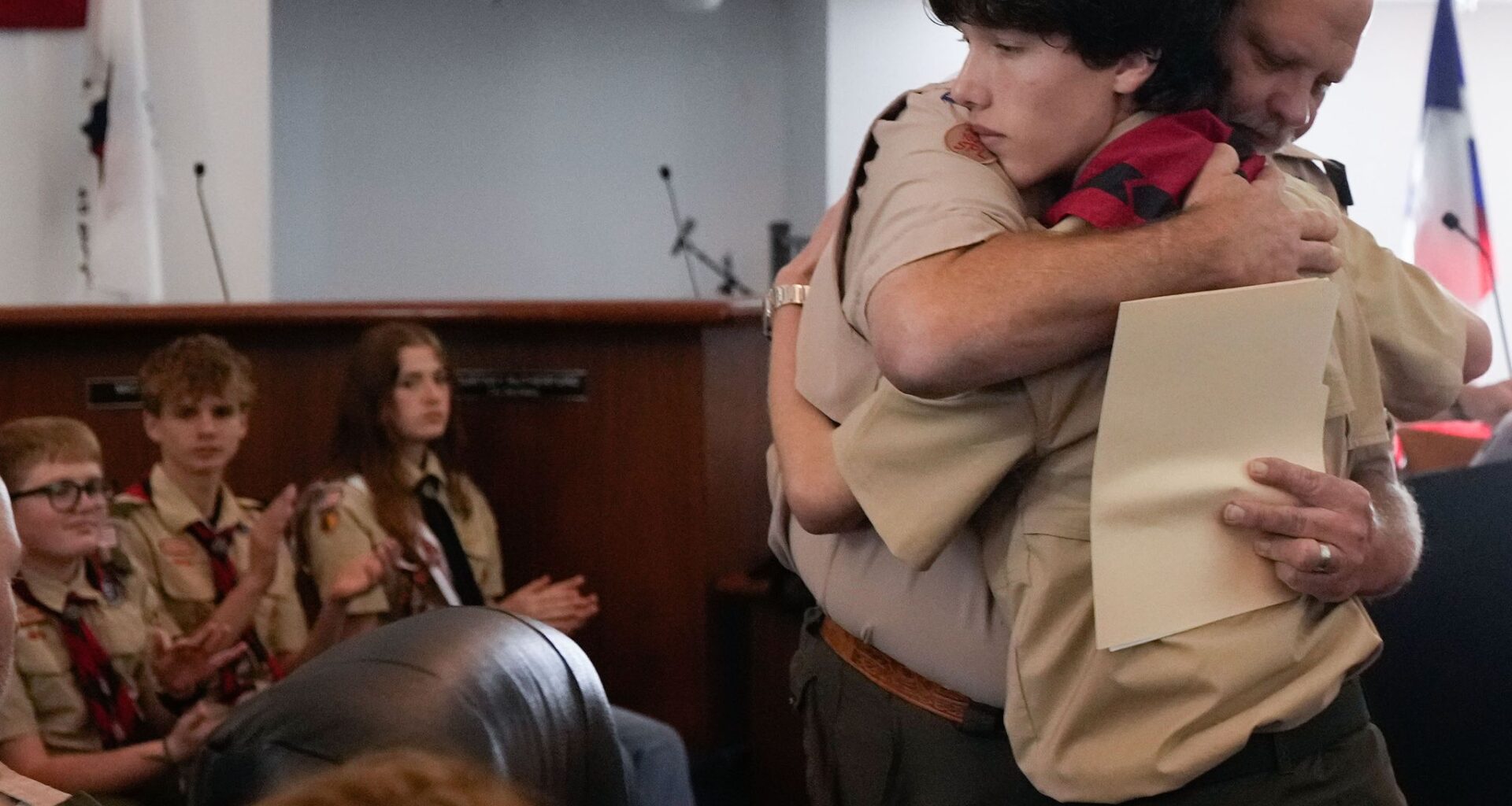
Scout Devon Champenoy gets a hug from Assistant Scoutmaster David Lemley before receiving the Scouting America Medal of Honor with Cross Palms in Jersey Village on Sunday, March 22, 2026.
Elizabeth Conley/Houston Chronicle
Boy Scout Devon Champenoy holds the Scouting America Medal of Honor with Cross Palms in Jersey Village on Sunday, March 22, 2026. Devon recieved the prestigious award following his actions that saved the life of an assistant scoutmaster during a white-water rapids trip.
Elizabeth Conley/Houston Chronicle
Boy Scout Devon Champenoy holds the Scouting America Medal of Honor with Cross Palms in Jersey Village on Sunday, March 22, 2026. Devon recieved the prestigious award following his actions that saved the life of an assistant scoutmaster during a white-water rapids trip.
Elizabeth Conley/Houston Chronicle
Boy Scout Devon Champenoy holds the Scouting America Medal of Honor with Cross Palms in Jersey Village on Sunday, March 22, 2026. Devon recieved the prestigious award following his actions that saved the life of an assistant scoutmaster during a white-water rapids trip.
Elizabeth Conley/Houston Chronicle
Assistant Scoutmaster David Lemley talks about the heroics of Boy Scout Devon Champenoy that saved Lemley’s life during a rapids trip in Jersey Village on Sunday, March 22, 2026.
Elizabeth Conley/Houston Chronicle
Boy Scout Devon Champenoy talks about receiving the Scouting America Medal of Honor with Cross Palms in Jersey Village on Sunday, March 22, 2026.
Elizabeth Conley/Houston Chronicle
Troop 277 Assistant Scoutmaster David Lemley, center, is transported June 12, 2024, following a life-threatening accident on the Nantahala River in North Carolina. Devon Champenoy, left, saved Lemley’s life by freeing his foot when he went overboard and was awarded Scouting America’s highest honor for heroism in 2026.
Contributed/Scouting America
The room rises in a standing ovation as Boy Scout Devon Champenoy receives the Scouting America Medal of Honor with Cross Palms in Jersey Village on Sunday, March 22, 2026.
Elizabeth Conley/Houston Chronicle
Assistant Scoutmaster David Lemley speaks about his near-death experience before honoring Boy Scout Devon Champenoy with the Scouting America Medal of Honor with Cross Palms in Jersey Village on Sunday, March 22, 2026.
Elizabeth Conley/Houston Chronicle
Assistant Scout Master David Lemley speaks about his near-death experience before honoring Boy Scout Devon Champenoy with the Scouting America Medal of Honor with Cross Palms in Jersey Village on Sunday, March 22, 2026.
Elizabeth Conley/Houston Chronicle
Assistant Scoutmaster David Lemley gives a thumbs up before honoring Boy Scout Devon Champenoy with the Scouting America Medal of Honor with Cross Palms in Jersey Village on Sunday, March 22, 2026.
Elizabeth Conley/Houston Chronicle
Boy Scout Devon Champenoy addresses attendees during a ceremony in Jersey Village on Sunday, March 22, 2026.
Elizabeth Conley/Houston Chronicle
Before receiving Scouting America’s highest award for heroism, one reserved for saving or attempting to save a life at extreme risk to oneself, Devon Champenoy, then 13, sat down with his mother to debate whether he should go on his troop’s upcoming whitewater rafting trip.
“We talked … about whether or not he should say he didn’t want to go,” recalled his mom, Nicole Champenoy. “Because he’s not a huge fan of water.”
“I was definitely nervous,” Devon agreed. He had never been whitewater rafting, and didn’t like the idea of “getting physical with water like that.”
Article continues below this ad
ORATORS: HISD students share stunning speeches on meaning of Martin Luther King Jr. Day
But the opportunity was too good to pass up. Troop 277, which meets in Jersey Village, had landed a spot that summer of 2024 at the coveted Camp Woodruff in Georgia’s Blue Ridge Mountains. It had a reputation for some of the best summer camp experiences in the nation and is known for its excursions. His troop had chosen the whitewater rafting trip.
Who knew if he’d have another chance to raft before he aged out of Scouts? And besides, he trusted his troop completely. He would be safe.
When the school bus filled with Scouts pulled up to the rafting put-in point, the troop was instructed to split into groups. Devon saw David Lemley, 52 at the time, asking for volunteers to join his raft.
Article continues below this ad
Lemley had been with the troop for nine years; his sons had been in it, and after they grew up, he stayed on as assistant scoutmaster. Though Lemley had grown up whitewater rafting, he had broken his back in the Army, and he only had three first-time campers, ages 10 and 11, in his boat (most rafts had seven people, giving them more manpower to navigate the rapids). So he was looking for at least one other strong paddler to come on board. But the other adults were parents and wanted to stay on the same raft as their children.
Devon volunteered to join.
Scouting America’s Houston-area Troop 277 readies for a whitewater rafting excursion in North Carolina on June 12, 2024.
Contributed/Scouting America
They piled into their yellow raft and set off on the tree-lined Nantahala River, joining the almost four dozen other Scouts in their troop. Rhododendrons arched gracefully along the banks.
By Lemley’s estimate, at 280 pounds, he weighed almost as much as the four other boys in his raft put together. Periods of calm waters mixed with rough passages with three- to six-foot drops. At one point, one Scout tumbled back in the boat during a rough patch of water, and the bow tilted toward the sky. Lemley jumped out so it wouldn’t capsize and climbed back in to laugh about it.
Article continues below this ad
Spirits were high. Shouts and whoops could be heard from the fleet of rafts. The sky was robin’s egg blue, dappled with clouds. Lemley’s booming voice kept a cheerful commentary. Devon connected with nature.
Then, about four-and-a-half miles in, came the stretch that changed their lives.
Assistant Scoutmaster David Lemley, center, is transported following a life-threatening accident on the Nantahala River. Devon Champenoy, left, saved Lemley’s life by freeing his foot when he went overboard and was awarded Scouting America’s highest honor for heroism in 2026.
Contributed/Scouting America
They entered Class III rapids, and as Lemley braced his foot across the side of the raft, preparing for impact with a tree growing in the middle of the river, the boat seemed to grab onto this foot and not let go. There was a channel for water to move past the inflated thwarts that served as benches in the raft — with the impact, his foot had somehow pushed through, so it was pinned under the seat. As he tried to wrestle it free, the boat slammed against something else.
Suddenly, his body was underwater. But his foot was stuck inside the boat. He couldn’t find the leverage to get his torso back up.
Article continues below this ad
He remembers looking up through the water at the sky and thinking: “If I cannot get my foot free, I’m going to die.”
FASTER THAN A FIFTH GRADER? HISD student likely broke world record in Houston Half Marathon
Then he saw Devon standing above him, and two kayakers from an unrelated church group pulled into view.
When Devon saw Lemley thrown overboard, he “took a couple of deep breaths and let instincts take over,” he said later. The scouts had taught him the importance of staying calm so that he didn’t make the situation worse. He tried to pull out Lemley’s leg. When he realized how jammed it was, he wedged his paddle underneath the seat and stood up in the bucking boat, which was surging and falling as much as three feet, prying the space open as he pulled and pulled. Lemley grabbed hold of one of the kayakers, struggling to lift his torso enough to catch intermittent breaths.
Then, suddenly, his foot was free.
Article continues below this ad
The pain was excruciating. He couldn’t climb back into the raft. So he let go and held on instead to a kayak, which towed him through a punishing quarter hour of rapids. When he later took a shower, purple bruising marked his back and legs. It would take doctors months to understand the extent of his injuries. He now has a 12-inch metal rod in his foot, compensating for the ligaments that were torn.
Lemley holds onto a kayak shortly after breaking bones and ligaments in his foot in the whitewater rafting accident.
Contributed/Scouting America
But as he held onto the kayak, his mind was with the raft, which was now without an adult. Then he heard Devon’s voice calling out commands: “Paddle left,” “Paddle right,” “Oars up.”
Devon said that the younger boys had frozen and weren’t moving at all until he told them to stay calm and start paddling.
Together, they were barely able to wrest the raft out of the powerful current and join the rest of the troop at a rendezvous point on the bank over 15 minutes away.
“At the time, I didn’t really think anything that crazy happened,” Devon said. “I just thought Mr. Lemley fell off the boat. He may have twisted his ankle or something, and he would have been fine.”
It took him days to process how high the stakes had been.
Heroism
Heroism, according to Matt Langdon, executive director of the Heroic Imagination Project, has a three-part definition.
A person takes action (1) on behalf of others (2) at risk to themselves (3).
“The opposite of the hero is not a villain,” Langdon said. “It’s a bystander.”
The Heroic Imagination Project is a nonprofit founded by Philip Zimbardo, who became famous for designing the Stanford prison experiment — an experiment that suggested that situational dynamics could influence behavior, with everyday volunteers playing the role of prison guards who quickly descended into dehumanizing acts.
After examining the dark side of human nature, Zimbardo became interested in the dynamics that influence heroism. The Heroic Imagination Project works to prepare people so that, in the right situation, they’ll be heroes, not bystanders. Because research has actually shown that people can prepare for heroism, Langdon said.
Devon holds Scouting America’s Honor Medal with Crossed Palms in Jersey Village on Sunday, March 22, 2026. Fewer than 300 people to have received the award in the last century for demonstrating “unusual heroism.”
Elizabeth Conley/Houston Chronicle
For example, just knowing that people are instinctively less likely to act when others are around (the bystander effect) makes it easier to understand what your mind is doing and to overcome it in the moment.
He also pointed out that the opposite of the bystander effect is true — by rushing in to help, you can inspire others to help as well. “All of a sudden, instead of one person trying to lift a car, it’s 10 people lifting a car — and it can actually happen then.”
Also, Langdon said, the fact that Devon was a Scout was a strong indicator that he would likely help.
The project’s research on people who have acted heroically has found that they are very likely to have had some kind of membership in a group as a young person, be it, for example, Scouts, a sports team or a youth group. Such groups build empathy with others, a contrast to online experiences, which tend to lessen empathy, Langdon said.
Another way to build empathy, Langdon suggested, was through imagination. When you hear a story like Devon’s, visualize what you would do in that situation. Reading about acts of heroism — especially in fiction, which is richly detailed and can take you into the mind of a character — can also prepare you to act, he said.
Reinforcing a Scout’s likelihood to help is the Scout Oath, a statement of values that Scouts often recite.
“There’s a lot of evidence that says people in groups with codes of behavior that are regularly visited can overcome those barriers a lot easier,” he said, citing the Marine Corps, pirates and samurai.
“The expectation is that a Boy Scout is going to help,” he said. “That’s part of what you pledge on a regular basis.”
So it becomes easier to make the leap from bystander to hero when the occasion arises. You’ve been prepped to act during a moment when there is not time to think.
“Anyone has what it takes to do what I’ve done,” Devon said.
Honor Medal with Crossed Palms
One of the reassuring, and perhaps surprising, facts Langdon has seen in his role is how common heroism is. The trick is hearing about it.
For example, there have been multiple subway rescues in which someone jumped onto the tracks to save another person, then got on the next train to their destination. “To them, it wasn’t really a remarkable thing in the moment.” Such stories often only get told if someone else reports them.
From left, Jamy and Nicole Champenoy hold hands with their son, Devon, as the story is told about how he saved Lemley’s life.
Elizabeth Conley/Houston Chronicle
Devon will acknowledge that he hasn’t really told people about what happened. But there have been signs of the experience for those who know where to look.
His mother noticed, “Less whining.”
“I locked in on academics,” Devon said. “I locked in on cross country.”
“We love it,” Lemley said, “when the kids — it’s like a light bulb goes off in their head and they realize: ‘I can actually do something. I don’t have to be looking at my parents or some other adult to give me instruction.’”
And he became more sure of himself in the water. This summer, he plans to either attend the Naval Academy’s Summer STEM program or go on a Scouting trip that will include — you guessed it — whitewater rafting.
Meanwhile, word of what Devon had done was traveling through Scout leadership.
The Scouts, like the military, has medals it awards for various acts of bravery, which it recognized almost as soon as it was founded in 1910. The chair of the Lifesaving and Meritorious Actions Awards Committee for the Sam Houston Area Council thought Devon qualified for the highest: The Honor Medal with Crossed Palms, reserved for unusual heroism in saving or attempting to save a life at extreme risk to self. No such medals were awarded in 2024 and 2025; less than 300 have ever been awarded.
The council submitted a nomination to the National Court of Honor, which approved it.
The room rises in a standing ovation as Devon receives Scouting America’s Honor Medal with Crossed Palms.
Elizabeth Conley/Houston Chronicle
On Sunday, Troops 277 and 1075 (277’s sister troop), along with their families and friends, gathered at the Jersey Village Civic Center for the presentation ceremony. Devon is now 15, and Lemley is 54. In addition to the medal, Devon was surprised with letters of congratulations from Gov. Greg Abbott and Sen. Ted Cruz.
Then the Scout, who had said so little about himself for so long, went into a back room to speak with an array of media that had gathered to cover his award. He composed himself before the cameras.
“Take a deep breath and relax, Champ,” Lemley said. “You’re good.”
Devon gave a quiet nod and began to tell his story.
And back in the ceremony, the rest of his troop began to recite the Scout Oath.
“On my honor, I will do my best to do my duty to God and my country and to obey the Scout Law,” they said. “To help other people at all times.”