
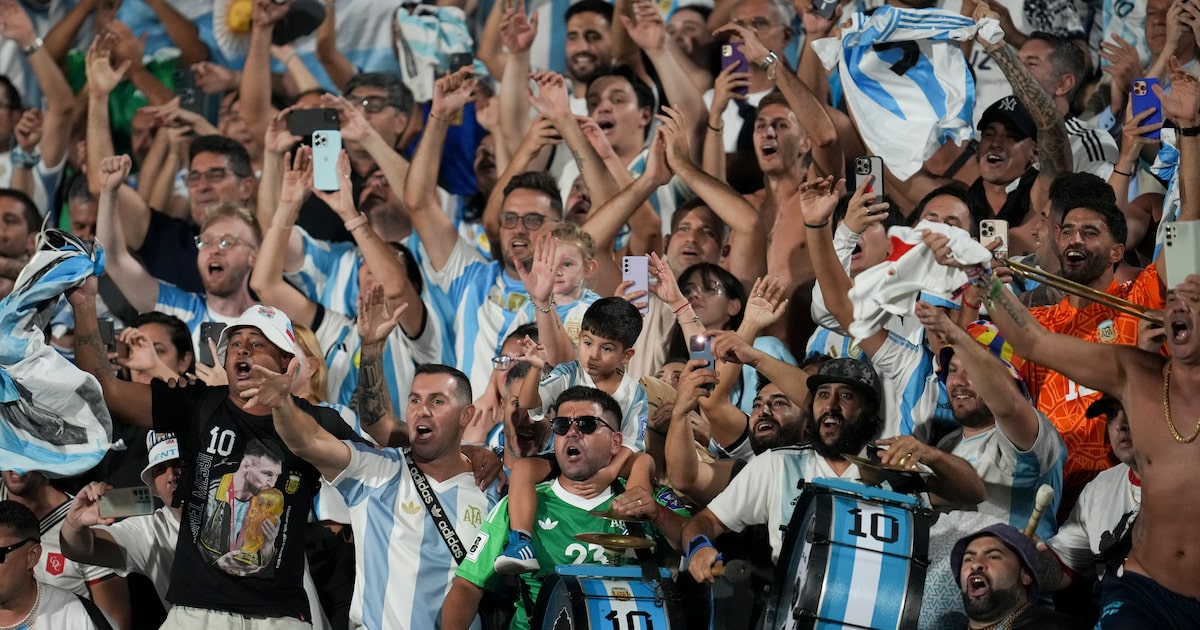
In just four months, the eyes of the world will turn to Dallas.
Dallas-Fort Worth will welcome the largest sporting event on the planet to the community. The 2026 FIFA World Cup will bring hundreds of thousands of visitors to North Texas and introduce billions of viewers worldwide to North Texas. The Dallas area will host more matches than any other U.S. city, including a semifinal at AT&T Stadium, one of the largest sports venues ever built.
For the region, the moment will be another triumph of ambition, scale and civic pride.
But before the mega event and the fans arrive, something else will arrive too: Disinformation.
Major global events today are information battlegrounds. In an era when emotion drives reason, the World Cup catalyzes and concentrates national pride, rivalry and massive digital attention into a few intense weeks.
Opinion
In this digital era, that emotional intensity becomes an opportunity for manipulation. The World Cup is a global moment when billions of people are watching, feeling and interpreting the same events at the same time, making it as much a cognitive event as an athletic one.
Dallas will be one of its most visible stages.
The Dallas–Fort Worth region sits at the center of one of the most complex transportation and communications systems in North America. Dallas-Fort Worth International Airport is among the busiest airports in the world with nearly 2,000 flights a day. Highways in the region make it a massive mobility node with millions of car trips every day across one of the largest highway networks in North America. This infrastructure is a tremendous advantage for hosting a major event.
But it also creates vulnerabilities in the information environment surrounding that event.
The 2018 Copa Libertadores Final in Argentina, contested by archrivals from Buenos Aires, demonstrates how viral rumors and competing online narratives can move from a digital reality into real life. Disinformation circulating across social media amplified fan emotions on both teams, blurred facts about an attack on one of the team buses and player-related injuries. The 2018 final had to be moved from Buenos Aires to Madrid.
The recent Paris Olympics are another case in point. The Microsoft Threat Analysis Center reported on June 2, 2024 that Russia-aligned influence networks were conducting coordinated disinformation campaigns targeting the 2024 Paris Olympics, using AI-generated media, fake news content and bot amplification to undermine confidence in the games and promote narratives of insecurity and corruption.
Deep fakes, artificial intelligence and algorithmic amplification have transformed disinformation into a scalable global industry. False narratives can now be produced cheaply and distributed instantly across multiple languages and platforms.
The perpetrators behind these campaigns vary widely. Foreign governments use major events to test influence operations, exploit ongoing tensions and foment polarization. Criminal networks exploit moments of confusion to divert attention, run fraud schemes or cyberattacks. Opportunistic online influencers fabricate dramatic stories simply to generate clicks and revenue.
What they share is a common objective: destabilization. Disinformation only needs to introduce enough doubt that people no longer know which information to trust. In a high-speed, emotionally charged environment like the World Cup, that uncertainty can spread rapidly.
Dallas is particularly exposed to these dynamics because of the velocity of its media and sports culture. Fans follow games through an interconnected digital ecosystem of sports networks, influencer commentary, live-stream platforms and betting communities. Sports narratives travel quickly especially in contexts such as the World Cup — which is only held every four years.
In the digital age, credibility is decentralized. Information spreads through networks of trust that extend far beyond government and law enforcement. The difference between stability and chaos may be measured in seconds and minutes. Public and private cooperation is essential.
Dallas has the capacity to provide new forward-thinking leadership related to event management. The region possesses visionary civic leaders, world-class universities, sophisticated law enforcement agencies and a strong technology sector. If these individuals and institutions coordinate early, Dallas could become a national model for protecting major public events in the era of information warfare.
The region was recently awarded $51.5 million in federal funding for World Cup security, including cyber threats.
In today’s high-speed information environment, World Cup planning must extend beyond stadium security and transportation to actively managing the information domain. As the community prepares to host nine matches, the city should integrate information management into security operations by establishing a regional public-private coordination cell that includes city agencies, law enforcement, federal partners, media organizations, civic and religious leadership and academic experts. This cell should be responsible for continuous real time multilingual monitoring, rapid assessment of emerging narratives and coordinated response actions.
Tabletop exercises and simulations should be conducted in advance to rehearse responses to viral rumors, false security threats, transportation disruptions, and fabricated incidents. Pre-approved rapid-response communication protocols must be tested and refined, while likely misinformation narratives should be pre-bunked through trusted local media and community partners. Embedding information monitoring directly into the incident command system will ensure that emerging rumors are logged, assessed and acted upon as operational intelligence alongside physical security and crowd safety.
The World Cup will bring celebration and pride to North Texas. It will showcase the Dallas-Fort Worth community to the world.
But the true test may not occur on the field. It will occur in the battle over narratives surrounding the event.
The game begins long before kickoff. The question is whether North Texas will be ready when it does.
Mark Rosenberg is the former president of Florida International University in Miami and is now a senior fellow at the Jack Gordon Institute in the Green School of International and Public Affairs at FIU.
We welcome your thoughts in a letter to the editor. See the guidelines and submit your letter here.
If you have problems with the form, you can submit via email at letters@dallasnews.com