
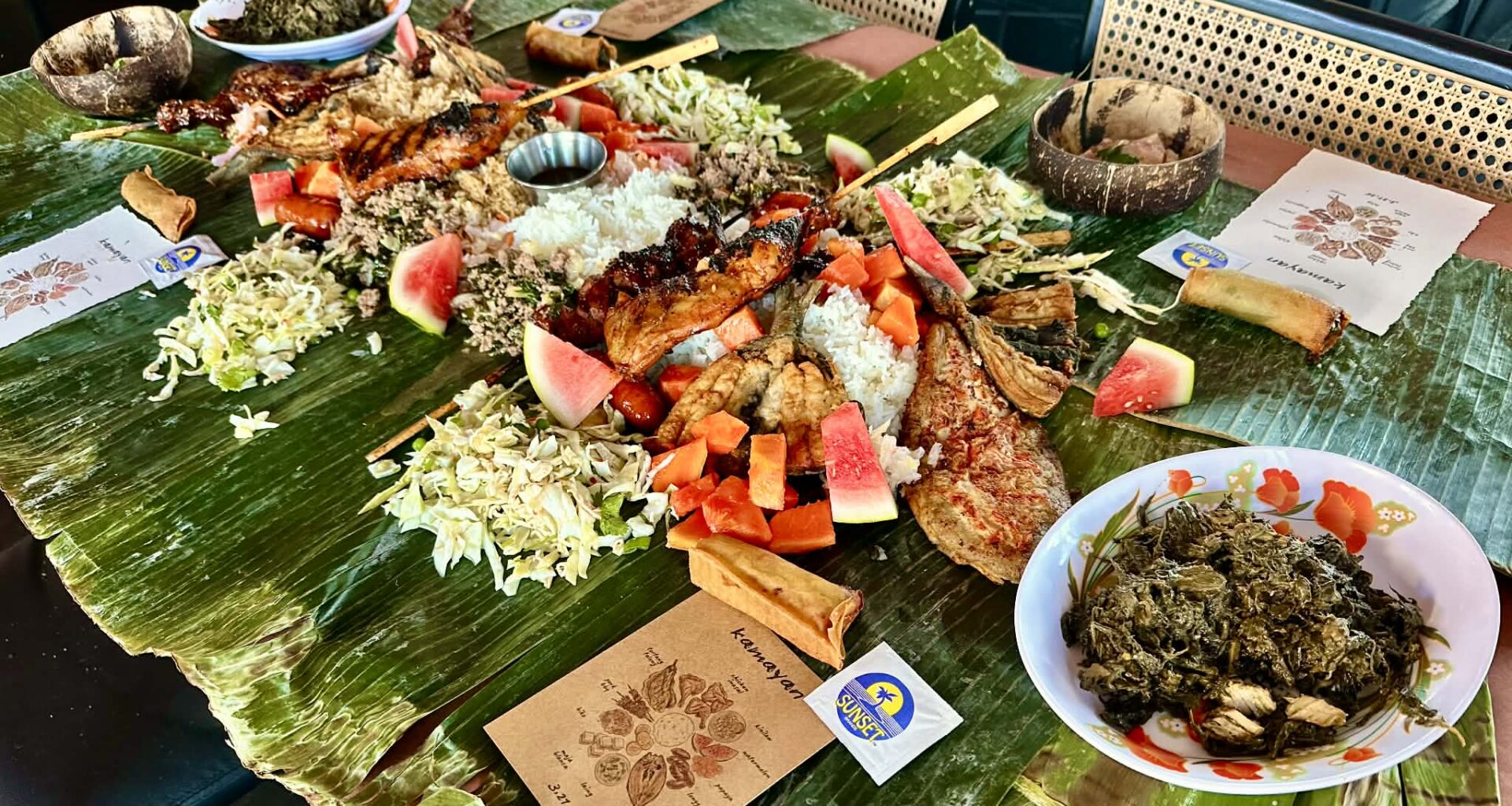
On a warm March evening, I congregate with strangers near a small auto repair shop in North Campus. In anticipation of the communal feast to come, we introduce ourselves in the courtyard of Oribello’s, the Filipino restaurant perched on the corner of 37th Street and Guadalupe.
We’re here for a kamayan, a traditional Filipino community meal spread out over glossy banana leaves and eaten by hand. Whimsical, hand-drawn menu cards identify the smorgasbord before us: vibrant chunks of tropical fruit amidst mounds of white and garlic rice, beautifully grilled meats, eggplant omelette, flavorful veggies, fried milkfish and kinilaw, a coconut-marinated ceviche.
“Filipino food is fusion,” says head chef and restaurant co-owner DJ Oribello. “The more I learn about how fusion our food is, the more I see how much [culture] there is to celebrate.”
The delectable spread is a true labor of love by multiple Oribellos. The eponymous restaurant is a family venture between Darrel Oribello and sons DJ and Wes. Darrel’s parents, Helen and Narciso, have flown in from California specifically to cook for the kamayan, while DJ’s wife Kaithlyn created the menu art.
Before we dig in, Darrel says a few simple words that feel sacred, like a benediction. He introduces the people who contributed to the kamayan, and explains what community dining means in Filipino culture.
It’s impossible to be unfriendly over a kamayan. We giggle as we reach for new foods at our long table, slowly navigating the nuances of eating with inexperienced fingers. Hesitant diners utilize food-safe disposable gloves, while the bolder dive in barehanded. The meal is impressively filling; we’re stuffed by dessert time, when two rice-based sweet treats are served on clean leaves.
Despite their creative hospitality, the Oribellos haven’t always been restaurateurs. DJ and Wes previously founded and operated a weed delivery service in California, while Darrel had a full career in the mortgage industry before entering the food and beverage space. But all roads led to Oribello’s, which opened in early 2025.
“Eventually, I realized all I wanted to do was cook food that I like,” DJ says. He credits his wife Kaithlyn, who previously studied in the Philippines, for connecting him to his heritage in a deeper way.
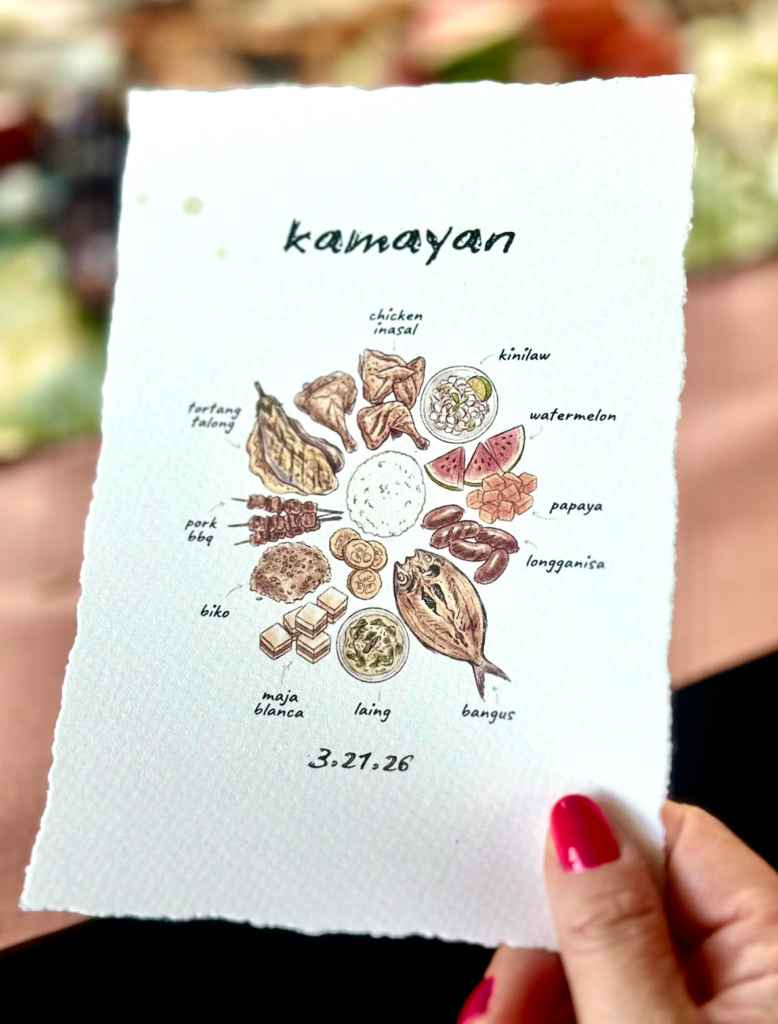 The menu Kaithlyn Oribello designed for March 21’s kamayan Credit: Katherine Fan
“I knew I was Filipino, but it wasn’t something [my parents] really explained to me,” DJ says of his upbringing in the Bay Area, an experience echoed by many Asian Americans whose parents wanted them to assimilate into U.S. culture. “I sometimes grew up eating kamayan, we had [family] parties, but I didn’t quite understand my Filipino side until I met my wife.”
DJ began exploring the Central Texas food scene when Kaithlyn began attending school in San Antonio in the 2010s. The long-distance couple spent their time together coming up to Austin to check out food truck legends like East Side King, Chi’Lantro, and Via 313, where DJ began connecting with other Asian American chefs.
While DJ was finding his way to culture through food, Wes and Darrel were on their own journeys of transition. Wes was one of the earliest employees at food delivery service DoorDash, recruiting and onboarding many of the company’s original drivers. Meanwhile, Darrel moved to Austin and became the general manager of Kirameki Restaurant Group, the entity behind Sazan Ramen.
Despite their vast entrepreneurial experience, the Oribello men found a fresh challenge in opening this restaurant together – one that felt deeply meaningful on many levels. Although the brothers had worked together with their mother in the business they founded together, Oribello’s was the first time they had gone into business with their father.
“I don’t think it’s ever going to be easy,” Wes says of working with family. “Whatever’s the first thing you want to say, you learn to not say that. But it’s rewarding. Everyone’s got different skill sets. You’ve just gotta lean on everyone’s skills and help each other’s weaknesses.”
Beyond the fact that Filipino food is extremely tasty in its own right, Wes and DJ feel strongly about sharing their cultural cuisine, which has survived multiple rounds of colonization.
“The younger generation [of Filipino Americans] is proud of our food heritage,” Wes says. “There are dishes we had before colonization that we can celebrate as ‘ours’. There’s so much that I want to learn about the Filipino food of our real ancestors, but I’m also very proud of the Filipino food we have in this modern culture.”
“In Austin, there’s just not a lot of Filipino food like there is Chinese or Vietnamese,” says Wes, whose responsibilities include events, catering, and “vibes” for Oribello’s. Previous Austin Filipino eateries like Be More Pacific and Oko have closed down, Wes points out, although Be More Pacific thrives in Houston, which has a far larger Filipino population.
“Not a lot of Austin people know much about Filipino food beyond lumpia”, Wes says. “There’s not a lot of Filipinos here and not a lot of Filipino culture, so we thought, ‘We have to do something [about it].’”
“Filipinos like to make people happy,” Wes says. “We’re willing to figure it out, [be] resourceful. When you look at some of the food we have, it’s not always made from the most desirable parts of the animal, but we make it into something super cool and flavorful. We have lots of soul food, lots yet to be discovered.”
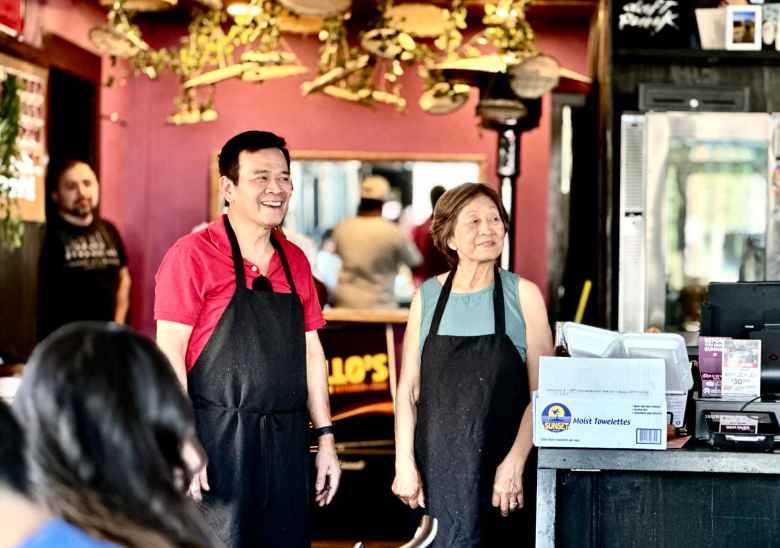 Narciso and Helen Oribello at Oribello’s kamayan on March 21, 2026 Credit: Katherine Fan
In the meantime, Oribello’s is figuring it out as they go. The eatery previously featured pizza as well, but the owners felt like they were running two separate restaurants simultaneously. So Oribello’s pivoted to focusing on Filipino and Hawaiian flavors that pay homage to the family’s diverse heritage, sprinkled with Mexican, Chinese, and Spanish influences.
“I get the most insecure when older Filipino women come in,” Wes says, “because a lot of the time, the first thing they say is, ‘It’s not the way I make it’ or ‘That’s not how my mom made it.’”
But the Oribellos have learned to take such statements at face value instead of interpreting them as critique. Wes recalls an instance where an older woman anxiously asked if Oribello’s sisig was made with offal, the traditional cut of meat used for the dish. When he informed her that they use pork belly instead, she breathed a sigh of relief and said, “Oh, good! I don’t like it the traditional way.”
“I think we’ve found our identity,” DJ says of the current menu at Oribello’s, which he developed over six painstaking months. “We’ve found a way to showcase Filipino food from my lens.”
“We’re trying to bridge the gap between traditional Filipino flavors and modern tastes,” says Wes. “We’re fighting a two-front war of discovery versus education. We’re always wondering, ‘How do we get people to try this, and then how do we get them to crave it?’”
If the battlefield is getting people to try and love Filipino food, then the kamayan dinner is a decisive win for Oribello’s. As the delicious meal winds down, 40 former strangers wipe down our greasy hands and pack up generous takeout containers filled with leftovers, already planning our next group meal together. The Oribellos smile, wave, and send us off in order to begin setting up for the next kamayan seating.
A note to readers: Bold and uncensored, The Austin Chronicle has been Austin’s independent news source for over 40 years, expressing the community’s political and environmental concerns and supporting its active cultural scene. Now more than ever, we need your support to continue supplying Austin with independent, free press. If real news is important to you, please consider making a donation of $5, $10 or whatever you can afford, to help keep our journalism on stands.