
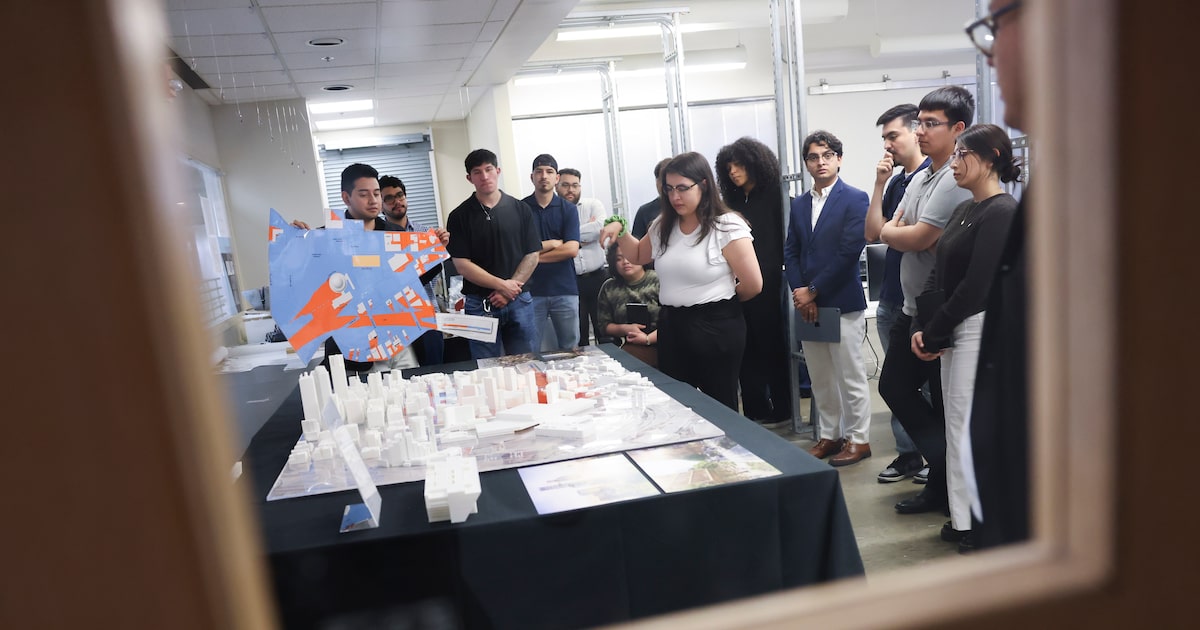
Fifteen students hover over Dallas City Hall’s miniature. They are just minutes away from unveiling a plan they say could resurrect downtown.
In a landscape of miniature models, the I.M Pei-designed building’s replica is lonely in its habitat, except for the central library across from it. The Memorial Auditorium’s familiar dome keeps it company with the Omni Dallas Hotel and the Reunion Tower sprouting like bonsai trees in the area’s western corner.
Business leaders, residents and preservationists agree: Dallas needs creative ideas as the city government tries to engineer conditions to remake downtown with a new iteration of the Kay Bailey Hutchison Convention Center.
But they disagree on whether that means saving City Hall and anchoring growth around it or letting the iconic building go for real estate development.
Political Points
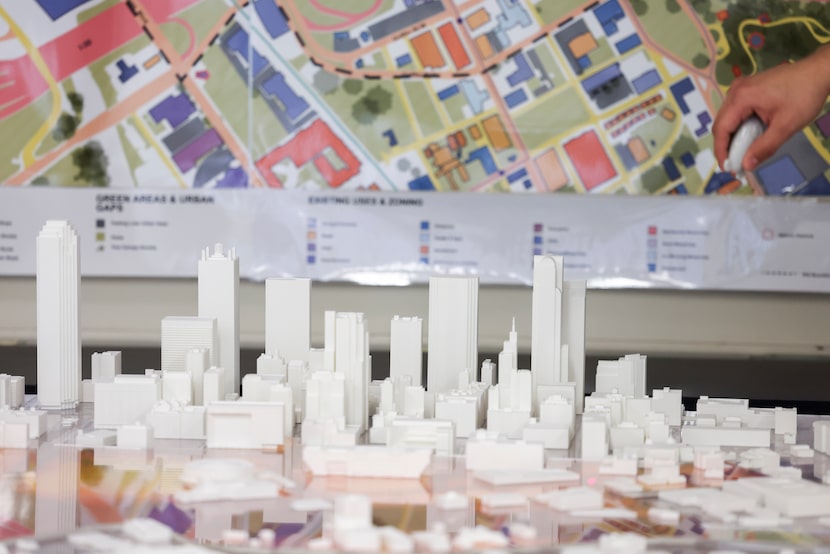
Models and designs by UT Arlington College of Architecture, Planning and Public Affairs students using the 15-minute city planning philosophy to make downtown Dallas a more vibrant, is displayed during a class presentation, on Friday, March 6, 2026 at UT Arlington.
Shafkat Anowar / Staff Photographer
A class of students and its professors at the University of Texas at Arlington are rejecting the premise that you need to give up one to have it all.
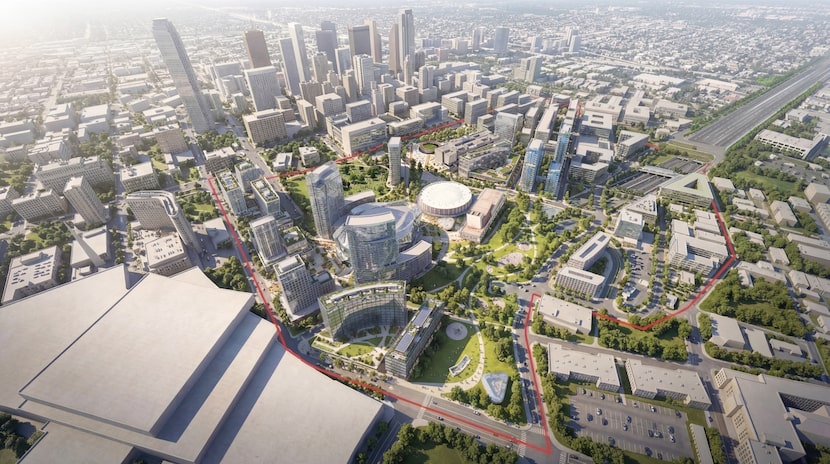
For months, seniors at the College of Architecture, Planning and Public Affairs have been laboring over an urban design that gives the city an arena for the Dallas Mavericks next to the new convention center, lets neighbors meet each other in walkable streetscapes and weaves City Hall as a link to the past.
Council members have asked for updated masterplans to decide the civic center’s future. Last year, as talks about a new arena gained traction, 10 past presidents at various levels of the American Institute of Architects released a white paper highlighting underutilized areas downtown that could help revitalize the region without sacrificing City Hall.
The students, now armed with a masterplan, want to show their vision to city officials and developers who will play a part in deciding the region’s future.
“As we look at the future of downtown, we’re looking past the idea that progress begins with the blank slate,” said Khalia Jackson, a 22-year-old architecture major.
Students pored over bike routes, street plans, decibel levels and wind speed. They scoped the city’s original urban planning and the area’s zoning. The result: a mammoth masterplan that covers 4,300,000 square footage of residential space and an additional million square footage of affordable housing.
Away from cars and closer to community interaction, it’s what the students describe as a “living room for the public.”
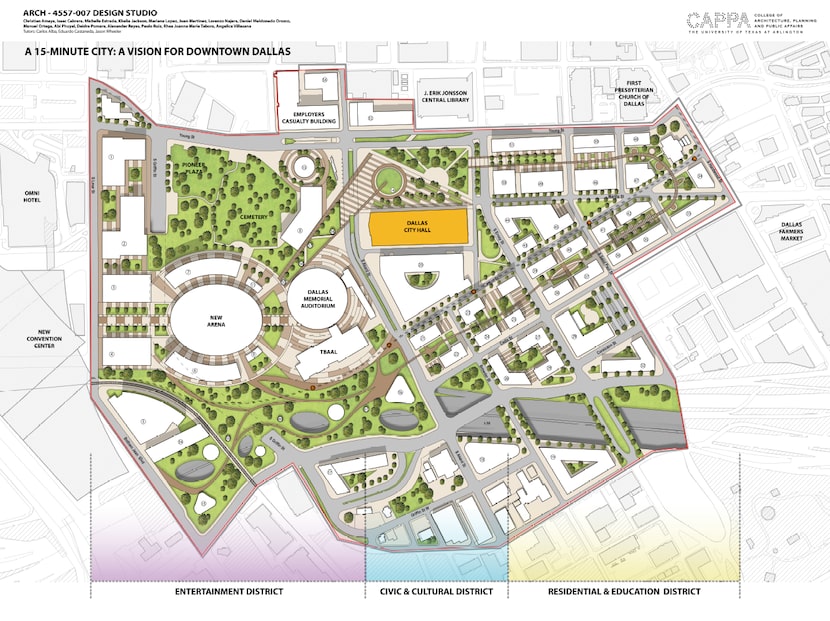
A group of 15 students have created a masterplan they say could give the city a new Mavericks arena and a greener, safer downtown Dallas without sacrificing City Hall.
UT Arlington CAPPA
The plan’s spine is a “green-loop,” a long promenade that replaces empty parking lots with courtyards filled with retail, restaurants and housing along Canton Street up to Harwood Street. Nestled in it is City Hall, with a greener plaza and an extension to the building to add more office space and accommodate workers.
The challenge
Carlos Alba knows a thing or two about what downtown Dallas could look like in the next four years.
He’s an architect at Perkins&Will, the firm at the helm of the more than $3 billion revamp of the convention center. But Alba and his colleagues Eduardo Castaneda, and Jason Wheeler, instructors of UTA’s design school, did not foresee the debate surrounding City Hall taking shape the way it has.
They saw opportunity as architects and educators, and turned to their students. “It’s happening in their backyard,” Castaneda, said.
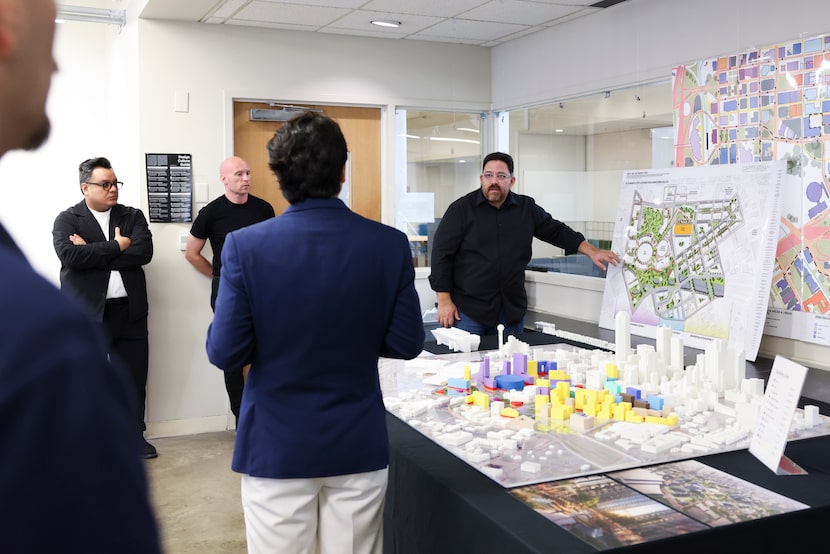
UT Arlington College of Architecture, Planning and Public Affairs adjunct assistant professor Carlos Alba talks during a presentation outlining the 15-minute city planning philosophy to make downtown Dallas a more vibrant, is displayed during a class presentation, on Friday, March 6, 2026 at UT Arlington.
Shafkat Anowar / Staff Photographer
In January, Abi Phuyal and his classmates began by taking a long walk from the Perkins&Will offices on Bryant Street to understand the terrain they’re dealing with. They made pit stops at the convention center, reviewed the DART lines that connect at the Union Station and toured the government building at 1500 Marilla Street.
Their challenge was using all their knowledge — from geo-spatial mapping to analyzing zoning and variables — to reshape downtown under the “15-minute city” concept. That concept was coined in 2015 and gained traction during the COVID-19 pandemic when urban planners sought to make local economics resilient against major economic downturns.
What if you could eat, sleep, work and play, all within a 15-minute walk or bike ride?
With the challenge in front of them, students split into three groups and discovered that discomfort through heat and lack of public infrastructure plagued the area.
Juan Martinez, 21, and his group said downtown’s current urban planning has no pedestrian and bus connections that adequately link the convention center with southern Dallas and Farmers Market.
Deidre Pomare, 24, looked at the city’s thoroughfare plan. Lots of streets downtown are one-way, an offshoot of city planning in the ‘70s when all officials wanted to do was help speed cars from workplaces downtown up the North Central Expressway to where people lived in Highland Park.
Pomare said she only found five to six streets with partial bike lanes in the area.
Rhea Lanawan Tabora, 25, looked at the trees – or the lack of them around City Hall and near the Farmers Market. “There’s not much of a tree canopy here, especially for something that’s used very heavily by people,” Lanawan Tabora said.
A pedestrian may find some respite at the miniscule greenspace near the Pioneer’s Cemetery. But everywhere else, when the temperatures ramp up to 102 degrees, that’s asking for a trip to the emergency room.
Daniel Maldonado Orozco, 23, looked at the hours of sun the area is exposed to. It’s the type of analysis that helps designers gauge the orientation of a building, placement of windows and ways to shape the outdoors.
Alexander Reyes,22, found noise levels around the I-30 canyon were scientifically uncomfortable for residents. It’s like being next to a hairdryer.
The result
Following three weeks of research, the students came up with a masterplan that divided the downtown’s southern half into three interconnected districts:
•Entertainment district: This district sits adjacent to the convention center, in the 20-30 acres that will be unlocked once the events space is reoriented. Students say here’s where a new arena for the Dallas Mavericks could go, leaving enough room for premium hotels, apartments and office spaces.
•Civic and cultural center: This district begins beyond Akard Street, and is anchored by the City Hall. Students suggest building a new community center and additional office space in the back of the City Hall. This space could include amenities such as a daycare center that currently do not exist in the main City Hall building. Part of this plan is also a deck park over I-30, which would connect downtown and South Dallas.
•Residential and education district: This district houses a new college campus, retail and health clinics. Students say this plan would need 20% affordable housing.
“We’re showing them everything that they design, every building they place, has an impact,” Alba said.
UT Arlington CAPPA
The latest version of the masterplan cuts noise emanating from the I-30 canyon by a wide margin, lowering the decibels by adding enough buildings and water elements like fountains to absorb the sound.
It also expands ideas in Downtown Dallas Inc.’s strategic 360 plan, where Marilla Street could become a way to connect the Reunion District near Young Street the Farmers Market, Deep Ellum via Canton Street as well as the City Hall Plaza.
The analysis also narrows roads, reducing car speed and allowing new restaurants and cafes to potentially spill into streetscapes. Christian Amaya, 22, who was part of the team that did the microclimate analysis, said the green loop in place of the empty parking lots reduces temperatures by 10 degrees.
The students said they want to present their masterplan to developers and encourage a scenario where Dallas gets to have it all. A new convention center. A new Mavs arena. And a City Hall that can be modernized.
Castaneda,, one of the professors, watches his students present everything from a wind analysis to the hottest time of a day in a summer month. “There’s plenty of ways to solve things,” he beamed.
Architects, he said, are problem-solvers after all.