
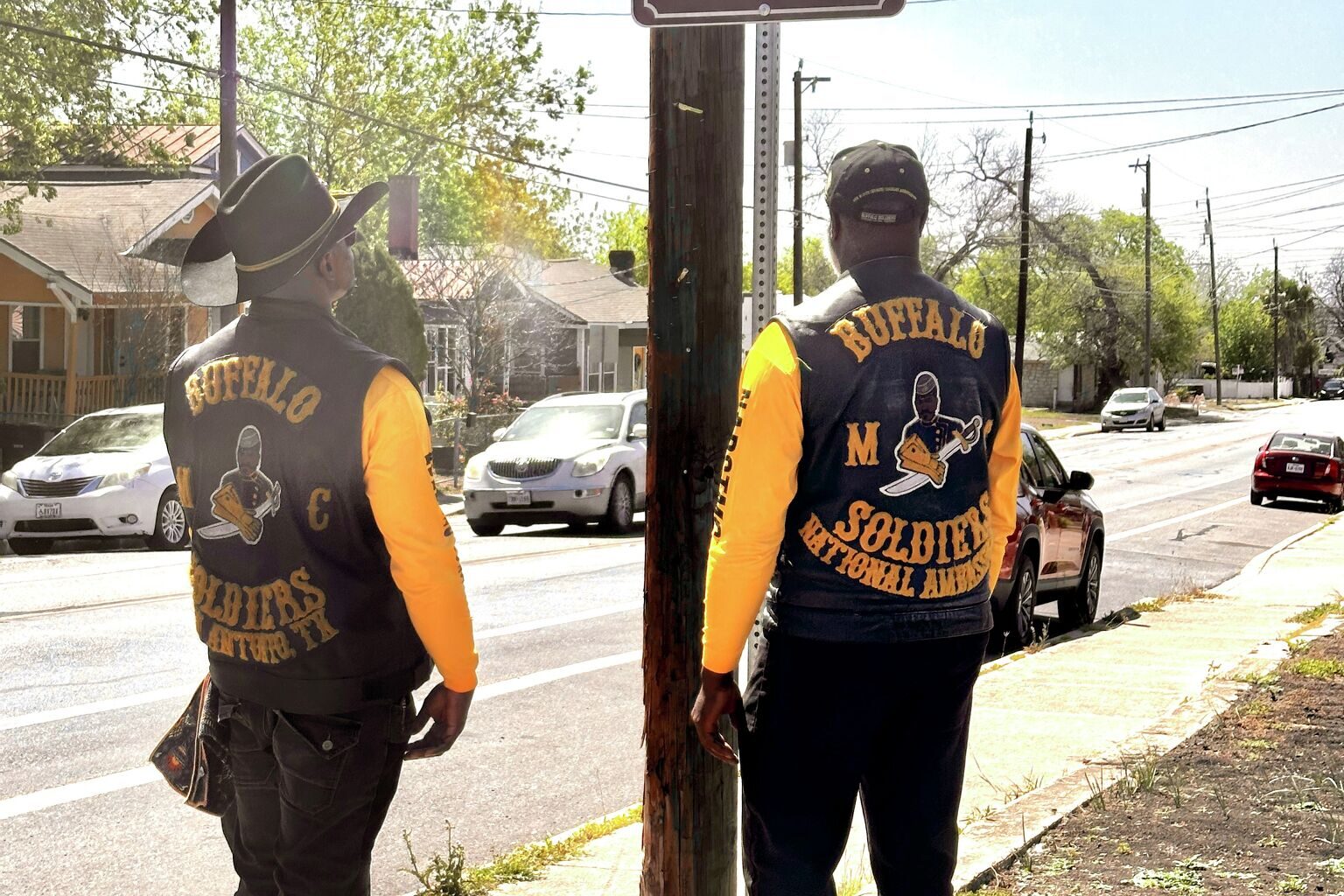
Two members of the Bexar County Buffalo Soldiers unveil the new Tuskegee Airmen Memorial Way marker at Iowa and Palmetto streets, near Pittman-Sullivan Park on the East Side of San Antonio.
Logic Allah/Photo courtesy of Melaneyes Media
Retired Air Force Lt. Col. Rick Sinkfield holds the new Tuskegee Airmen Memorial Way marker at the corner of Iowa and Palmetto streets. Sinkfield is president of San Antonio Chapter Tuskegee Airmen Inc., which asked the City Council to rename the road to honor the airman.
Logic Allah/Photo courtesy of Melaneyes Media
San Antonio native Thomas Ellis (bottom center) is seen during his time serving with the Tuskegee Airmen from 1942 to 1945. A section of an East Side road has been renamed in honor of the Tuskegee Airmen, the nation’s first African American military pilots.
Kin Man Hui/SAN ANTONIO EXPRESS-NEWS
A section of Iowa Street on San Antonio’s East Side has been renamed Tuskegee Airmen Memorial Way, in honor of the first African American military pilots who fought during World War II.

On Thursday afternoon, more than 100 people gathered in the historical Denver Heights neighborhood for the unveiling of a memorial marker erected beside the Iowa and Palmetto street signs.
Article continues below this ad
Organizers said the ceremonial marker honors the airmen, without requiring nearby residents and businesses to change their mailing addresses.
ALSO READ: ‘They still live in us’: Legacy carries on as Tuskegee Airmen honored in San Antonio
“We’re here for a simple and powerful purpose, to honor the Tuskegee Airmen of San Antonio, heroes from this community who fought fascism and challenged injustice,” Bexar County Commissioner Tommy Calvert told a crowd that included descendants of some of the airmen.
Commonly known as the Tuskegee Airmen, the 332nd Fighter Group flew in more than 1,200 missions during the war. They protected Allied bombers from German fighters, escorting them on long-range missions over Europe, flying in P-51 Mustangs known as Red Tails for their distinctive colors.
Article continues below this ad
During the ceremony, March 26 was designated as Tuskegee Airman Commemoration Day, and proclamations from the city and Bexar County were presented to the San Antonio Chapter Tuskegee Airmen Inc., which initiated the change.
The group submitted a request to the city last year, and the City Council unanimously approved the plan in December.
‘A brand of patriotism’
Members of the Bexar County Buffalo Soldiers Association began the ceremony by posting the colors, and gospel artist Cristal Byrd sang the national anthem and “Lift Every Voice and Sing.”
Article continues below this ad
The Rev. Ricky Georgetown, pastor of St. Paul United Methodist Church, led the attendees in prayer, and called for the newly-named street to become more than a marker on a map.
“Let it be a witness, let it be a testimony,” he said. “Let it be a teaching tool for every child who walks by, every family who drives through and every generation to come.”
Lt. Col. Michael Trott spoke of continuing the legacy of the original 99th Pursuit Squadron, the first African American flying unit. Trott is commander of the current 99th Flying Training Squadron at Randolph Air Force Base.
“They had to be smarter, more prepared and more resilient than anyone else, simply to get the chance to prove themselves,” Trott said of the Tuskegee Airmen. “And prove themselves they did. That is the very mindset we seek to instill in the next generation of fighter and bomber pilots in the Air Force.”
Article continues below this ad
Leon Butler, national president of Tuskegee Airmen Inc., said the fighter group was a mobilized force of talent that proved excellence knows no color.
“They fought for a country that didn’t always fight for them,” he said, “demonstrating a brand of patriotism that remains the gold standard of American Service.”
Descendants of honorees shared memories of men people called heroes but they called father.
Morgan Lankford recalled that his father, Joshua J. Lankford Jr., was content to know when needed he stepped up for his country and family. Anita Coggs-Rowell, daughter of Dr. Granville Coggs, said she learned about compassion and giving back to the community from her parents.
Article continues below this ad
READ MORE: In the 1930s, an S.A. teacher found a way to elevate Black children
‘It’s an American story’
Calvert thanked retired Air Force Lt. Col. Rick Sinkfield, president of the local chapter, for initiating the project.
Sinkfield said he thinks of the memorial as a starting point to encourage people to learn more about the story of the Tuskegee Airmen.
Article continues below this ad
“It’s not really presented effectively or comprehensively in school,” Sinkfield said. “And it’s not only a military story, not even all a civil rights story, it’s an American story.”
He said many of the honorees lived on the East Side. At one time, two of the original Tuskegee Airmen, Thomas Ellis and Warren Eusan, lived near Iowa Street. The two men and Sinkfield were part of the same congregation at St. Paul United Methodist Church.
Sinkfield said Iowa Street was chosen for the marker because people who lived on the East Side used the street as a corridor to downtown.
Article continues below this ad
He read the Lonely Eagles Roll Call, sharing the names and details of the 20 original Airmen who have died. The local chapter president said he always thinks about what those men went through and what they achieved.
“It’s just amazing,” Sinkfield said, “that if you think it can’t be done, you need to look at the Tuskegee Airmen, and it can be done.”