
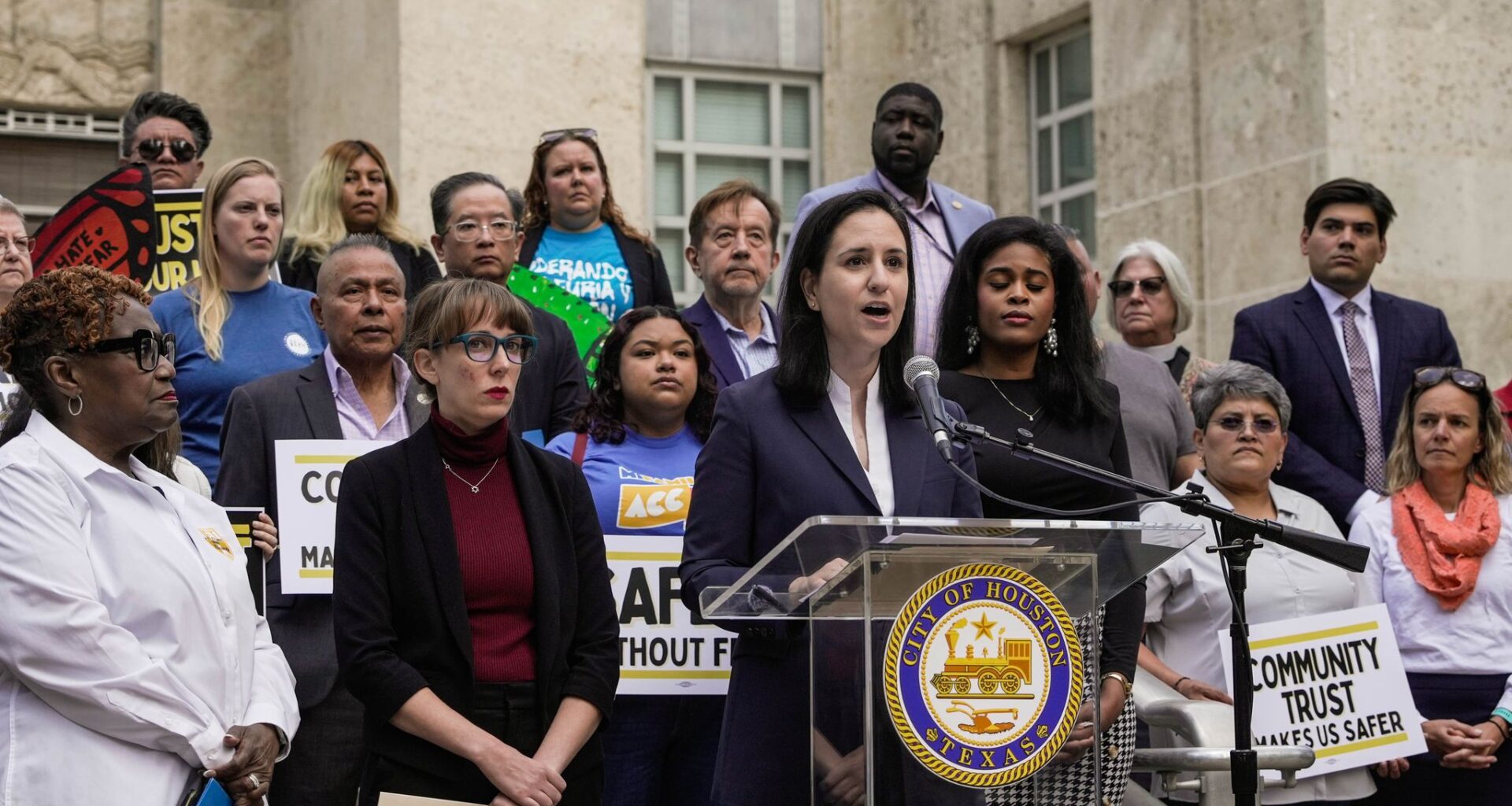
Houston City Council Member Alejandra Salinas speaks during a press conference outlining a proposal to define when Houston Police Department officers can and cannot contact U.S. Immigration and Customs Enforcement during traffic stops outside City Hall in Houston, Thursday, March 19, 2026.
Raquel Natalicchio/Houston Chronicle
Community members stand behind Houston City Council Member Alejandra Salinas as she speaks in support of her proposal outlining when Houston Police Department officers can and cannot contact U.S. Immigration and Customs Enforcement during traffic stops outside City Hall in Houston on Thursday, March 19, 2026.
Raquel Natalicchio/Houston Chronicle
A proposal to change the way Houston police officers work with immigration agents looks set to move ahead with two of its three original provisions after the City Attorney’s office rejected one of them, saying it would have violated state law.
The proposal from a trio of council members would eliminate a requirement that officers wait a full 30 minutes for federal agents to pick up people on non-criminal administrative warrants issued by U.S. Immigration and Customs Enforcement, and would require police leaders to compile reports on the department’s cooperation with ICE.
City attorneys rejected a third provision that would give officers discretion on when to call ICE, saying it might violate state law.
Article continues below this ad
Council members Alejandra Salinas, Abbie Kamin and Edward Pollard on Friday said they were working to refile the proposal, while saying they “strongly disagree” with the legal ruling. Other Texas cities have made it discretionary for their officers to call ICE.
“It is out of step with other major Texas jurisdictions and without this provision, under current policy, Houston police are forced to go beyond what state law mandates – pulling officers away from patrol and straining resources,” the council members wrote in a joint statement.
However, the statement said, “This remains a strong ordinance that delivers real protections and transparency for Houstonians. We are moving forward because our communities cannot afford to wait.”
It’s unclear why City Attorney Arturo Michel’s office rejected the provision, given that Austin and Dallas have changed their policies to reduce how often officers call ICE for administrative warrants.
Article continues below this ad
The Chronicle has reached out to the city attorney’s office for a copy of the ruling but had not received a copy Friday afternoon.
READ MORE: Exclusive: Texas says Flock surveillance violated state law over licensing issue
The ruling brings the proposal, which sidesteps Mayor John Whitmire’s authority, one step closer toward appearing on a city council agenda.
Whitmire and Chief Noe Diaz earlier this month had already issued slight tweaks to department policy on ICE administrative warrants after a Chronicle report found at least two cases where officers directly transported drivers to immigration agents – actions Whitmire said violated city policy and that legal experts said may have been unconstitutional.
Administrative warrants are civil documents often issued in deportation cases that do not on their own give officers the authority to make arrests.
Article continues below this ad
Diaz’s directive said officers must call their supervising sergeant to the scene every time they come across someone with an administrative warrant and give federal agents a 30-minute window to pick up the person.
The next week, the three council members brought forward their proposed ordinance under Proposition A, a 2023 charter amendment that lets any trio of council members add an item to a meeting agenda as long as it’s legal. The charter typically only gives the mayor the power to place items on the agenda.
Whitmire did not respond to a request for comment on the city attorney’s ruling. His office hasn’t returned any Chronicle reporter’s requests for comment since Aug. 17.
The swirling debate over the city’s handling of administrative warrants started when officials in President Donald Trump’s administration added 700,000 noncriminal administrative warrants to a national law enforcement database in the first months of his second term as president.
Article continues below this ad
Immigration advocates have questioned whether it would violate the U.S. Constitution for local officers to make detain people based solely upon the warrants, and both national police associations and Houston leaders have said police shouldn’t make arrests on immigration violations alone.