
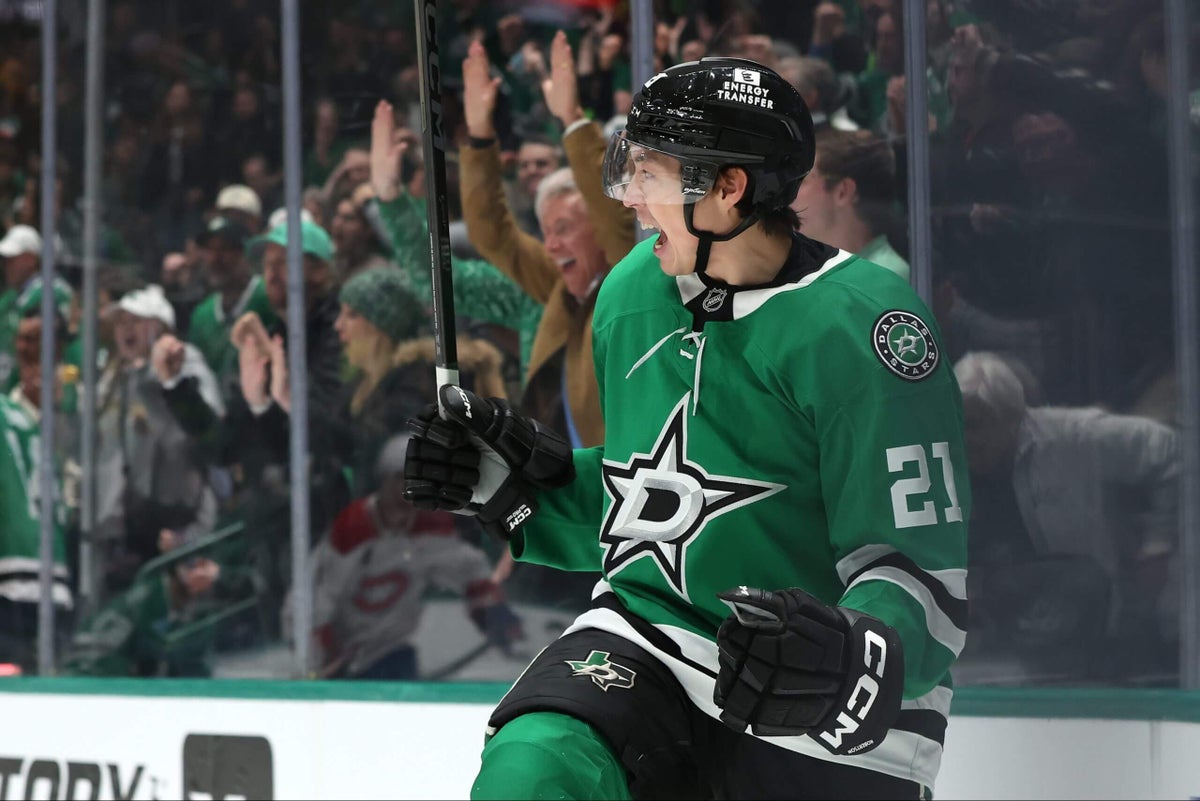
Jason Robertson may not be a front-runner in a deep Hart Trophy field, but he has been one of the most valuable players in the league this season. And the timing couldn’t be better for a player who has something to prove ahead of his next contract.
As much as Robertson has starred in Dallas over the years, he hasn’t consistently played at a franchise level at times — especially in a high-pressure playoff environment. And those shortcomings came up a lot in this year’s Player Tiers project.
“He’s a player I expected to be 2A that played like a 3A last year,” one analyst said ahead of the season. “I thought of him as a franchise player, but he plays like a good All-Star, no more, no less.
“When you’re just a good second-line winger on that contract, which is where he is leveling out to be, that’s not good enough.”
So after doubts crept into Robertson’s game, he has leveled up this year with one of his best regular seasons yet, which has highlighted his importance to this Stars team. If that high-caliber play can finally translate when it matters most, it should only add to his value this summer.
With 85 points in 71 games, Robertson is on pace for a 98-point season.
When the Stars weren’t scoring much at five-on-five in the early goings of the season, Robertson picked up the pace. Through October and November, Dallas outscored opponents 26-11 in his minutes, for a team-high plus-15 goal differential.
Robertson’s best weapon, his shot, has a lot to do with his five-on-five impact. He has been shooting the puck more often and efficiently this year, with more emphasis on the scoring areas in tight without consistently getting set up by high-danger passes. His puck-moving ability has also been a real plus, between his ability to breakout of the defensive zone with control, gain the offensive zone and set up his teammates with primary passes. That all-around game has been a real needle-mover for the Stars; the team’s xG generation is up by 0.47 per 60 in his minutes, relative to the team, and so is their scoring.
The Stars have stayed in control in Robertson’s minutes across the full season, with a 55.6 percent xG rate, and a 55-32 scoring edge in his minutes. Not only has he been trusted to play a bit more at five-on-five this season, but his power-play usage is also up. Robertson went from about 60 percent usage last year to an outright fixture, who is deployed 80 percent of the time on the advantage. He has matched that increased responsibility with more production; even when accounting for the change in usage, his scoring rate is up to 7.61 points per 60 (a plus-3.08 increase from last year, and a pace that puts him just outside the top-10 league-wide).
Between that offensive impact and a defensively sound game, it adds up to a plus-17.6 Net Rating, which ranks seventh in the league. That value has been key, considering how many injuries and absences there have been in Dallas this season.
With that level of play this season, Robertson is playing beyond his $7.75 million cap hit. His market value (according to Dom Luszczyszyn’s model) is about $13.6 million this season. Over the next eight seasons, his projected market value will jump up to an average of $15.7 million.

That is a pretty unattainable number in today’s NHL, even with the rising cap — only one player’s cap hit will exceed that next season: Kirill Kaprizov, an MVP-caliber winger for the Wild. It’s even less attainable for an RFA, who doesn’t have the threat of hitting the open market and sparking a bidding war in a pretty thin class of free agents.
The current environment has pushed teams to invest more in their own difference-makers as the cap has increased. And it could promote more hockey trades this summer, since teams have the space to absorb longer-term deals (and so many players were left on the trade board at the deadline). All of that should benefit Robertson, who is arbitration-eligible and only a year away from unrestricted free agency — whether it’s in Dallas or elsewhere.
As much as the Stars may not want to trade Robertson, it may be the only way to shake up this roster if this postseason ends up in disappointment again. Dallas’ asset pool has been decimated over the years; its prospect pipeline is down at 31st in the league, and the club is already without two of its next three first, second and third rounders. So this may be the best path to gaining assets that allow this team to swing for another high-end player (ideally with more cost-certainty). It’s just a risky path, considering how few players are as valuable as Robertson right now. The Stars know exactly what he is capable of, how well he fits in Dallas, and what a core part of this team he has become.
As much as Robertson has some leverage this summer despite his RFA status, so do the Stars.
Robertson isn’t the Stars’ No. 1 forward; Mikko Rantanen is. He may be a few years older, but he has played at the level of a franchise winger in each of the last four seasons, brings more year-to-year consistency, and is a dawg in the playoffs with a Stanley Cup ring. The Stars have already experienced his clutch factor — it was his hat trick that powered Dallas over the Avalanche in Game 7 last year, which helped make up for the fact that the team was short-handed while Robertson was sidelined with injury.
And in the grand scheme of things, that No. 2 slot is somewhat of a toss-up between Robertson and Wyatt Johnston. It all may depend on whether Robertson can find that next gear in a playoff environment.
Robertson isn’t bad in the playoffs, per se. In 2024, he was tied for the team lead in scoring with 16 points in 19 games. And he still contributed while recovering from a sprained MCL last spring, with some much-needed rush offense, and a playoff-high 3.75 Game Score while facing elimination against the Oilers. But 18 goals and 44 points in 56 playoff games haven’t matched his regular-season pace. There is a difference between being a playoff contributor and an outright force, and Robertson has generally been the former when this team needs him to kick it up a notch.
So with all that in mind, Robertson doesn’t have the leverage of a Kaprizov or even Kyle Connor, as an irreplaceable star that both franchises desperately needed to extend. And unlike the Wild and Jets, the Stars have gone on deep runs in seasons past and don’t have to sway players to keep betting on them, either.
Some teams have an internal cap structure around their star players, and that could be a factor here to keep costs down if Rantanen’s $12 million is viewed as the salary to build around. Take Dallas’ defense: Miro Heiskanen was worth 10.4 percent of the cap in Year 1 of his eight-year extension; so while Thomas Harley technically makes more on the surface, it will take up slightly less cap space (10.2 percent) next year.
So Rantanen’s $12 million cap is worth 12.6 percent of a $95.5 million salary cap this season. Next year’s cap is projected to rise to $104 million, so all things being equal, that $12 million AAV would be equivalent to $13 million next season. So that could be the absolute ceiling for Robertson in Dallas.
It’s a pretty reasonable one, all things considered. Martin Necas, Colorado’s No. 2 forward behind Nathan MacKinnon, will jump up to an $11.5 million cap hit next year, while Adrian Kempe’s new AAV is a tick lower for next season at $10.6 million. Factor in contract projections for Robertson, and it all passes that vibe check, too. Evolving-Hockey’s model pointed to an $11.9 million AAV extension over eight years in a $104 million cap world last summer, which is right in line with AFP Analytics’ midseason projections.
The one quirk here is that Robertson has to be signed before mid-September, when the new CBA kicks in, to get that eight-year max term. Otherwise, extensions will be capped at seven years, and players signing with new teams are limited to a maximum of six. In Robertson’s case, signing for less could have its benefits, too; he’d be guaranteed less money in this next contract but has a better chance of signing a lucrative next deal before he reaches his mid-30s.
All eight-year contracts come with some element of risk, because it’s a massive commitment for any player, even a 27-year-old. But at this point, the long-term is a later problem for Dallas because this core gives the team its best chance of a long window of contention.
In Robertson’s case specifically, his comps point to a few potential outcomes here. He doesn’t have any strong matches, but there are decent and partial comps that point to how his career may unfold.

The Taylor Hall comp shows how much a player’s game can drop off from a Hart Trophy level over the years. Tyler Seguin’s aging hasn’t been the most graceful, either (and injuries could be a factor behind that). Aleksander Barkov, David Pastrnak and MacKinnon are obviously the dream curve to follow, but there is some separation here between those three MVP-caliber players and Robertson. Logan Couture and Roope Hintz, on the other hand, show more reasonable paths ahead. Matches a little lower on Robertson’s comp list, such as Joe Pavelski and Jakub Voracek, show what longevity could be ahead, too. If that’s what the Stars can count on moving forward, it should take a lot of the risk out of a long-term deal.
A longer contract could be the best way for the Stars to keep that AAV in check, which would help the team maintain a shred of cap flexibility. A contract in the $12 million range, as things stand, would be a tight fit. Dallas’ signed contracts — 10 forwards, six defenders and two goalies, including Harley’s raise — add up to about $89 million. The other free agent to consider up front in Dallas is Mavrik Bourque, who hasn’t taken enough of a leap to earn a hefty raise, but should be extended for more than his current $950,000 salary.
If the Stars crash out early in the playoffs, there really isn’t much room to improve around the existing roster, either, if Robertson signs for maximum value — unless management makes other cuts around the fringes. Over the last year, those cuts have included Mason Marchment and Matt Dumba to open up space. This offseason’s subtractions could include players such as Ilya Lyubushkin, who is signed for another season after this one at $3.25 million, without any trade protection, if necessary.
So, between a potential internal cap, the option of a longer-term deal before the new CBA kicks in, and the promise of being a key part of a contender, could help keep costs down in Dallas. An in-season agent swap could help facilitate a reasonable deal, too, since Robertson’s new agent, Andy Scott of Octagon, has already negotiated long-term deals in Dallas for Wyatt Johnston, Rantanen and Harley. Add in the no-income state factor for home games, and there could be an agreeable path forward in Dallas. It just may all come down to what happens over the next few weeks.
Robertson came into this season with something to prove: That he could be a franchise-caliber player on a team with Stanley Cup aspirations. And so far, he has delivered with a star-powered regular season that has helped Dallas climb the standings despite key injuries. But the real test is whether he can be a game-changer in a playoff environment — and that could ultimately be the difference between a maximum extension in Dallas, a more team-friendly deal or even a fresh start elsewhere.
— Data via Evolving-Hockey, HockeyViz, HockeyStatCards, All Three Zones, Dom Luszczyszyn, Natural Stat Trick, CapWages, and AFP Analytics. This story relies on shot-based metrics; here is a primer on these numbers