
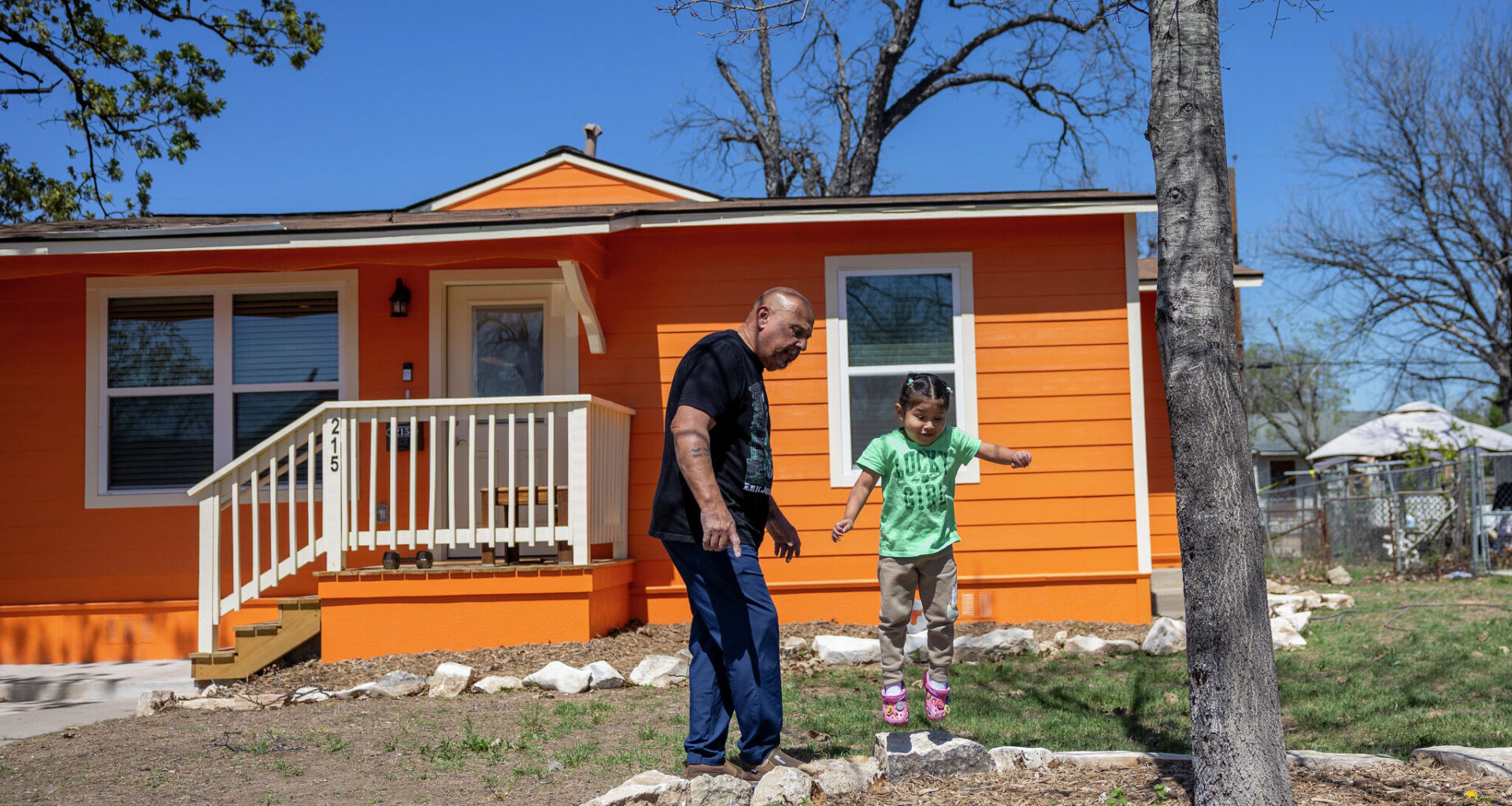
The floor in Manuel De La Rosa’s house in the Palm Heights neighborhood had started tilting.

He couldn’t open the windows. But air got in anyway — wind would rush through gaps around the frames.
He relied on four old window units to keep the circa-1948 house cool. In the winter, he had to kick the heater to get it running.
Article continues below this ad
Saving up for the many repairs and upgrades his Southwest Side home needed would take years.
The 68-year-old production assistant said he sought help from the city of San Antonio’s home repair programs several times with no luck. Then he got a call about a year ago from a city employee who said his application had fallen through the cracks. The employee visited his house and suggested he apply for funds from the city’s $150 million housing bond program.
De La Rosa said he got a forgivable, no-interest loan of just under $130,000 from the city to rehabilitate his house. Workers started taking it down to the studs last year.
Article continues below this ad
Left: Manuel De La Rosa watches his granddaughter Ezri Pinales, 4, play with her toy camera at home on March 17, 2026. Right: Manuel De La Rosa walks outside his home on March 17.
Andrew J. Whitaker/San Antonio Express-News
Top: Manuel De La Rosa watches his granddaughter Ezri Pinales, 4, play with her toy camera at home on March 17, 2026. Bottom: Manuel De La Rosa walks outside his home on March 17.
Andrew J. Whitaker/San Antonio Express-News
He temporarily moved into an apartment during construction, but he’d stop by the house early in the morning to check on the contractors’ progress, peering through the windows with a flashlight. He watched as crews replaced the electrical wiring and plumbing, repaired the foundation and installed a central air conditioning system, along with new windows, doors and cabinets.
When it came time to choose paint for the exterior, he selected a cheery shade of orange.
“I couldn’t believe it,” said De La Rosa, who moved back in in February. “It’s incredible. This house was nothing like this.”
Article continues below this ad
Four years after voters approved a first-of-its-kind housing bond, the money is nearly gone — and City Council is discussing putting a second such bond on an upcoming ballot to help pay for more projects as residents continue to grapple with a shortage of housing they can afford.
The city has since pledged 86% of the money to developers, nonprofits and San Antonio’s public housing authority to help preserve, rehabilitate or build homes across nine of the city’s 10 council districts, according to city staff. The city will also spend some of the funding to buy land for future housing projects.
The work paid for with bond proceeds includes making repairs to around 400 single-family houses and 2,256 apartments, converting a mobile home park to a cooperative and helping build 1,952 apartments and 90 single-family houses, along with 242 units for homeless people, according to city figures.
“I feel blessed that I knew about it,” De La Rosa said.
Article continues below this ad
His granddaughter, who lives with him, is eight months pregnant and often hot. Before the overhaul, she’d huddle near a window unit, but now that the house has central air, she can move from room to room and stay cool.
Left: Ezri Pinales, 4, and her mom Serena Sanchez play with toy cameras in their home on March 17, 2026. Right: Manuel De La Rosa plays with his granddaughter, Ezri, at home on March 17.
Andrew J. Whitaker/San Antonio Express-News
Top: Ezri Pinales, 4, and her mom Serena Sanchez play with toy cameras in their home on March 17, 2026. Bottom: Manuel De La Rosa plays with his granddaughter, Ezri, at home on March 17.
Andrew J. Whitaker/San Antonio Express-News
Housing affordability is a problem in San Antonio, one of the country’s poorest large cities. About 90,000 homeowners and renters in the area are considered cost-burdened, meaning they spend 30% or more of their income on housing and utilities. Veronica Garcia, director of the city’s Neighborhood and Housing Services Department, said they’re having to choose between covering rent or mortgage payments, and paying for food, transportation and other basic needs.
The bond financing has helped the city get closer to its goal of building and safeguarding 28,094 affordable housing units through 2031. A mishmash of city subsidies, including bond funding, have helped renovate and construct about 11,000 homes so far, Garcia said.
Article continues below this ad
Some projects partially funded by the bond have been completed, such as the Vista at Silver Oaks apartments on the North Side and renovations to units at Preserve at the Port near Port San Antonio. Other developments are still under construction or in the planning stages, such as the Commons at Acequia Trails on the Southeast Side, which is expected to open next year with housing and services for chronically homeless people.
The city is getting ready to dole out the final $12.2 million in bond funds.
“We know we need to create lots of different affordable housing options,” Garcia said.
Not enough housing
Voters approved a $20 million bond for “neighborhood improvements” in 2017. The city primarily used the funding to buy land and partner with developers to build housing. The final project using funds from that program, an 80-unit apartment complex just north of downtown with on-site services, opened in early 2026.
Article continues below this ad
Then-Mayor Ron Nirenberg created a task force in 2017 to set goals, policies and funding options for affordable housing over the next 10 years. As the city rapidly moved closer to meeting its targets, officials started drawing up a new plan in 2020 to retain and build 50% more units and laying the groundwork for a much larger — and more direct — housing bond.
Then-Mayor Ron Nirenberg during the Housing Policy Task Force’s first gathering on Oct. 3, 2017.
Kin Man Hui/San Antonio Express News file photo
The COVID disaster also struck. Not long after the pandemic hit in 2020, home prices and rents skyrocketed as interest rates and the supply of available properties plunged. As eviction moratoriums put in place early in the crisis expired, many tenants either struggled to pay rent or lost their apartments.
City staff initially proposed a $250 million housing bond, but they scaled that back to $150 million because City Council members wanted more money for other kinds of bond projects.
Article continues below this ad
A citizens’ bond committee said the city should prioritize projects for residents having the hardest time finding housing they could afford, such as people with disabilities, senior citizens and homeless people.
“Projects that receive bond funding must serve San Antonio’s most vulnerable cost burdened low-income populations,” the committee stated in its recommendations.
The bond was one of several financing sources for affordable housing in the city’s plan, which set a goal of building and preserving 13,592 homes for people earning up to 30% of the median income in the area — some of San Antonio’s poorest residents. Voters approved the initiative in 2022 as part of a record $1.2 billion bond package.
Since then, less than a quarter of the housing built or preserved with bond funds — among other funding sources — so far has been geared toward people making up to $20,300 annually for one person or $23,200 for a couple, according to city figures.
Article continues below this ad
Leticia Sanchez, co-chair of the Historic Westside Residents Association, and Kayla Miranda, a housing advocate who served on the bond committee, said the city isn’t prioritizing San Antonians hurt most by a dearth of housing they can afford.
Kayla Miranda, a housing advocate, speaks about the city’s housing at City Hall on July 14, 2021.
Billy Calzada/San Antonio Express News file photo
“When we first started having discussions, the entire point of this bond was to serve those who are the most vulnerable,” Miranda said. “I’m very disturbed at how it has been used and how it has played out.”
Building housing for those residents is expensive. The cost of buying land and constructing apartments is generally the same as it would be for a market-rate property, but the rents the owner receives are much lower.
Article continues below this ad
“Those types of projects really require multiple levels of subsidies to ensure that they can be built, and that they can guarantee the rent will be held at different income levels for 40 years, which is our requirement,” Garcia said.
The city initially required developers seeking housing bond dollars to set aside at least 10% of the units in a new complex for people earning up to 30% of the median income. But officials have since boosted that mandate to 15%.
“The one area that continues to be a challenge is new, deeply affordable homes,” Garcia said.
Miranda and Sanchez said they’re also concerned about other aspects of the program.
Article continues below this ad
Miranda said some of the money has gone to projects that were in the works before voters approved the bond, helping developers and organizations piece together financing to get deals across the finish line — rather than setting off a wave of new development.
With the home rehab piece of the bond — the funding De La Rosa benefited from — Sanchez said residents have been confused about when they can apply for funds for repairs and how the money is being distributed.
Some homeowners who have received help through the city’s repair programs have also complained of shoddy workmanship. The city hired the Why Group, a local consulting firm, to review its rehabilitation initiative. The analysis found that some contractors hired by the city “lack knowledge in construction techniques and lead abatement” and “missed steps or quality issues” in making home improvements, News 4 reported.
In light of the review, the city established “a formal quality assurance process to monitor compliance and ensure continuous improvement,” and is scheduling appointments with residents to improve communication and partnering with nonprofits to help with legal issues, a spokesperson said.
Article continues below this ad
The city plans to use $9 million from the bond to acquire property along VIA Metropolitan Transit’s Green and Silver rapid bus transportation lines and partner with the San Antonio Housing Trust to build housing at those locations. That wasn’t one of the uses recommended by the bond committee, Miranda said.
A city spokesperson said the housing bond set aside money for property acquisitions, and the city’s plan identifies buying land as a strategy to help it meet its housing goals.
Where’s the money going?
Think of an affordable housing development as a puzzle, where the pieces are the variety of funding sources an owner uses to build the project. The bond is one piece.
Article continues below this ad
A committee made up of city staff, residents and a VIA representative ranks developers’ and nonprofit organizations’ pitches for bond dollars based on income thresholds, location, proximity to public transportation, how close a project is to being ready to start construction and what social or health care services would be offered at a property, Garcia said.
The city has doled out the money through a half-dozen rounds of solicitations. And it’s re-allocated funding for six projects that fell through because the organizations involved couldn’t secure the rest of the financing they needed or failed to meet the city’s deadlines.
“We are able to really dictate the kind of housing communities we want to see,” Garcia said. “Every round it gets more competitive.”
About $37.4 million is being spent on minor and major repairs at 400 houses. To qualify for 10- to 20-year forgivable loans of up to $130,000, homeowners must make up to 50% of the median income in the area and have clear title to the property. They also have to agree not to sell their house during the term of the loan. If they violate that condition, they have to pay off the loan.
Article continues below this ad
Another $19 million is helping pay for 242 units of what’s known as “permanent supportive housing” — affordable units with on-site social services for chronically homeless people — at Towne Twin Village on the East Side and Commons at Acequia Trails.
Construction work on The Commons at Acequia Trails on March 26, 2026.
Andrew J. Whitaker/San Antonio Express-News
San Antonio Metropolitan Ministry Inc., a nonprofit that provides housing and services for homeless people, started working on plans for Commons at Acequia Trails after voters approved the bond, which had funds set aside for permanent supportive housing, said President and CEO Nikisha Baker.
The complex is expected to be finished in early 2027.
Article continues below this ad
At $56 million, the 201-unit project on the South Side requires layers of subsidies. More than $16 million is coming from various city programs, including $9.1 million from the bond.
“I don’t know that we would even be talking about the Commons as a real thing had the city’s investment not been a part of that conversation,” Baker said.
Another chunk of the bond, about $25 million, is going to developers to build 12 apartment complexes with 1,952 units for people earning less than the area’s median income. Some 1,150 are for people making up to 60% of that level, which comes out to about $40,620 annually for one person or $52,200 for a family of three.
Rose Lathan, 65, moved into an apartment at one of those complexes, Vista at Silver Oaks, early last year. Opportunity Home San Antonio, Atlantic Pacific Cos. and OCI Development built the 76-unit, $29.3 million property with $3.3 million from the bond.
Article continues below this ad
Lathan, who was injured in a car accident and now receives disability assistance, said she relocated to San Antonio from a rural community north of Austin in search of better medical care. She said she found Vista at Silver Oaks while searching for apartments online and was thrilled when her application for a Vista unit was accepted.
She declined to say what she pays for her two-bedroom, two-bathroom unit. She said she appreciates the newness, cleanliness and safety of the complex, a big improvement over other places she’s lived. Lathan frequently takes long walks around the property and visits a city senior center about two miles away.
“I love it here,” Lathan said.
Left: Rose Lathan walks around the complex at Vista at Silver Oaks on March 25, 2026. Right: Lathan exercises in the fitness center of her apartment complex on March 25. The apartment complex, where Latham lives, is funded by San Antonio’s 2022 affordable housing bond.
Katina Zentz/San Antonio Express-News
Top: Rose Lathan walks around the complex at Vista at Silver Oaks on March 25, 2026. Bottom: Lathan exercises in the fitness center of her apartment complex on March 25. The apartment complex, where Latham lives, is funded by San Antonio’s 2022 affordable housing bond.
Katina Zentz/San Antonio Express-News
Another $30 million is committed to making improvements at 2,256 apartments. Under another category, Habitat for Humanity of San Antonio, Mission Trail Community Association and Opportunity Home are getting $6.2 million to build houses and convert a mobile home community to a resident-owned cooperative.
Article continues below this ad
The city will soon choose the housing projects that will receive the last $12.2 million in funding.
Who’s getting the most funding?
Opportunity Home, the city’s public housing authority, is the largest recipient of bond funds, with $16.7 million going to upgrade six apartment complexes and build five single-family houses. The agency has also partnered with developers on other projects benefiting from the bond.
It applied for another $38.6 million but was not awarded those funds, a spokesperson said.
Article continues below this ad
Diana Kollodziej Fiedler, Opportunity Home’s chief financial officer, described the housing bond as a “godsend.”
The agency gets about $17 million annually from the federal government for improvements at its properties, but it has more than $500 million worth of deferred maintenance and repairs, Fiedler said.
It typically acquires apartments financed through a tax credit program for affordable housing, near the end of the program’s 15-year term. Those deals generally come with debt on the property, which — combined with the lower rents at the complexes — makes it harder to persuade a bank to lend money for rehabilitating the complexes, Fiedler said.
Opportunity Home is using the bond funds to replace windows and siding at its Woodhill Apartments, install a new elevator at Pecan Hill Apartments, replace the roof at Victoria Plaza Apartments and upgrade air conditioning units at the Cottage Creek complex, among other repairs across six properties. Opportunity Home put $11 million from its coffers into the improvements, Fiedler said.
Article continues below this ad
“For voters to step up and say, ‘Yes, we want this to happen’ — it was great,” she said.
Opportunity Home was set to receive an additional $8.2 million to renovate and rebuild Alazán Courts, the city’s oldest and largest public housing complex. But the agency’s leaders scrapped the $112 million project after they couldn’t come up with enough money to pay for it. They forfeited the bond funds.
Janelyz Feliciano, 10, plays soccer at Alazan Apache Courts on Oct. 31, 2024.
Jessica Phelps/San Antonio Express News file photo
“It’s a huge undertaking,” Fiedler said. “I think the only way to consider it is to consider the whole project, as opposed to band-aiding. And I think that’s all the this type of program would be able to provide for a property that large.”
Article continues below this ad
A second housing bond
The city’s 10-year plan for paying for more affordable housing includes a second $150 million housing bond, along with tax credits and conventional loans.
City officials haven’t set the size of the next bond package, but it will be much smaller than previous programs because of declining property tax collections. Property value increases have slowed because of a sluggish housing market and property tax cuts approved by the Texas Legislature.
A portion of the city’s property tax revenue is used to repay general-obligation bond debt, and static property values mean less tax revenue for the city.
Article continues below this ad
A majority of City Council members support increasing the city’s property tax rate and stormwater fee to fund a larger bond, which could go to voters in May 2027 at the earliest. They want the housing part of the package to be at least $150 million again.
Miranda said it should be larger.
“We need significantly more,” she said. “We need a $500 million housing bond.”
That’s because the poorest residents continue to bear the brunt of elevated prices and rents, and now the middle class is being squeezed too, Miranda said.
Article continues below this ad
De La Rosa said higher costs have affected friends of his, who have sold their houses for much more than they paid years ago but had to move in with their children because they couldn’t find an affordable house to relocate to. The repairs to his home will make it easier for him and his family to stay there, he said.
“No one’s leaving this house,” De La Rosa said.
Manuel De La Rosa and his granddaughter Ezri Pinales, 4, walk outside to check on the flowers they planted Tuesday, March 17, 2026, in San Antonio. De La Rosa and his family recently moved back into their home after, he got a deferred forgivable loan via the city’s 2022 affordable housing bond for major repairs.
Andrew J. Whitaker/San Antonio Express-News