
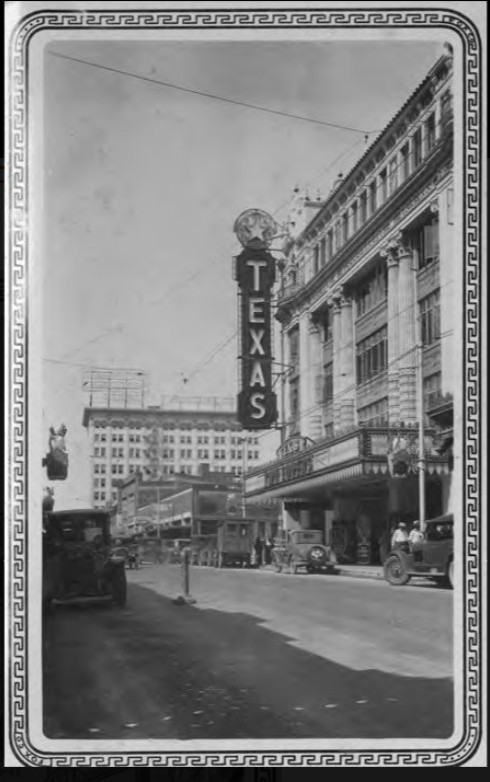
The Texas Theater, seen here circa 1928 at 101-105 E. Houston St., opened in 1926 as part of the Publix chain of movie houses. Designed by Boller Bros., a Kansas City, Mo., architecture firm, it was an atmospheric theater in a style that blended southwestern, Spanish and other European influences.
UTSA Special Collections
In this undated photo, Spanish-born artist José Arpa works on a painting outdoors, probably one of his famous sunny landscapes that earned him the nickname “the Sunshine Man.”
UTSA Special Collections
A 1923 painting by José Arpa depicts houses built by Irish settlers in the Irish Flats community north of Alamo Plaza.
Portal to Texas History
As shown with a model in the San Antonio Light, Oct. 3, 1926, a panel from José Arpa’s scenes of old Texas seems to be painted on canvas rather than directly on the walls of the theater’s auditorium, where four such paintings were placed on each side.
San Antonio Light
First of two related columns

I enjoyed your (Aug 20, 2016) article on José Arpa and am wondering if you know more about the murals that he painted for the San Antonio Express-News building. Are they still there? If I go over there, could I see and photograph them? If not, do you know what happened to them?
Article continues below this ad
Before the New Deal-era wave of federally funded projects (mentioned here March 7) that put murals in buildings such as San Antonio’s former main post office at 615 E. Houston St., now the Hipolito F. Garcia Federal Building, there were equally lavish wall paintings in private buildings such as the former Express Publishing Co. building at 301 Avenue E.
The murals by noted artist José Arpa were not in place when the building opened Oct. 29, 1929. Yes, that was the inauspicious “Black Tuesday” of the stock-market crash that kicked off the Great Depression – but the newspaper went on to have a good run there, from 1929 to 2020. It has since relocated a block away.
“New building has many distinguishing bits of beauty,” proclaimed a headline in that day’s San Antonio Express, where a sculptural frieze by Pompeo Coppini (discussed here Nov. 22, 2025, and Oct. 27, 2018) over “the imposing entrance” is one of the artistic flourishes highlighted.
Article continues below this ad
The Arpa murals depicting scenes from newspaper production were not in place on opening day but were added later and not mentioned in the Express until April 20, 1930, maybe because 1929-1930 was a busy year for the Spanish-born artist.
During 1929, Arpa won the first prize of $2,000 in the San Antonio Art League’s Edgar B. Davis competition for his painting of cotton fields, had a solo show in the gallery of the Milam Building (then a snazzy new skyscraper, completed in 1928) and was invited to design courtyard furnishings for the planned renovation of the Spanish Governor’s Palace (mentioned here Sept. 18, 2022).
Known for his skills as a colorist and painter of sunlit landscapes, Arpa (1858-1952) spent about 25 years of his long career in and around San Antonio as a popular art instructor and artist. His works included paintings of historic sites such as the Cos House in La Villita (mentioned Dec. 13, 2025), the Irish Flats community settled in the mid-1800s, and Alamo Plaza.
That interest in old-timey subjects, plus his considerable local fame, might have been what got Arpa his previous mural commission at the Texas Theater, opened in 1926.
Article continues below this ad
RELATED: Arpa as instructor
During the era of the movie palace, San Antonio had some fantastic examples of the atmospheric theater, meant to transport moviegoers from their everyday lives to some faraway place and time. There was the Aztec (mentioned here Aug. 24, 2019), opened in June 1926 just a few months ahead of the Texas with a Mesoamerican theme that drew on several Native Mexican cultures; and the Majestic (April 4, 2014), opened in 1929, with an auditorium designed to resemble a Spanish or Mexican courtyard, under a “sky” ceiling with realistic clouds and stars.
The Texas Theater was part of the Publix Theaters chain (1925-1935), then “the largest theater-operating company in the world,” according to the San Antonio News, Dec. 16, 1926, “with moving-picture theaters of the deluxe type.”
Designed by Robert Boller of Boller Bros., a firm of theater architects from Kansas City, Mo., the theater’s aesthetic was a romantic melange of Southwestern, Spanish colonial and other European influences. Inside and out, there was polychromatic terra cotta and tile, lighting to bring out the colors, and glass and copper wind chimes on the marquees (street and river side).
Article continues below this ad
In the auditorium, there was an “outdoor effect,” as Boller told the News, like a “Spanish garden with a drawn canopy overhead.” On the side walls, “arches with ornamental iron grills are designed with typical Texas scenes showing in the distance (between) the arches.”
Those scenes were painted by “the virile brush” of Arpa, said the San Antonio Light, Oct. 3, 1926, assisted by his nephew Xavier Gonzales, who went on to become a successful artist with murals of his own in Los Angeles and New Orleans. The two men started painting the Texas Theater murals in October 1926 and had them finished in time for the Dec. 17, 1926, opening.
RELATED: Portrait painter studied with Arpa
“Beyond the walls (of the auditorium),” said the next-day report in the News, “there is another land, the hills of which tower the patio, reproduced in mural panels by José Arpa.” There were eight panels, “four on each side of the house,” and their theme dealt with “the retreat of the Indians and the advance of the pioneer scouts and covered wagons.”
Article continues below this ad
If not separated by columns, the panels “would make a complete picture, the dimensions of which would be 60 by 25 feet.”
While the Texas Theater was a popular, first-run movie house through the 1930s, it was just far enough away from the heart of the Houston Street entertainment and shopping district to decline slowly from mid-century. Like the other downtown theaters, it lost customers to television and the suburban theaters.
Deteriorating, the Texas closed in the late 1970s, after a fire in 1976 and some experiments with live music performances. The building was bought by Dallas-based Republic Bank, which went to some lengths to prove that it couldn’t be saved. At least some of the Arpa murals were damaged by water leaking through the roof and apparently the atmospheric plaster canopy.
Except for the facade, which was retained as a decorative element, the former theater was demolished in 1982-1983 in favor of the office tower in what was called RepublicBank Plaza.
Article continues below this ad
Late last year, the Laredo-based International Bank of Commerce or IBC announced plans to convert the office tower into a hotel, with the theater facade as an entrance.
Thanks to Debbie Countess of the San Antonio Public Library’s Texana/Genealogy Department and Beth Standifird of the San Antonio Conservation Foundation library for their help in researching the Arpa murals.
Next week: Industrial art; paper craft
Article continues below this ad
historycolumn@yahoo.com | X: @sahistorycolumn | Facebook: SanAntoniohistorycolumn