
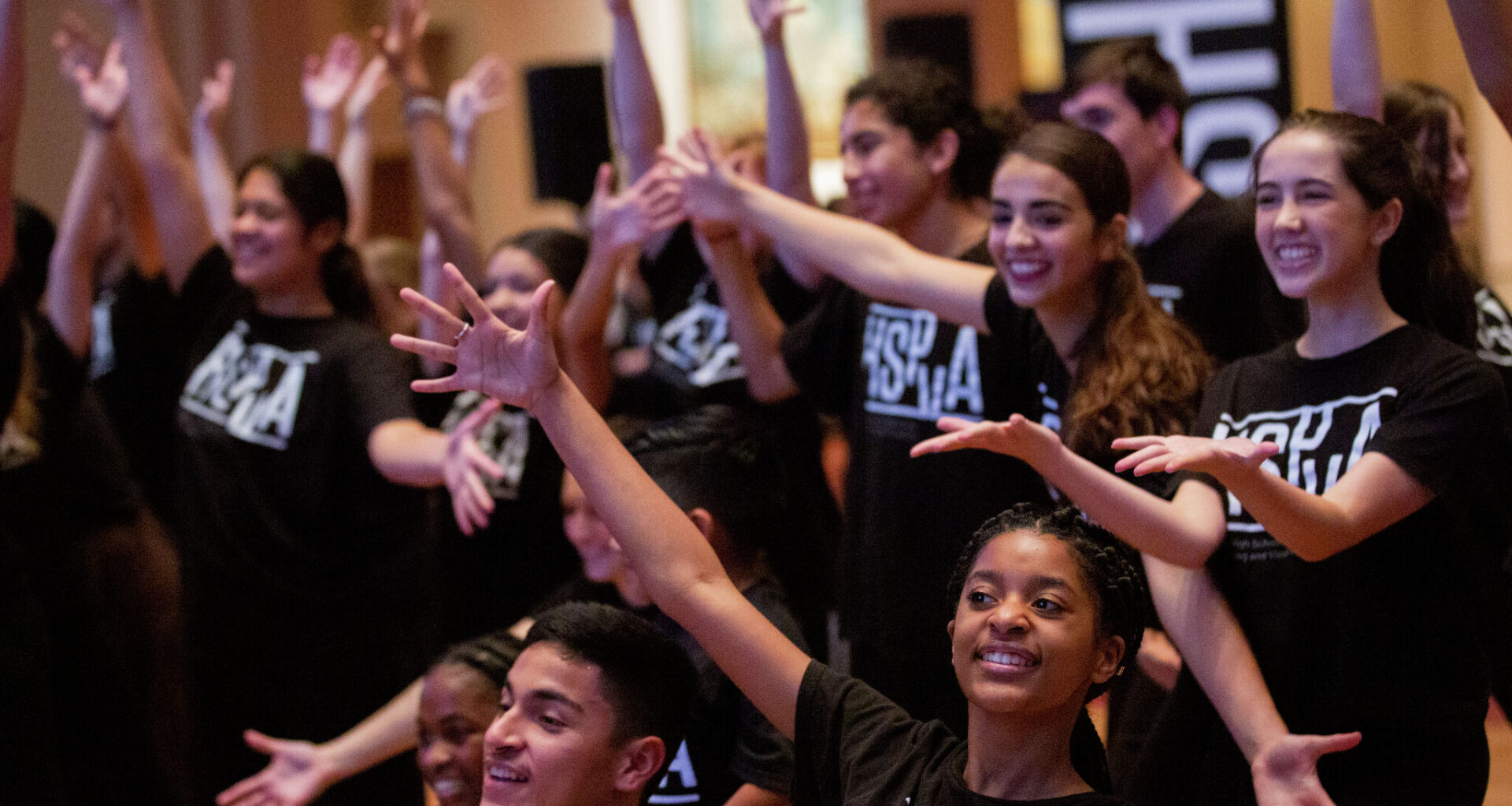
High School for the Performing and Visual Arts students perform at the Wortham Theater Center during the Theater District Open House on Sunday, Aug. 25, 2019, in Houston.
Marie D. De Jesús/Staff photographer
When Houston ISD launched its first magnet school in 1971, leaders pitched the arts as a powerful force for integration, bringing students from different races and neighborhoods together through their talent. At the time, HISD was one of the largest segregated districts in the country.
“There is no better way to integrate the schools than through the arts,” Ruth Denney, who developed and led HSPVA as its first director, told the Houston Post that year. “There is no color line. You’re either good or bad.”
Fifty-five years later, that same campus — Kinder High School for the Performing and Visual Arts — is entering a new chapter under outside management, raising fresh questions about who it will serve and whether it will live up to its original mission of equity.
Article continues below this ad
HISD’s Board of Managers voted this week to hand over day-to-day control of the arts magnet to its longstanding nonprofit booster, HSPVA Friends, under a state law that incentivizes partnerships with outside organizations. State-appointed Superintendent Mike Miles said the new partnership will bring more funding and autonomy to HSPVA and three other top-performing magnets.
While school leaders and some parents welcome that increase in flexibility and resources, the move also introduces uncertainty around admissions, oversight and accountability — especially at a campus long tied to the district’s efforts to create racially diverse, accessible and high-quality schools.
SB 1882: What to know about HISD’s partnership plan for its top-performing schools
Many HSPVA community members — including students, parents, teachers and alumni — say they broadly trust HSPVA Friends to oversee the campus, given their decades-long support. They say they are cautiously optimistic about the partnership due to the additional autonomy the district’s leaders have promised.
Article continues below this ad
Still, for alumni and advocates, the shift raises a central question: whether a school founded to expand opportunity will continue to do so under a new model, or become harder for students of color to access.
“My concern isn’t really necessarily about (HSPVA Friends) as an organization, but more so whether equity commitments are going to be explicit and enforceable in this new structure, not just assumed,” said Denise Ward, president of the HSPVA Black Alumni Network. “HSPVA’s history shows that the school’s equity mission has not necessarily sustained itself on goodwill alone. Anytime that it’s been deprioritized by leadership, we have felt it.”
HISD — which did not respond to a request for comment — has not publicly released the contracts between the district and any of the nonprofit partners, including HSPVA Friends. Under Senate Bill 1882, the nonprofits can change enrollment procedures, but school and nonprofit leaders say that’s not their plan.
NEW PARTNERS: Five nonprofits are seeking to run HISD schools in the 2026-27 year. Here’s what we know about them.
Alene Coggin, executive director of HSPVA Friends, said admission to the school will remain solely based on an audition process that prioritizes talent and an eagerness to grow in an artistic area. She said the campus will remain a tuition-free public school that is open to talented and diverse students through “an equitable admissions process.”
Article continues below this ad
“Keeping the admissions process equitable is a major priority for both HSPVA Friends and Kinder HSPVA’s administration,” Coggin said in a statement to the Houston Chronicle.
Kinder High School for the Performing and Visual Arts is shown in Houston, Wednesday, May 14, 2025.
Melissa Phillip/Houston Chronicle
Tool for desegregation
In the 1970s, HISD faced a controversial court-mandated desegregation order. HSPVA was opened as an experiment, aiming to show that schools could be desegregated voluntarily if there was a “magnet” attracting students and families of different backgrounds to a campus.
According to HSPVA Friends, HSPVA was the first U.S. public school for the arts founded specifically for racial desegregation purposes. The magnet model became a relatively successful formula not just for HISD, but other urban school districts across the country that wanted to desegregate on their own.
Article continues below this ad
Billy Reagan, who became HISD’s superintendent in 1974, launched a massive magnet program at dozens of HISD schools. HSPVA — as well as the DeBakey High School for Health Professions — served as examples of how top magnet schools could serve as tools for desegregation. That magnet program has since expanded to nearly 120 campuses in HISD.
Meredith Richards, an associate professor of education policy at Southern Methodist University, said magnet schools like HSPVA were fairly successful in creating diverse learning environments for their students, but they never quite lived up to their mission of equity.
‘I’M IN FAVOR:’ Some HISD parents want to sidestep Mike Miles’ reforms by letting nonprofits run their schools
“In general, these schools tend to be more white than their surrounding areas, and so they tend to continue to … create these just sort of competitive, prestigious spaces that often, in practice, are sort of hoarding opportunities for those kids — very much not the original goal,” Richards said.
Article continues below this ad
Despite the school’s founding mission, HSPVA’s student body has never fully reflected the racial demographics of its large, urban school district. The campus is currently the most affluent and one of the whitest high schools in HISD, according to state data.
Less than 50% of the school’s current students are Black or Hispanic, and about 20% are low-income, according to district data for the 2025-26 school year. In HISD, more than 80% of students districtwide this year are Black or Hispanic, and more than 75% are low-income.
“I don’t necessarily think it’s even realistic that we would ever go back to a system right where diversity is the explicit target,” Richards said. “I just don’t think that’s going to be politically palatable in a district like (HISD), but I still think it could be a consideration that Friends of HSPVA think about — trying to make sure that at the very least students have the opportunity to attend, even if they may choose not to.”
PRE-K PARTNERS: HISD plans pre-K partnership with childhood education nonprofit for 2026-27
Potential for more outreach?
Bowen Ma, a senior at Kinder High School for the Performing and Visual Arts, performs in Houston, Wednesday, May 14, 2025.
Melissa Phillip/Houston Chronicle
HSPVA is currently one of the most-sought after magnet high schools in Houston. About 1,000 students applied through HISD’s school choice process last year to attend the nationally ranked school, which typically enrolls about 210 freshmen every year.
The school has produced award-winning actors and musicians, including “Grey’s Anatomy” star Chandra Wilson and jazz musician Robert Glasper. Its most famous attendee is undoubtedly Beyoncé, though the mega star left HSPVA and attended Alief ISD until Destiny’s Child took off.
The downtown campus – costing about $90 million with support from the Kinder Foundation – is near Houston’s Theater District. To gain admission, students must audition in fields like dance, visual art or theatre and submit an application through HISD’s school choice portal. The competitive process can prompt some families to hire coaches and tutors to help students land a spot.
Admissions will fall under the purview of HSPVA’s new governing nonprofit, HSPVA Friends. The outside group will also oversee day-to-day operations, and the school could have more flexibility in its curriculum, instructional model, budget, staffing and more.
So far, leaders with the school and the nonprofit say that admissions will not dramatically change. In fact, they think the autonomy under outside management could help them simplify the admissions process and make it more equitable.
“We are committed to preserving everything that already makes HSPVA extraordinary and to helping it grow to meet the needs of future generations of young artists from across HISD,” Janis Jarosz, the chair of the HSPVA Friends’ board of directors, told the HISD school board in March. “SB 1882 gives the school greater autonomy to shape its curriculum while remaining an HISD public school, serving a diverse student population.”
‘WHY SHUT IT DOWN:’ HISD families brace for community upheaval under plan to close 12 schools
Mike Morath, Texas Education Agency commissioner, is shown during a tour of classrooms at the Kinder High School for the Performing and Visual Arts in Houston, Wednesday, May 14, 2025.
Melissa Phillip/Houston Chronicle
HSPVA Friends already has a close relationship with the campus, raising millions of dollars in private support since 1978. Currently, it provides arts supplies, specialized instruments and equipment, production and box office support, and scholarships for students attending summer programs and private lessons. It also pays more than 150 adjunct faculty, artists-in-residence and guest artists to deliver courses.
It remains unclear how much will change at the city’s’s top public arts school under the new partnership.
At a March 19 meeting, board member Janette Garza Lindner said contracts should hold each magnet campus accountable and keep them accessible and equitable for the entire HISD community.
“How will these contracts ensure that schools are accessible to all of our HISD students, and that schools do not cherry pick students in order to maintain their accountability rates?” Garza Lindner said.
At a recent parent meeting, principal Priscilla Rivas tried to quell some concerns. She said HSPVA will continue to be an “in-district school for in-district students,” with admissions still based on auditions and requiring an HISD address.
The “only difference,” Rivas said, was that they could simplify the application process in the future. They also are working on a revised timeline so students who audition can still apply for other HISD options if they are not accepted.
School leaders say HSPVA already works to recruit families from every Houston neighborhood – creating early connections in elementary and middle school – and could expand that outreach under the new partnership.
“Those concerted efforts are still in the works,” Rivas told parents. “In fact, if anything, we might be able to be a little bit more in control of school choice in our audition process, to make it even more accessible, more equitable for our students.”
SCHOOL CHOICE: Houston ISD reports 18% drop in K-12 school choice applicants for 2025-26 year
Hope for transparency, accessibility
HSPVA parent Crystal LaShan said while HSPVA Friends deserves “props” for supporting the school’s curriculum and its mission, she’s concerned whether there will be enough safeguards in place to ensure the nonprofit is equitably serving all students and families.
“I’m really concerned with transparency and making sure that a selected few (aren’t) really making the decisions for the overwhelming majority,” LaShan said.
Mignonne Anderson Goode, a former president of HSPVA’s PTO, said she’s hopeful about the partnership and believes HSPVA Friends is an ideal partner. However, she echoed LaShan’s concerns about the lack of specific information about the partnership, including the admissions process.
“There hasn’t been any transparency, and anytime you don’t know what something is, you have a reason to be concerned,” Anderson Goode, the founding advisor of the HSPVA Black Alumni Network, said. “I mean, we need to know what that (application) process will look like, and that would quell my personal fears, and I think the fears of many.”
Anderson Goode and other HSPVA community members say the nonprofit board should restore HSPVA’s annual school-wide Black history musical, which was canceled this school year in part to create room for college auditions, senior recitals, conferences and competitions.
“We often find that the community partnership that used to be so positive and so spoken of at the school has eroded,” Anderson Goode said. “I’m hoping that (HSPVA Friends) might be able to rekindle that. I don’t know for sure, but that is certainly my hope, because I know how much they have cared for and about the students.”