
It is difficult to put an exact figure on the number of students who have withdrawn from San Antonio public schools because of heightened immigration enforcement, school district leaders and advocates have said.

School districts don’t ask students for their legal status, and families often don’t give a reason when they stop sending their children to school. But there are signs that President Donald Trump’s immigration crackdown is reaching into San Antonio schools and preventing kids from learning.
“We’ve had a lot of our emergent bilingual (students) not show up,” San Antonio Independent School District Superintendent Jaime Aquino said, referring to students who are learning to speak English. “We actually have known places that they’ve been either deported, self-deported or that they’ve told us the kids are here, we’re just not sending them.”
Article continues below this ad
Jaime Aquino, superintendent of San Antonio ISD, addresses students, staff and community members during a meeting at Carvajal Elementary School on Thursday, Jan. 8, 2026, in San Antonio.
Charlie Blalock/Contributor
In North East ISD, district officials reiterated there is “no way to know whether students are leaving due to ICE enforcement.” But officials noted a 7% decrease in emergent bilingual students in one year, from 11,702 in October 2024 to 10,828 in October 2025.
News reports have detailed the high-profile detention and release of Liam Conejo Ramos, a 5-year-old Minnesota boy from Ecuador, and teenage mariachi performers Antonio, Caleb and Joshua Gámez-Cuéllar from McAllen. But those are just a few of an untold number of children that have been held in a federally run family detention center in South Texas.
“I don’t think people realize how many school-age kids are currently detained, whose stories don’t make it to the spotlight. Those are the type of families and the type of students that we’re working with every day,” said Viridiana Carrizales, CEO of ImmSchools, a nonprofit that provides legal representation and support to families affected by the nationwide efforts of U.S. Immigration and Customs Enforcement agents.
Article continues below this ad
School district leaders, largely cautious about discussing how immigration enforcement is affecting their schools, have said the strain of sustained mass arrests and deportations on local classrooms, particularly among Spanish-speaking students, can’t be ignored.
San Antonio ISD, the city’s oldest and third-largest district, has seen a noticeable jump in withdrawals and absences that it attributes to fears related to raids and arrests. Educators describe students who are there one day and gone the next because a family member has been arrested. They have witnessed groups of children staying home from class because of immigration sweeps near campus that provoke fear in the community.
“We do have students who have a parent that has been picked up,” said Alejandra Lopez, president of the San Antonio Alliance of Teachers and Support Personnel, San Antonio ISD’s employee union. “It impacts the student in a really difficult way and the family. In the case of some families, it may be the parent who brings in household income.”
A December 2025 demographic analysis prepared for San Antonio ISD outlines “recent shifts in federal enforcement” resulting in “increased absenteeism, mid-year withdrawals, and lower participation in school-based services in communities with intensified immigration operations.”
Article continues below this ad
The report notes that Edgewood ISD had some 200 students withdraw during a single month in 2025, with leaders in the neighboring West Side district linking the student loss to “high-profile enforcement actions.” Edgewood officials declined a request for an interview.
The SAISD study estimates more than 100,000 “unauthorized immigrants” lived in Bexar County in 2024, including nearly 40,000 parents of minor children and close to 6,000 school-age children.
Local advocates and school officials have said that ICE agents have not entered local schools, but their mere presence in surrounding neighborhoods is often enough to affect school attendance.
The Trump administration reversed a 2011 policy that designated schools, churches and hospitals as “protected areas,” giving federal agents authority to question or detain individuals on campus. Raids and arrests have occurred near schools throughout most of San Antonio, Carrizales said.
Article continues below this ad
“They could come at any time and actually conduct these type of enforcement activities within the school grounds,” she said. “We’re hearing from some parents who are no longer feeling safe driving their kids to school or even having their kids wait for the bus.”
ICE fears ripple through San Antonio classrooms
Some school employees have been emotional after being in contact with teens or young children who’ve suddenly disappeared from school campuses as a result of the increased immigration enforcement.
One SAISD elementary school teacher, who asked not to be named out of fear of being disciplined for speaking publicly without authorization, recalled having “a lot of my students absent one day” after federal agents were “banging on (students’) doors all night at this one apartment complex.
Article continues below this ad
“They were fearful of leaving their apartment because they were so scared someone was going to take them. So they stayed inside for about three or four days,” the elementary teacher said.
SAISD has about 1,600 fewer students than the district thought would show up in the 2025-26 school year. Although school districts don’t track or ask for the legal status of students, the SAISD elementary teacher estimated the heightened ICE enforcement and related fears could account for one-fourth to half of the enrollment deficit.
While many of the San Antonio families affected are from Mexico or Central or South America, some are originally from the Middle East and other regions where refugees have come to the United States and other more developed countries, seeking resettlement, the SAISD teacher said. The instructor described students crying in class after they’d been placed in a shelter while a parent was being held in detention.
The teacher recalled a boy from Syria who made his way to the United States by walking from Guatemala to Texas.
Article continues below this ad
“He was looking at a map and he started naming all the countries in Central America. And I said, ‘How do you know all these countries? ‘ And he said, ‘Because I walked them all.’”
The teacher said it’s upsetting “to think that kids in America are hiding out because they’re nervous to go to school.”
Another San Antonio teacher, who has worked in multiple districts and is trained to provide English as a Second Language (ESL) instruction at a San Antonio-area high school, said she’s lost about 10 students to immigration enforcement in the current school year. Some were high-achieving seniors with plans to attend college on scholarships, only to see those dreams dashed.
The ESL teacher, also requesting anonymity for fear of disciplinary action by administrators, recalled a 10th grader from Guatemala missing class one day, and his family being out of reach by phone. He had picked up the English language quickly and showed promise as a “brilliant” student.
Article continues below this ad
“One of his friends, I pulled him aside and said, ‘Hey, where’s your buddy? I haven’t seen him.’ He told me, ‘His dad was caught by ICE.’ His whole family had to leave. That just broke my heart,” the ESL teacher said.
Another one of the teacher’s students recently withdrew from school.
“Her friends were telling me, she doesn’t have papers and that she’s afraid ICE would get them,” the ESL instructor said. “That’s what happens. They withdraw, they just stop coming. Or they’ve been caught, or a family member has been caught, and they all have to go.”
Adrian Lara, a Madison High School graduate, last year addressed the North East ISD board, urging trustees to recognize the impact of ICE enforcement and provide protections and resources for students.
Article continues below this ad
“Schools should fight to protect their students. If they’re scared from immigration enforcement, they’re not going to want to learn,” said Lara, now a freshman at the University of Texas at San Antonio, in an interview.
A spokesperson with the Department of Homeland Security, the cabinet-level department that oversees ICE, said federal agents have the authority to enter schools — not for the purpose of questioning or detaining children, but to keep them safe.
“ICE is not going to schools to arrest children—we are protecting children,” DHS said in a statement responding to questions from the Express-News. “Criminals are no longer able to hide in America’s schools to avoid arrest. The Trump Administration will not tie the hands of our brave law enforcement and instead trusts them to use common sense.”
DHS bluntly denounced claims that ICE had increased activity around schools as misinformation. Agency officials called claims that ICE was raiding schools “garbage” from “sanctuary politicians.”
Article continues below this ad
Children, part of a Cuban family detained ICE along with their mother, are placed on a bus contracted by immigration enforcement for transport to an ICE detention center. The family was taken into custody outside of the federal immigration courts in San Antonio on Tues, Jun 11, 2025.
Christopher Lee/Staff Photographer
Schools grapple with federal enforcement efforts
When immigration law and policies change, districts are often left to interpret the updates on their own.
After the federal government reversed a policy in January 2025 that gave special “protected” status to schools, the Mexican American Legislative Caucus asked Texas Education Commissioner Mike Morath to preserve legal educational rights for “roughly 111,000” undocumented children attending Texas public schools.
Article continues below this ad
The 25 legislators who signed onto the letter, including five from San Antonio, requested Texas Education Agency guidance for districts on federal limits on access to student records; protocols for ICE actions on campuses; and trauma-informed support “to help students cope with the fear and anxiety that ICE presence may cause.”
Morath replied days later with a three-paragraph letter saying school employees with any uncertainty when confronted by law enforcement authorities “should ask their administrators or in-house legal counsel” but “must not impede federal officials.”
Paige Duggins-Clay, chief legal analyst with the San Antonio-based nonprofit Intercultural Development Research Association, which strives for equal educational opportunity through public schools, said Gov. Greg Abbott and other state leaders have said “schools should be cooperating with law enforcement at every level.”
“TEA’s MO lately is to sort of lay behind the log and leave school districts to figure this out on their own,” Duggins-Clay said.
Article continues below this ad
TEA did not respond to a request for comment on Duggins-Clay’s critique of the agency’s response.
SAISD’s protocol regarding ICE on campus is “really tight,” Aquino, the SAISD superintendent, said. Principals and front office staff members have been trained to ask ICE agents to show a judicial warrant and to notify a deputy superintendent and legal counsel to verify the document, in compliance with state and federal laws.
“Fortunately we have not had that,” Aquino said of ICE officers attempting to enter a campus. “They could threaten and say, ‘We want to walk in.’ And we would not allow them, just like we don’t allow any parent to walk in to our school, into a classroom.”
Northside ISD’s policy for access by law enforcement officials to question or interview a student at school starts with initial verification by a campus administrator or district police officer of the official’s identity and reason for the visit. Parents or caregivers are notified through “all reasonable efforts” by a principal or administrator. A “district designee” is present during questioning, unless the interviewer provides a “valid legal objection.”
Article continues below this ad
Northside has not had a campus visit by ICE officials and has not documented any absences or withdrawals as a known result of immigration enforcement, district spokesman Barry Perez said.
North East ISD officials echoed the other districts, saying ICE agents attempting to come onto campus would be treated in the same manner as any other law enforcement agency.
“That means, they are not permitted onto the campus unless they have a signed arrest warrant for a specific individual,” NEISD spokesperson Aubrey Mika Chancellor said.
Many schools in Texas have protocols for ICE agents entering a school, “though it is our position that should never be the case unless there is actual evidence of criminal activity or threats of harm,” Duggins-Clay with IDRA said.
Article continues below this ad
A student’s right to an education
Just last week, Stephen Miller, President Trump’s immigration adviser, asked state Republican lawmakers why they had not ended public education funding for undocumented children, according to reporting from the New York Times.
Doing so would challenge a child’s constitutional right to an education, regardless of their legal status, which was established nearly half a century ago by the U.S. Supreme Court. In the 1982 landmark Plyler v. Doe case, the U.S. Supreme Court struck down a 1975 Texas statute denying education funding for undocumented children and a Tyler ISD policy to charge an annual $1,000 tuition for each undocumented student.
In its 5-4 decision, the court ruled the statute violated Fourteenth Amendment equal protection provisions and “does not comport with fundamental conceptions of justice.”
Article continues below this ad
WASHINGTON, DC – MARCH 27: White House deputy chief of staff Stephen Miller speaks during a Fraud Task Force meeting in the Indian Treaty Room at the White House on March 27, 2026 in Washington, DC. Vice President JD Vance held the Fraud Task Force Meeting with aims to reduce federal spending by identifying misuse of federal funds. (Photo by Heather Diehl/Getty Images)
Heather Diehl/Getty Images
Duggins-Clay said the Plyler ruling has been reaffirmed many times, with some of its principles enforced through the 1974 Equal Education Opportunities Act, which prohibits states from denying equal educational opportunities to individuals based on race, color, sex or national origin.
“The Supreme Court in that case said no,” Duggins-Clay said. “It’s not fair to young people who have no culpability in the decisions of their parents, that the reality is that the ability to access education is so fundamentally important to a child’s development, well-being and future, in addition to our nation’s future and development, our economy and having an educated populace.”
Gov. Abbott, arguing that educating undocumented children creates unsustainable costs for Texas taxpayers, said during a 2022 radio talk show that he may challenge the Plyler ruling and seek to reinstate the 1975 law.
Article continues below this ad
Reached for comment this month, Abbott’s office said it’s still working four years later to overturn court rulings the governor feels are unjust.
“In 1982, a liberal Supreme Court majority ruled that Texas must provide free public education to children of illegal immigrants, forcing American taxpayers to subsidize those with no legal right to be here,” Abbott press secretary Andrew Mahaleris said. “American citizens should be first in line for government services and not forced to bear the costs of supporting those whose entry into this country began with breaking its laws.”
Mahaleris characterized policies like the one providing free public education for students without legal status as “magnets for illegal immigration.”
Conservative Texas House lawmakers filed bills last year that would deny undocumented children access to public education, requiring students to provide proof of citizenship or legal status to enroll. Districts would have to report children who do not meet the requirement. Those bills did not pass.
Article continues below this ad
‘We don’t want to have empty classrooms’
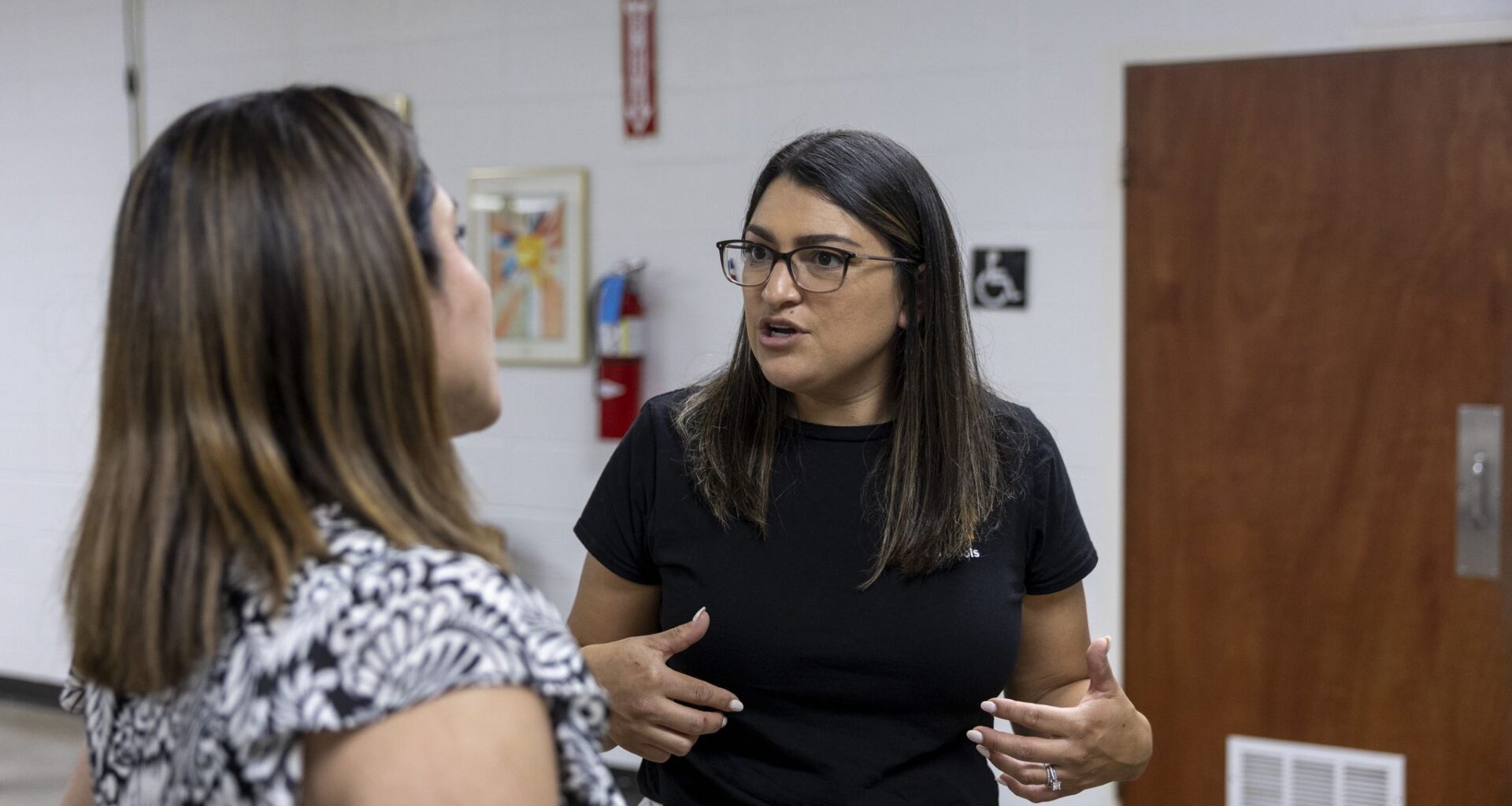
Viridiana Carrizales, right, speaks with Esmeralda Alday at their ImmSchools office at the Family Service Neighborhood Place in the San Antonio’s Westside neighborhood Monday, March 23, 2026. Carrizales co-founded ImmSchools as an educational resource for undocumented families.
Andrew J. Whitaker/San Antonio Express-News
As fear rises about immigration enforcement in San Antonio, ImmSchools and other advocate groups are working to hold “Know Your Rights” sessions virtually or in small groups to help families who could potentially be targeted by ICE.
“It’s a very complicated and sensitive situation right now,” Carrizales said. “We try to center our conversation with school districts and remind them that ultimately, federal protections and the Constitution are above everything. We cannot be in a position where our kids are afraid to come to our schools.”
Article continues below this ad
Carrizales knows what it is like to be a student in fear of disclosing their immigration status. She grew up in Mexico, then attended public schools in Dallas starting at age 11.
“I learned very early on not to share my status with anybody. I didn’t understand why exactly, but I trusted my parents and never really shared much about it,” she said.
She was a high school senior applying for college when a counselor put her “in contact with immigration officials” who asked for her Social Security number.
“I remember being very afraid as I was talking to people that were asking me questions that I didn’t have the answer to. That’s when I realized it doesn’t matter what my grades are; it doesn’t matter that I’m one of the top students in my school; it matters that I don’t have this nine-digit number,” said Carrizales, who attended the University of Texas at Austin, got a bachelor’s degree in Spanish literature and communications and became a naturalized U.S. citizen in 2016.
Article continues below this ad
In 2018, she co-founded ImmSchools, which partners with school systems in Texas, New York, New Jersey and Pennsylvania to create safe, welcoming campuses to meet the needs of K-12 immigrant students, their families and educators. She operates out of an office on San Antonio’s West Side.
“We hear constantly from teachers or from principals who almost on a weekly basis let us know, ‘OK, now I’ve lost two kids. This morning, there’s another empty desk; another family who maybe had a member detained, and then the family’s making the tough decision to all go back to their home country,” Carrizales said.
Aside from lost state revenue for school districts, the increased enforcement lays waste to students’ aspirations and prevents them from contributing to society, she said.
“We don’t want to have empty classrooms because we know that when we push kids out of schools, it’s not just them who lose. We all lose, and it affects all of us,” Carrizales said.
Article continues below this ad
Duggins-Clay recommends schools, parents, caregivers and other community members explore different options to keep kids in school during a “scary time,” such as adding names of friends, neighbors and other trusted adults authorized to pick up a child after school.
“Sometimes, you just need to pick up the phone and reach out to a family and say, ‘I noticed Johnny’s not coming to school today. What’s going on? How can we help?’ That kind of outreach, though it feels really small, can be the start of creating a strategy to get a kid back in school despite this really harmful climate,” she said.
There have been some successes amid the upheaval, Carrizales said.
Article continues below this ad
A San Antonio high school student detained while delivering food after school a year ago was held in detention for over two months. With legal assistance provided by ImmSchools, he was released a week before graduation. He’s now attending Texas A&M University-San Antonio.
“This is a kid within the top 5% of his class. We should not be having kids in detention centers. We should be having them in classrooms, graduating,” she said.
Esmeralda Alday, left, and Viridiana Carrizales of ImmSchools walk the hallway near their office at the Family Service Neighborhood Place in the San Antonio’s Westside neighborhood Monday, March 23, 2026. Carrizales co-founded ImmSchools as an educational resource for undocumented families.
Andrew J. Whitaker/San Antonio Express-News