
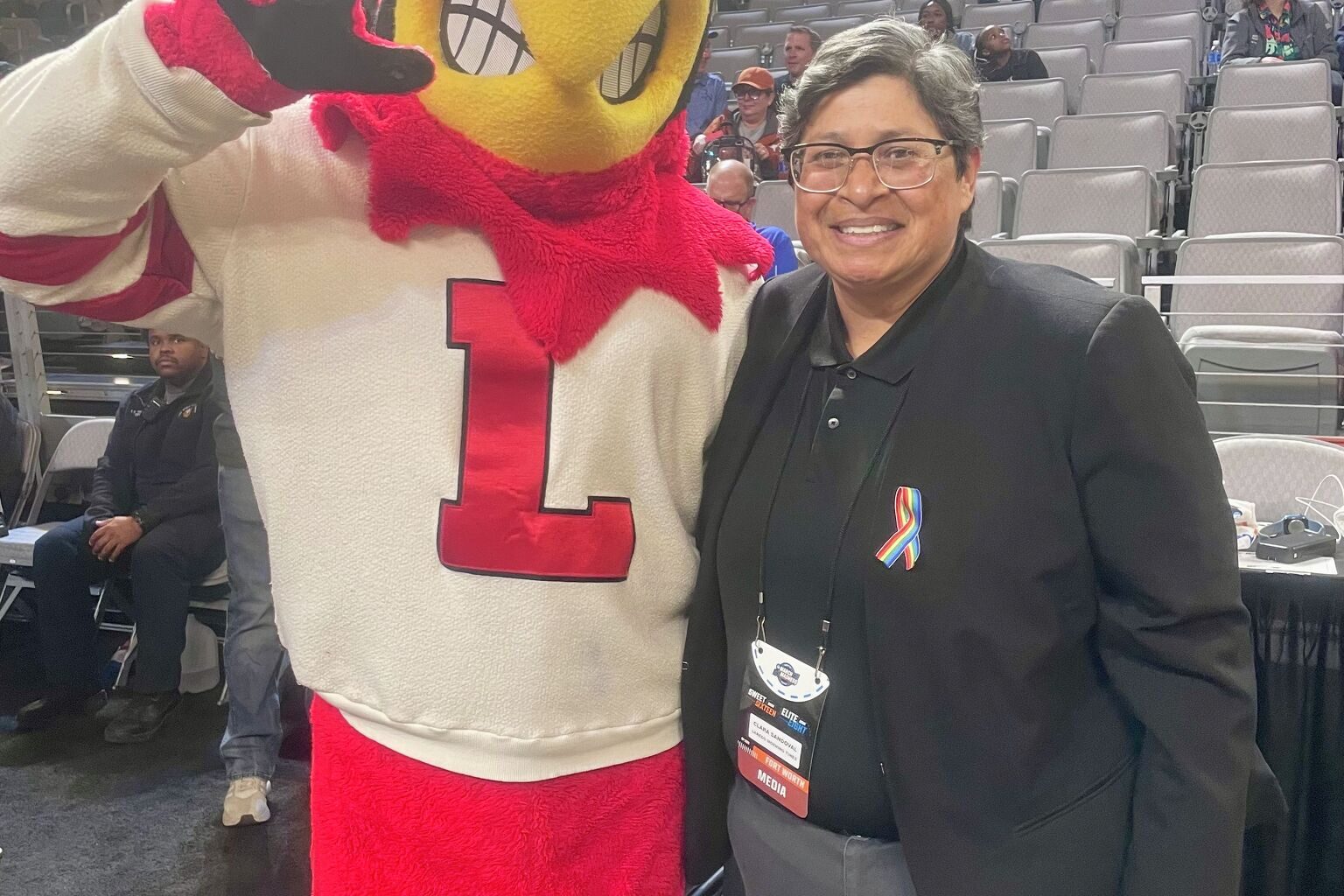
LMT’s Clara Sandoval at the Sweet 16 and Elite Eight in Fort Worth.
Clara Sandoval/Laredo Morning Times
In basketball, there are certain moments you don’t just cover—you chase them. For me, those moments have always lived on a personal bucket list, the kind that quietly fuels a career in sports journalism. Over the years, I’ve been fortunate enough to check off some of the biggest stages the game of basketball has to offer. NBA game? Check. WNBA game? Check. NCAA Division I Women’s and Men’s Final Fours? Both checked. Even the NBA Finals found their way onto that list.

But one experience kept slipping through my fingers—the Sweet 16 and Elite Eight rounds of the NCAA Tournament. There’s something different about that stage. It’s where pressure sharpens, stars emerge, and seasons either validate themselves or fall apart. It’s not just basketball—it’s survival.
Article continues below this ad
So, when I saw that Fort Worth would host those rounds, it wasn’t just an opportunity—it was a necessity.
Over two days, I wasn’t just watching games—I was witnessing the essence of March Madness. Notre Dame and Vanderbilt set the tone with a battle that felt more like a statement than an opener. Hannah Hidalgo didn’t just play well—she took over in a way that defines greatness in March. A triple-double with 31 points, 11 rebounds, and 10 steals isn’t just a stat line—it’s a moment. Add in a single-season steals record, and you start to understand how legacies are built this time of year.
Article continues below this ad
Then there’s UConn—because, of course, there’s UConn. Programs like that don’t just win; they impose their identity. North Carolina hung around early, but it never felt sustainable. Once UConn settled in, the game followed a familiar script. That’s what championship DNA looks like—it doesn’t panic, it doesn’t rush, it simply takes over.
Day two brought a different kind of narrative. Michigan’s comeback against Louisville wasn’t just about erasing a deficit—it was about resilience. Falling behind by 11 and then turning that into a 19-point win says everything about composure and adjustments. Olivia Olsen’s 19 points led the charge, but the story was bigger than any one player—it was about response.
And then there was Texas.
Article continues below this ad
From the moment the bracket was announced, that was the game I had circled. Not just because of the matchup, but because of familiarity. I’ve seen this Texas team up close multiple times this season—even as far as Las Vegas—and what stood out then still holds true now: this is a team built for March.
They don’t just win—they control games.
From early-season statement wins over UCLA and South Carolina to grinding out tough victories like the one against Ole Miss, Texas has consistently shown an ability to adapt. By the time they reached the Sweet 16, they weren’t just playing well—they were playing with purpose.
And against Kentucky, that purpose was undeniable.
Article continues below this ad
A 76-54 win doesn’t just send you to the Elite Eight—it sends a message. Texas didn’t just beat Kentucky; they overwhelmed them. It was execution, depth, and confidence all rolled into one. Having already beaten Kentucky in the regular season, this felt less like a rematch and more like a confirmation of who they are.
That’s what made the experience so meaningful.
This wasn’t just another box checked on a list—it was a reminder of why the list exists in the first place. The Sweet 16 isn’t just about getting closer to a championship; it’s about seeing teams at their most complete, their most desperate, and their most real.
Article continues below this ad
After years of chasing this moment, it lived up to everything I thought it would be—and maybe even a little more. Thank you, March Madness, for the four wonderful Sweet 16 games I was able to cover this weekend. Next year, I will be chasing the Men’s Sweet 16 games, which will be played in San Antonio.