
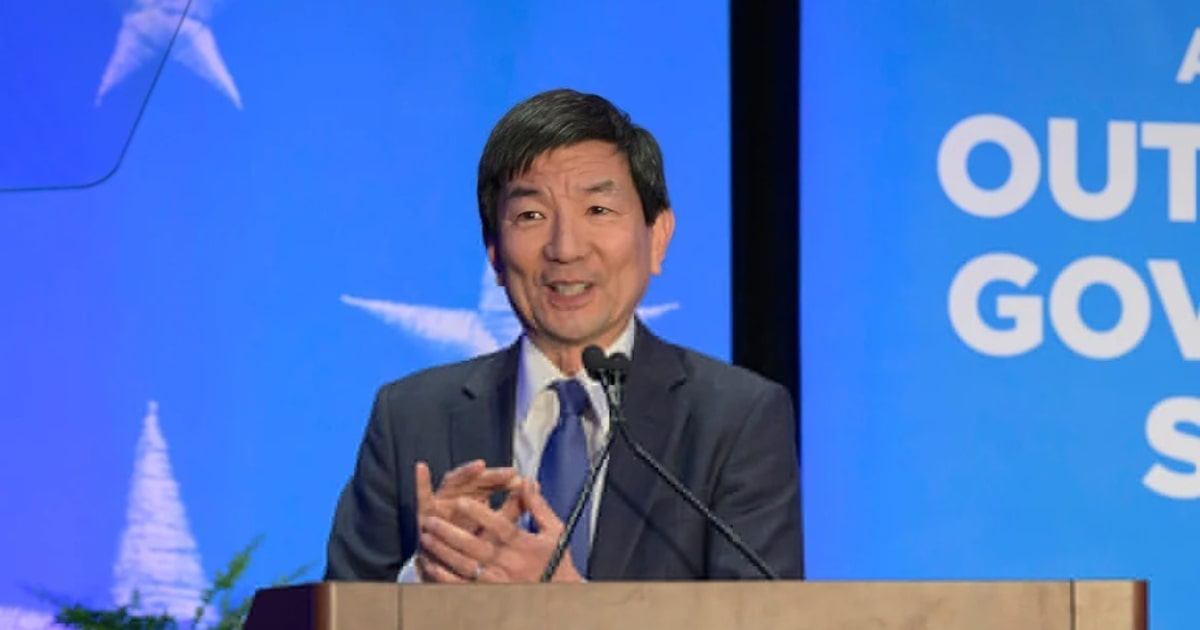
Earlier this year, the Dallas County public health director won a national award for his work.
Dr. Philip Huang won an American Medical Association Award for Outstanding Government Service, highlighting his work on chronic disease, HIV and data modernization.
Huang has been the director of Dallas County Health and Human Services since 2019, and he saw the county through the uncertain early days of the pandemic. Before the move to Dallas, Huang spent more than a decade as the Austin Public Health’s medical director. He also previously worked for the Texas Department of State Health Services, leading the charge in the fight against tobacco and secondhand smoke.
After he received the national award, Huang talked to The Dallas Morning News about his career, why he thinks business leaders should care about public health and what could be the next big public health topics.
Business Briefing
This phone conversation was edited for length, clarity and readability.
Question: Would you be able to talk a little bit about a project or an initiative that you’re particularly proud of from your time in Dallas over the past six years or so?
Huang: With respect to HIV, when I first got here, we talked to community partners about this fast track, county/city effort to end the HIV epidemic. … There’s a Paris Declaration to end the HIV epidemic that Judge [Clay] Jenkins signed and some of the other mayors. It’s a real comprehensive community approach to addressing HIV.
The goals are 90/90/90: 90% of persons know their HIV status, 90% of those persons are on sustained treatment, 90% of those persons are virally suppressed. And I think now we’ve moved them up to 95%, to achieve those goals by 2030.
People can have normal, full lives with HIV. Still, even though it’s treatable, it’s a huge impact on people’s lives. So that’s certainly one effort that has been really important.
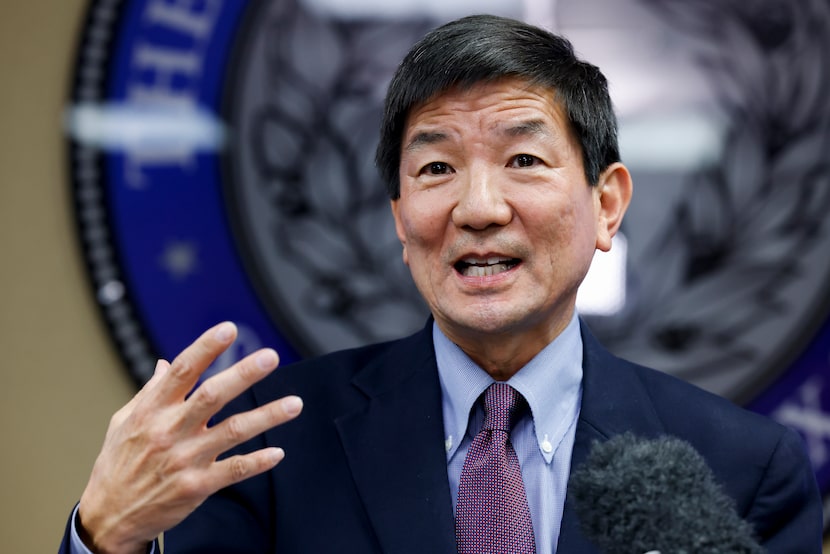
Director of Dallas County Health and Human Services Philip Huang speaks during a press conference updating on Dallas County’s COVID-19 response on Friday, April 22, 2022 at Dallas County Homeland Security and Emergency Management in Dallas.
Shafkat Anowar / Staff Photographer
The other thing is that, before I came here, there was no chronic disease programming per se at the health department. It was very much focused on infectious diseases and communicable diseases. We’ve really developed that. That’s heart disease, cancer, stroke, and diabetes. And the main risk factors are tobacco use, physical activity, nutrition, obesity. All of those things are just so important for improving health.
And then another final one. Since COVID, we’ve really been doing a lot with data modernization. At the beginning of COVID, we literally had stacks and stacks of lab reports (with workers) manually entering that data into spreadsheets.
We’ve really come a long way and invested a lot to modernize our systems … to get a more real-time picture of what’s going on with all of these conditions.
Q: DCHHS has released reports on the economic impact of HIV. For a business audience, can you talk about how public health measures can impact a community’s economic outlook? Why should business leaders care about public health?
Huang: It’s multiple factors for business leaders. Something like HIV, you get one new diagnosis and just that one diagnosis can be $420,000 — now almost $500,000 — worth of lifetime economic cost.
But also from a business standpoint, this is the health of your employees. The absenteeism, the impact that can have. Look at COVID just as an example. How did that impact the business community? In so many ways.
We can put these minimal and predictable investments in prevention and health, versus if you don’t do that, then you’re really subject to potential huge costs.
Q: Are there ways that you hope business leaders will partner with public health for any of this work?
Huang: Absolutely. It’s working with all of our community partners, because that’s how we address the issues collectively.
I spent a lot of my early years working on tobacco use. Changing those policies to protect people from exposure to secondhand smoke, that’s a great example. Those policies that were put in place by business leaders, policies that made such an impact on the behaviors. It’s a public health win that I don’t know that people think about or appreciate.
They used to allow smoking on airplanes. Were you ever on an airplane that allowed smoking?
No, I wasn’t. I do remember smoking sections in restaurants, but not on airplanes.
At the time, it seemed so radical. They were saying, ‘Oh, you’re not going to be able to do this. Smokers aren’t going to be able to be without their cigarettes for hours on end. They’re going to be lighting up in the airplane bathroom. Planes are going to be catching on fire and crashing and burning.’
And now we can’t imagine — and there’s a whole generation of people who can’t even imagine it — allowing smoking in an airplane.
And same with restaurants and bars.
I remember the Austin hearing when we were considering smoke-free restaurants. It went until after midnight, because all the restaurant owners were lined up to testify and say, ‘Please don’t do this. We’re going to go out of business.’
That’s one of the studies that I worked on, is looking at some of the sales tax revenue from the comptroller’s office, looking at restaurant revenues before and after communities went smoke-free. And it did not adversely impact them. That’s what we’ve seen, it doesn’t push people out of business.
It’s working with business owners on these sorts of things. They’re a key part of making our communities healthy.
Q: It really is hard to imagine having a smoking section on an airplane now. I’m curious, are there any public health changes happening now that you think we’ll look back on in 20, 30, 40 years and we’ll have a hard time imagining that it was ever the way it is now?
Huang: I’m sure there are. I’m trying to think of which ones. Who knows? [Laughs] I can’t predict that.
There’s so many crazy things that are done, that are risky behavior or make you wonder, ‘How will people look at that in the future?’ Maybe people will say, ‘Wow. Can you believe people used to drive their own cars?’
It’s hard to imagine, but I’m sure there are things like that.