
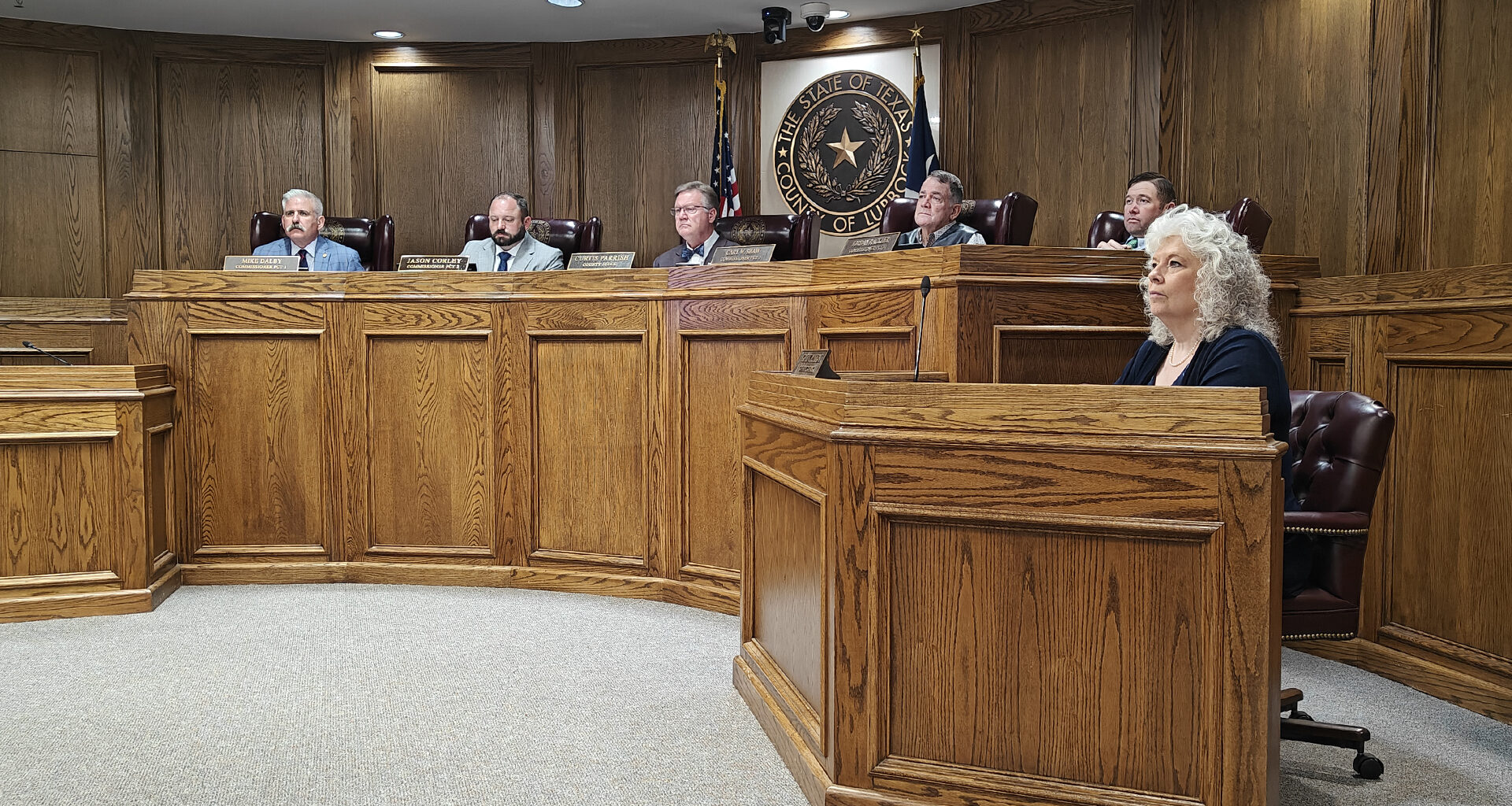
Four county commissioners are upset with County Auditor Kathy Williams and she’s “miffed” with their criticisms after an audit released last week shows Lubbock County finished the 2024-25 budget year in excellent financial shape.
This began in late summer 2024 when commissioners Jason Corley and Jordan Rackler walked out of budget hearings to force a no-new-revenue rate (which we covered here). Forecasts from Williams said the county would have to spend $7 million from reserves to make it through the year.
By the end of the year, the county added nearly $3 million to reserves instead of withdrawing $7 million.
It led to a war of words.
Commissioners Michael Dalby, Cary Shaw and Rackler – are “upset” with Williams. A fourth, Corley, stopped trusting what he’s been told. County Judge Curtis Parrish has been supportive of Williams.
Williams told LubbockLights.com, “They’re angry? I’m angry. I got a good audit report. I have a good budget. And because they decided to walk out, then now my stuff is in question? No, sir. No.”
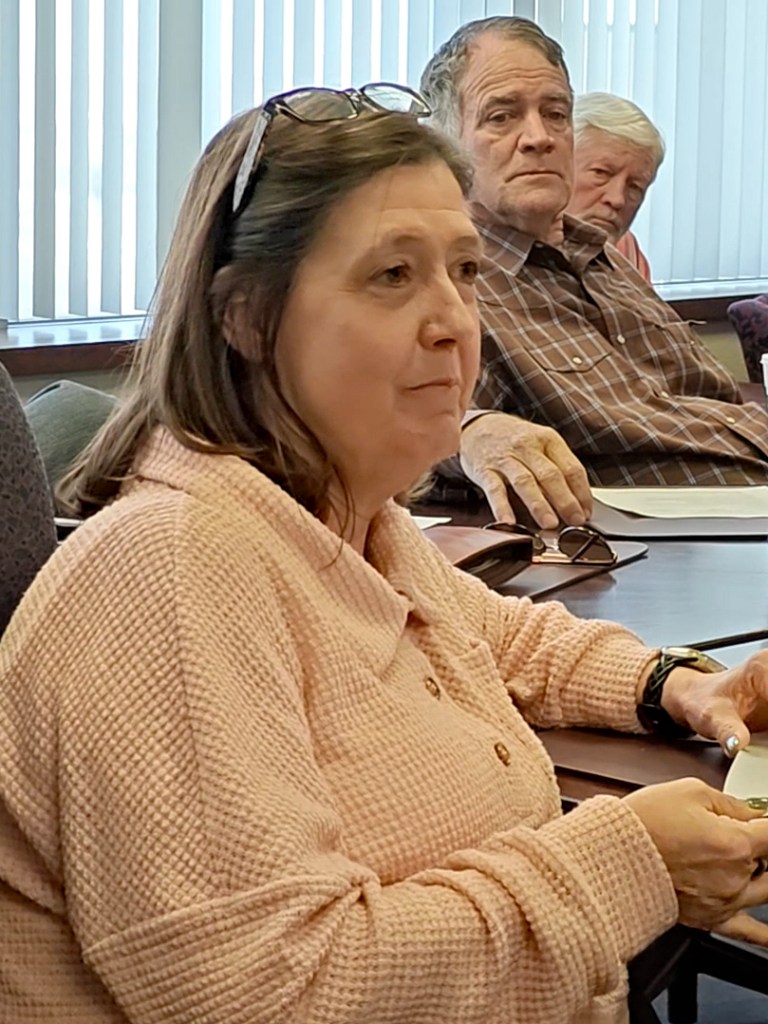 Kathy Williams (foreground) with Cary Shaw and Eddie McBride (background) during a March 2026 meeting of the Local Government Corporation. Credit: Staff photo.
Part of the disagreement between commissioners and the auditor is using some numbers that fluctuate during the year – investments are one example. They also disagree on how property taxes are figured under a no-new-revenue rate.
Shaw said, “I went to the board of judges [which appoints the auditor] after our meeting [with Williams and the outside audit firm in February] … because our auditor made a statement in that meeting that she underestimates investments intentionally because if she didn’t, we’d want to spend it every year. That’s not her job. Her job is to tell us how much money we have available to do the work.”
When asked if his complaint was in writing, Shaw explained it was a verbal complaint to one of the district judges – not in writing.
Rackler said, “When you’re trying to figure out a budget and not be wasteful of taxpayers’ dollars, I believe you should put all funds that go into the equation as possible income.”
Williams responded, saying, “If I was to budget $6 million the last couple of years as recurring [investment] revenue, we would be spending that in salaries and new hires. And then I’d have to take it back when the economy does not meet that expectation.”
Shaw asked, “If we can’t rely on her to get accurate numbers, then what are we supposed to do?”
Williams took issue with that – especially on property tax revenue. She emphatically said she accurately projected the numbers.
“I budgeted $109,732,000. We received $109,087,000. So, that’s a difference of $645,000. That’s pretty close,” Williams said of the less than 1 percent difference.
Corley said, “I’ve done this for so long that I’ve heard all these lies, and I don’t even look at the numbers. I just look at people’s eyes when they tell me what they’re trying to do. And that’s how I know if they’re telling the truth or not.”
By the numbers
The county did better than expected in the months after budget meetings in late summer 2024. The outside audit showed the county added almost $3 million to its reserves instead of taking out $7 million – a $10 million difference.
The sheriff spent $2.4 million less than budgeted.
The IT department spent $1.8 million less than budgeted.
The county received nearly $6 million of investment income not budgeted in advance, Williams told LubbockLights.com in her interview.
The county had other good financial results, not connected to the disagreements between commissioners and Williams.
The county’s “net position” – when all the income, expenses, assets, debts and liabilities are considered – was $50 million better at the end of the 24/25 budget year than the previous year.
Much of the increase in net position was expected, for example, the county making payments on debts and receiving a $10 million grant for the Texas Anti-Gang Center building.
Unrestricted cash and investments went up $330,000 during the fiscal year – ending at $44.2 million. The unassigned fund balance (what most people would call “reserves”) ended at $58.4 million – an increase of $2.7 million.
Property tax revenue was up $4.8 million.
What this means going forward
For Dalby, the problem wasn’t the numbers. It was the surprise.
“When we got this presentation, I was a little shocked. You probably could have picked my jaw up off the floor. And I was pleasantly surprised. I was happy with what I saw. And, you know, we’ll push forward with the no-new-revenue rate seeing as how the county is in much better financial shape than what we thought,” Dalby said.
The current budget (2025-26) did not include employee pay raises because county departments were told to cut back.
“You could have done employee raises. You could have funded a couple things that we thought that we could not fund. And is that frustrating? Yes, it’s frustrating,” he said.
Dalby wants to restore funding for volunteer firefighters, do more road maintenance and revisit employee pay.
“According to the State of Texas, … JPs [justices of the peace] and the constables have to come out of the courthouse and move to their respective precincts,” Dalby said.
Dalby called it a massive budget impact in the next few years. In addition to that, the county has several buildings like 916 Main Street needing renovation or repair.
Fight about property taxes
Commissioners were happy the outside audit found an increase of more than $4.8 million in property tax revenue.
But they were not happy to have been told during budget negotiations that the no-new-revenue rate literally means no new revenue regardless of new construction.
Shaw looked into the issue, saying both Williams and Parrish are wrong about the benefit of new construction on the tax rolls when the no-new-revenue rate is adopted.
“A county that’s growing should be able to live off of new growth. And so no-new-revenue with new construction should finance the new growth,” Shaw said.
Williams said, “When you’re doing the calculations for the no-new-revenue rate, they identify what the new construction is, and then they subtract it from your current year total taxable value.”
“I have always said that we’re a growing county, and we can’t make it on the no-new-revenue rate,” Williams added.
Corley disagreed.
“You can run Lubbock County on the no-new-revenue rate, and this is proof. … I cannot tell you how many people have called me and said, ‘Just don’t raise my taxes,’” Corley said.
How does the no-new-revenue rate work?
According to state law: The no-new-revenue tax rate will raise the same amount of property tax revenue from the same properties in both the preceding tax year and the current tax year.
Williams provided a copy of the simplified math formula to LubbockLights.com – which comes from the Texas Comptroller’s office. When we plugged in the 2024/25 numbers for Lubbock County in a spreadsheet, the formula showed new construction adds to the total revenue.
The simplified formula did not take into account agricultural exemptions, homestead exemptions, tax ceilings, tax increment finance districts or other details.
‘We didn’t fund out of reserves’
Rackler said he took a took a lot of criticism for the walkout – amid public claims he was spending down the reserves by insisting on the no-new-revenue rate.
“We didn’t fund out of the reserves,” Rackler said.
“In the long run, we ended up with more money left than we were told we were going to have. And we did not use a penny out of the reserves to fund the 24/25 budget – which was a walkout. … I do believe that it was the right thing to do.” Rackler said.
Corley said, “It didn’t hurt anything. The county’s still running. Everything’s fine.”
Shaw said, “After being told the doom and gloom – we’re borrowing our kids into oblivion – we did not have to … transfer anything from reserves.”
Dalby said it will be harder to persuade him the county doesn’t have enough money in future budget talks.
“Yeah, 100 percent, because, if I go to the mat for a certain tax rate or a certain philosophy moving forward, I want to know that the numbers are close,” Dalby said.
Asked if this circumstance damages the credibility of the auditor, Corley answered, “Yeah. Yeah, it does. But there’s a lot of stuff that I’ve been told over the years that I didn’t believe in the first place.”
Parrish praises and defends Williams
We reached out to County Judge Curtis Parrish, but he was out of town. However, he had high praise for Williams and her staff when the outside audit was released during a commissioners meeting.
“I just want to commend … Kathy [Williams] and the entire staff who are sitting here with us today for the job that they do,” Parrish said.
“Our auditor’s office is known now nationally and even internationally as being one of the best accounting offices for a governmental entity in the entire nation. I want you to let that soak in for just a second. We get national awards, not just state awards,” Parrish said.
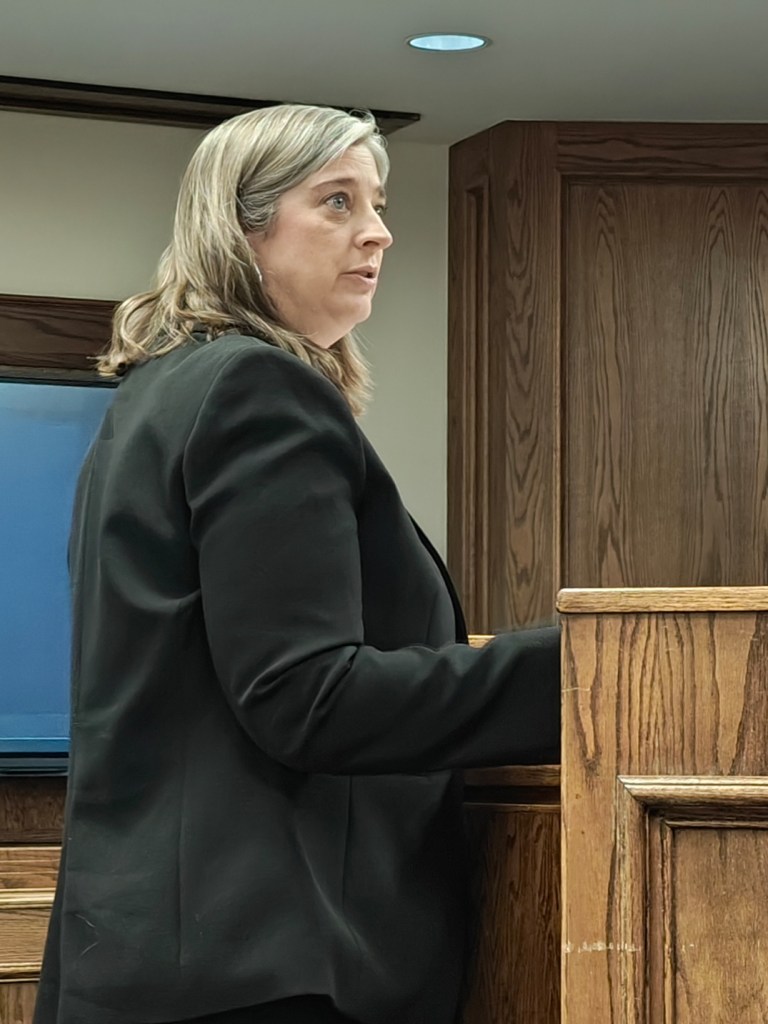 Kristy Frye presents an audit to the Lubbock County Commissioners Court. Credit: Staff photo.
Kristy Frye, a partner with Bolinger Segars Gilbert and Moss, which did the outside audit, said they found no problems with their annual review, the county was in good shape financially – better than expected.
“There were no reported findings. No questioned costs, no evidence of concern in there. So, yes, everything’s good. … It’s the best report that we can render,” Frye said during the most recent Commissioners Court meeting.
Parrish said the task gets harder all the time.
“For some reason, there’s people in Washington and Austin that feel like they have to justify their jobs by giving us new things that we have to do,” Parrish said.
“It is a constant moving target for Kathy and the staff to keep up with all the new stuff or changes that are coming in. … I’m very proud of the work that you guys do and I don’t think we praise you enough and thank you enough for what you do,” Parrish said with Williams listening just a few feet away.
“It is the best. It is the gold standard or even the platinum standard when it comes to what we do here in Lubbock County – as far as taking care of the people’s money,” Parrish added.
Williams said, “Of course I agree that we have an award-winning office. We work really hard.”
Auditor plays a constitutional role
According to the Texas Association of County Auditors, the auditor is the “fiscal officer … with oversight responsibility of all financial books and records of all county offices.”
The association website said, “The Local Government Code dictates, ‘The county auditor shall see to the strict enforcement of the law governing county finances.’”
“Both the county auditor and Commissioners Court are required, by law, to approve or reject claims for disbursement of county funds. Simply put, the integrity of county financial administration is entrusted to a dual control system of ‘checks and balances.’”
The auditor is not chosen by the Commissioners Court but instead appointed by a panel of state district judges.
The press conference
In February, Shaw and Rackler talked to the local news media even though the audit was not yet officially released to the public.
Rackler talked to Williams before contacting the media.
“She wasn’t in a very good mood because I told her I was fixing to make it public. … It’s information that the taxpayers of Lubbock County need to know. I think people need to know that we are not pulling money out of reserves,” Rackler said.
Shaw said, “This information was public information anyway. Anybody could have had it. And I don’t know why it would be a secret.”
Williams thought they missed the point.
“They have not come and asked me why I thought the press conference was wrong, why I thought it was misleading,” Williams said.
“Do you have recurring revenue to give pay raises? And the answer was no. Okay. Do you have recurring revenue to hire new sheriff deputies? And the answer was no,” Williams said.
And that was the point. She said her projections were dependable.
“I don’t understand why you get a good audit report, and the focus is on your budget, which also is not bad, but I guess that’s politics,” Williams said.
Add to that her sense of frustration with the negotiations leading to the 2024/25 budget.
“Elected officials say things that they know aren’t true. It was a very difficult year. And it was not productive in my opinion,” Williams said.
Although there was not a walkout this most recent cycle, negotiations for 2025/26 were not any easier.

Related

Related posts