
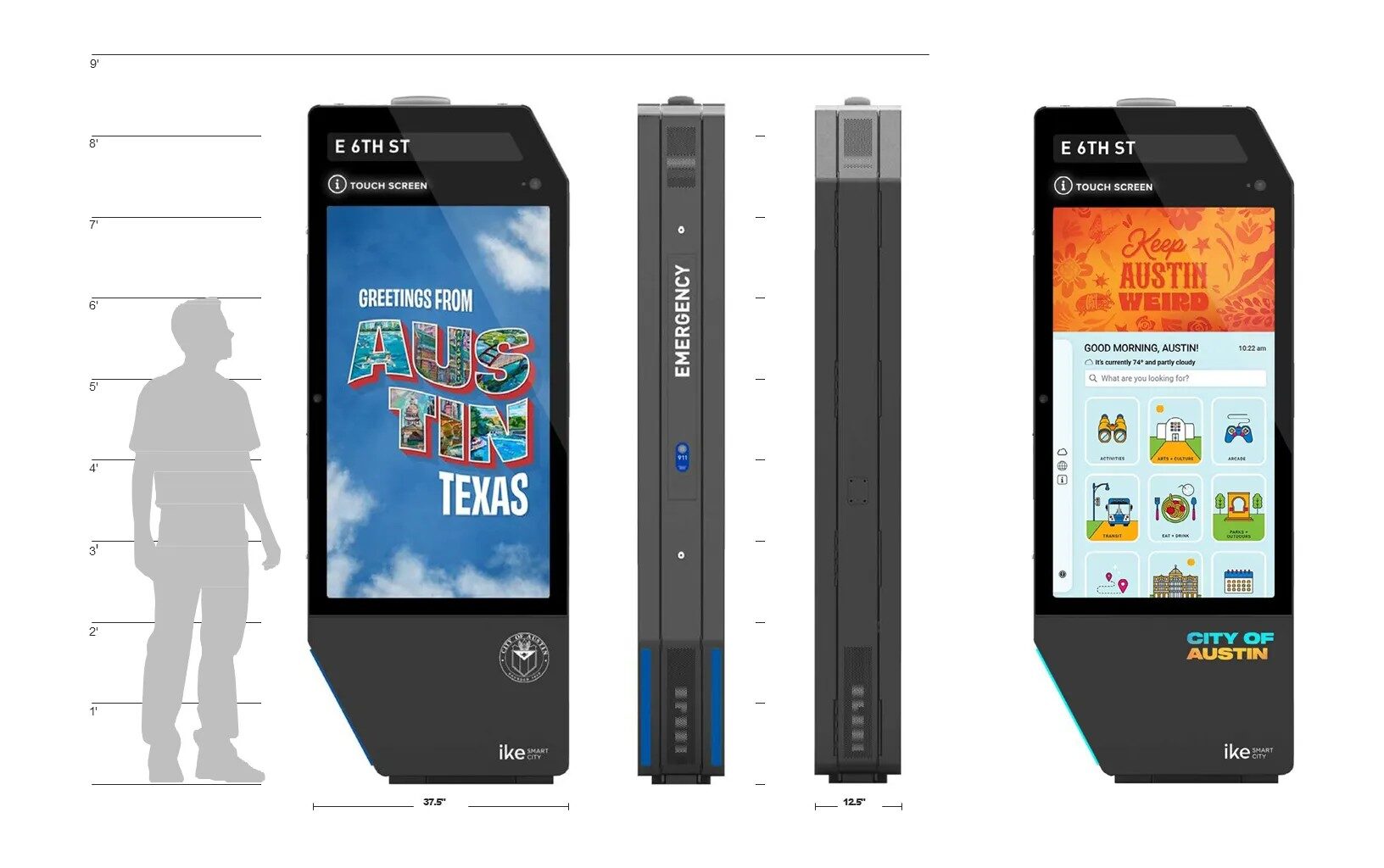
Downtown Austin will soon be dotted with digital kiosks that city leaders say will help visitors navigate the area and promote local events — but that will also prominently display advertising expected to generate millions for a city facing a tightening budget.
The Austin City Council last week approved an ordinance allowing the interactive wayfinding kiosks in public rights-of-way, advancing a plan the city has pursued as it searches for new revenue sources during a budget crunch. The move clears the way to implement a contract signed in September with IKE Smart City to install about 100 kiosks in downtown and other high-traffic areas.
City officials say the kiosks could bring in roughly $2 million to $6 million annually through advertising, funds supporters argue are increasingly necessary as Austin grapples with financial pressures.
“This is a time when any new revenue is desperately needed,” said Davon Barbour, president and CEO of the Downtown Austin Alliance, who added the money could support services for unhoused residents, park maintenance and public events.
The kiosks are designed to provide transit routes and schedules, maps, business directories and local event listings, along with emergency messaging capabilities and free Wi-Fi. They will not include cameras. Similar systems are already in place in cities such as San Antonio and Houston.
Still, the plan drew pushback from some council members concerned about expanding advertising into public spaces.
Council Member Marc Duchen, one of three members who voted against the ordinance, underscored those concerns by playing a clip from the film “Wayne’s World” during the council meeting — a scene that satirizes excessive product placement.
“I think we’re missing an important conversation around what city resources are appropriate to monetize for advertising and marketing,” Duchen said. “I want you to imagine the ‘PepsiCo Austin City Hall’ and the ‘ATXN Network, brought to you by H-E-B.’”
Duchen said the city needs clearer policies to guide such efforts, cautioning against relying on corporate partnerships in place of broader fiscal strategies.
Council members Mike Siegel and Zo Qadri also opposed the measure. Siegel proposed amendments to cap the number of kiosks and limit where they could be placed, but both failed.
Council Member José “Chito” Vela, who has pushed for expanding signage options tied to transit funding, argued the kiosks represent a pragmatic approach to generating revenue without raising fares or cutting services. He has also explored a similar advertising-backed model for Capital Metro bus stops, though no contract is currently in place.
The kiosk proposal was previously linked to a broader effort to loosen billboard restrictions, but that measure has been repeatedly delayed and is now expected to return for consideration in April.
Staff writer Chaya Tong contributed to this report.