
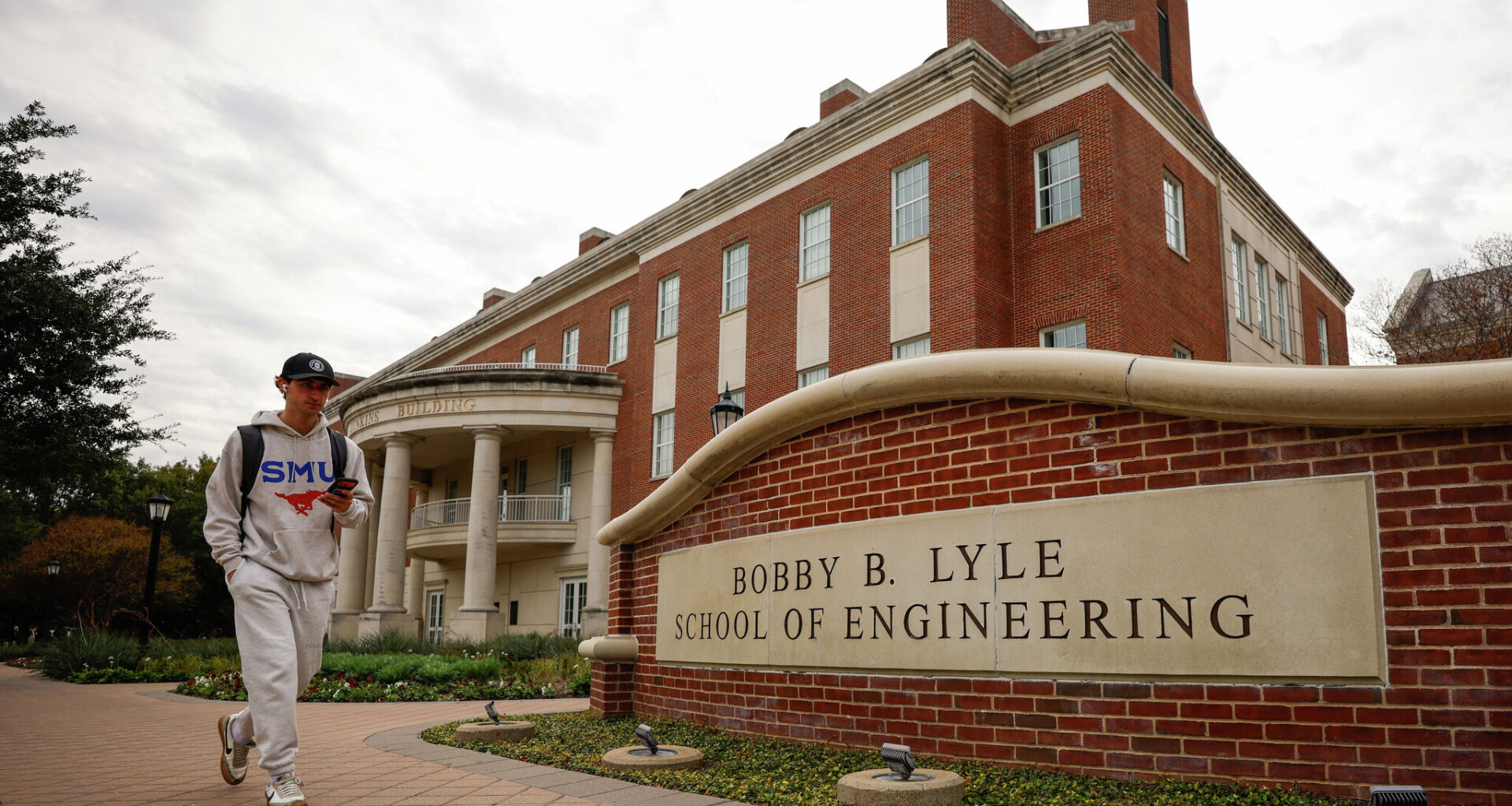
A student walks in front of the Lyle School of Engineering at Southern Methodist University on Friday, Dec. 5, 2025, in Dallas.
Christine Vo/Staff Photographer
Engineering giant AECOM can’t find enough people with their ideal artificial intelligence skills. They’re turning to a Dallas university to create their next hires.

Southern Methodist University and AECOM, one of the largest U.S. engineering design firms, are partnering to build a long-term talent pipeline of AI engineers for the Dallas-based company, the school announced Wednesday afternoon.
Article continues below this ad
Companies are in an arms race for AI talent, scouting for top candidates with deep experience who can revolutionize their businesses. But finding someone with the right skills and background can be hard, and luring them can get expensive.
AECOM CEO Troy Rudd’s solution is to build, not buy, AECOM’s next AI workforce.
While AECOM has had success recruiting workers with specialized artificial intelligence knowledge, it’s difficult to find people who also have a background in engineering, Rudd said.
Make Dallas News a preferred source so your search results prioritize writing by actual people, not AI.
Add Preferred Source
A new fellowship at SMU’s Lyle School of Engineering, which AECOM is funding, will recruit doctoral engineering candidates whose research will focus on how to apply AI to AECOM’s infrastructure challenges. When they graduate, they’ll have a guaranteed job.
Article continues below this ad
“I have every intention that everyone that comes out of this program is going to come work at AECOM,” said Rudd, who sits on the Lyle School’s executive board.
Students in the program will work closely with company leaders and SMU faculty to gain hands-on experience solving real-world problems, according to Nader Jalili, dean of SMU’s Lyle School of Engineering.
That means AECOM’s needs will drive students’ research and coursework — an experience that increases the likelihood graduates will more easily land jobs with high salaries after completion, Jalili said.
“It aligns with SMU’s culture that this is how we’re moving forward,” Jalili said. “We’re producing students who are ready so they’re not wondering about what to do once they graduate.”
Article continues below this ad
The first cohort, which they hope will have five to 10 students, will begin this fall, according to Jalili.
SMU and AECOM officials tout the program as the first of its kind. In his search for a talent pool to recruit from, Rudd said he hasn’t found a doctoral program that melds machine learning research with deep engineering experience.
He hopes the partnership will also establish Dallas, the company’s chosen headquarters, and SMU as an epicenter for machine learning engineering. Rudd pointed to Stanford University and its engineering department, which played a key role in building Silicon Valley by encouraging start-ups that exploded into businesses in its surrounding areas. He sees an opportunity to build a similar “permanence of innovation” around AI engineering in the region.
“In the long-run, we’re creating something that attracts more students and improves the profile and ability of the school,” Rudd said. “And it’s great for us in terms of our business.”
Article continues below this ad
A major focus for AECOM is building AI models that can speed up complex calculations that are usually done by humans in a linear, iterative manner. Rudd describes it like this: A building project might typically pass through an architect, then a civil engineer, then a structural engineer, and so on, as each does their own calculations.
The goal is to have an AI model that can do all those calculations at once. That could look like finding the most efficient way to fit fire protection and water systems into a building or making tradeoffs if something isn’t available in the supply chain. Then human engineers can take the outputs and decide, alongside the customer, if they want to tweak certain components.
Amid a global shortage of engineers, Rudd believes such AI models can help his current employees do their jobs faster and better.
“We can do a lot of optimization, such as taking out a lot of material costs out of a building,” Rudd said. “You usually don’t have time to because … you run out of the time to iterate.”
Article continues below this ad
Rudd “can’t build the models fast enough.” He’s betting the new partnership with SMU will be a solution.
He declined to share how much AECOM is spending to fund the fellowship program.
“My presumption is that once we do this and we show some success, my competitors are going to look to do the same thing,” he said.
Rudd added that if SMU’s program is successful, he hopes to launch similar partnerships at other campuses across the country.
Article continues below this ad
The goal is for candidates to complete their Ph.D. programs in a year and a half, according to Rudd. That’s a significantly shorter timeframe than typical programs, which take three to five years, but it’s a key part of building AECOM’s AI engineer pipeline.

By signing up, you agree to our Terms Of Use and acknowledge that your information will be used as described in our Privacy Policy.
“We don’t want candidates who are interested in doing this in four years. That’s not the point of this program,” Rudd said. “I want to find the candidates who want to grab this, get this done in a year and a half, and get onto the next thing.”
The DMN Education Lab deepens the coverage and conversation about urgent education issues critical to the future of North Texas.
Article continues below this ad
The DMN Education Lab is a community-funded journalism initiative, with support from Bobby and Lottye Lyle, Communities Foundation of Texas, The Dallas Foundation, Dallas Regional Chamber, Deedie Rose, Garrett and Cecilia Boone, Judy and Jim Gibbs, The Meadows Foundation, The Murrell Foundation, Ron and Phyllis Steinhart, Solutions Journalism Network, Southern Methodist University, Sydney Smith Hicks, and the University of Texas at Dallas. The Dallas Morning News retains full editorial control of the Education Lab’s journalism.