
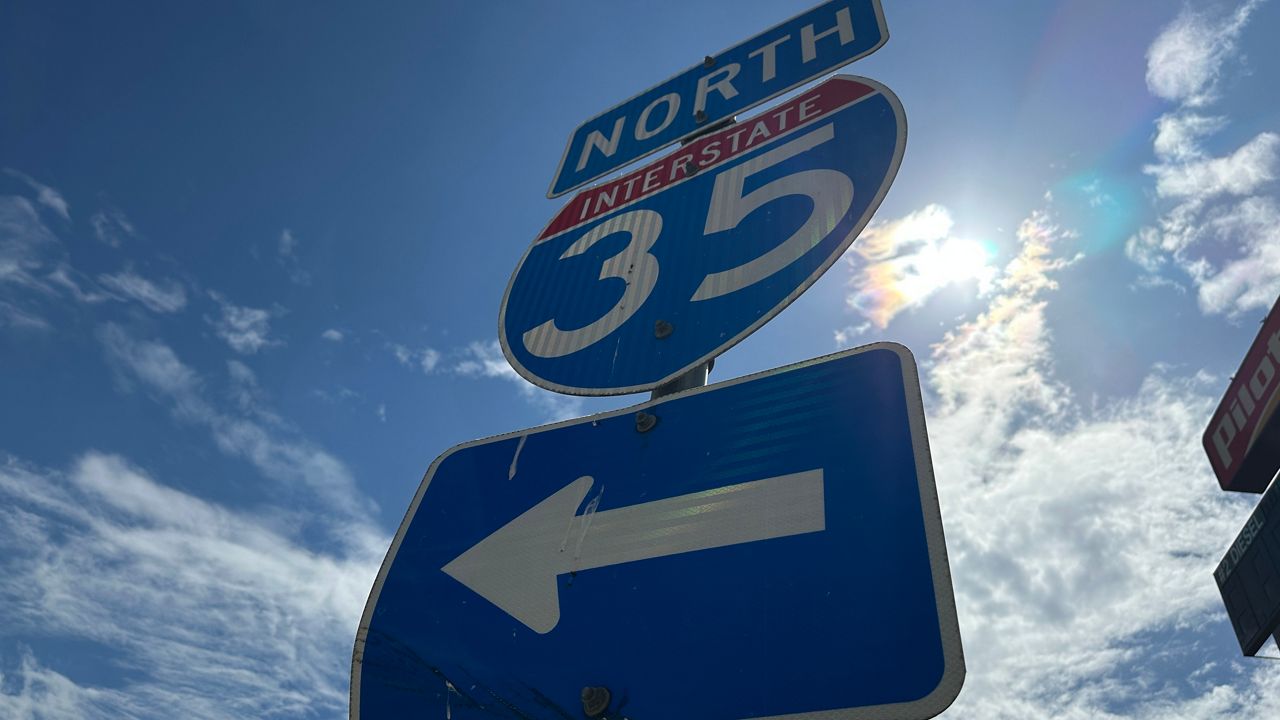
WACO, Texas — Travel through Texas’s busiest communities along Interstate 35 likely will come with some back-ups and construction delays this summer as road crews work to upkeep that road and get it moving better despite the state’s growing population.
However, take a look into the annals of Lone Star State history, and experts say you’ll find this is not a new tale about that monster of a road.
“The songs you sing about I-35 over and over and over again,” said Dr. Stephen Sloan, with a laugh.
Sloan, a professor of history at Baylor University, directs the Institute for Oral History—the state’s largest collection of audio recordings and interviews with people who were present at some of Texas’s defining moments. As part of their mission, and to tell the stories of the community they call home, the institute put together an online collection of firsthand accounts from Waco’s storied past; including a deep dive on the community’s relationship with I-35.
Sloan says it’s pretty tough to tell Waco or Baylor’s stories without discussing the massive interstate right next to campus.
“You can’t ignore I-35,” said Sloan. “It’s so central to life here in Texas.”
Initial construction on the interstate began in the mid-1950s, after being authorized by the Interstate Highway Act of 1956, and that work fully hit Waco by the 1960s. Recordings in Sloan’s archives from Waco residents show the concern at the time about the construction of the road was it going through long-established neighborhoods, cutting the community in half with traffic, and the cost of building an interstate to stretch from northern Minnesota to southern Texas.
Topics which, as Sloan alluded to, don’t sound all that different from the complaints many Texans bring up regarding I-35 today, especially with some of the large-scale projects currently going on along that road.
“That challenge is real when you have the population growing by 1,500 people a day,” said Brian Barth, deputy executive director for program delivery at the Texas Department of Transportation (TxDOT).
Barth said that the boom in population has fueled a lot of the major projects on I-35 currently. It makes sense, as TxDOT reports that roughly 50% of the state’s population lives in the I-35 corridor and about half of the state’s freight travels along the road.
Two of the larger projects are the Capitol Express project through Austin and the Northeast Expansion project in San Antonio. Barth says other major expansion work is going on in Waco, Dallas and near the Texas-Oklahoma border.
The Capitol Express project illustrates a new wrinkle in I-35’s story that Barth says they’re seeing more with these expansion efforts: space. That project requires drilling to lower the expanded roadway downward, since there’s simply no space to expand the road much further outward in the packed cityscape.
“You just have nowhere else to go,” said Barth, pointing out that is quickly becoming the case in a lot of the large city-centered sections of the road.
Barth said that is something TxDOT and road crews are heavily considering as they plan for the next waves of construction and expansion work on I-35, as they continue to try to keep that road up with the growing state. He said they’re also looking at how technology like autonomous vehicles will affect the road’s layout in the future and are taking additional steps to handle the increased traffic, like working to make sure the state’s entire 500-plus mile stretch of the road contains at least three lanes going each way—which Barth says currently approximately 41% of it is less than that.
But the bottom line is that just as construction and expansion has been the story of I-35 from day one, it looks like it will continue to be as the state and the road grow up together.
“History’s not the story of the past; it’s not even passed,” said Sloan, as he expects more stories of growing pains on I-35 to enter his archives. “It is the spine of Texas, so there’s really no other way around it.”