
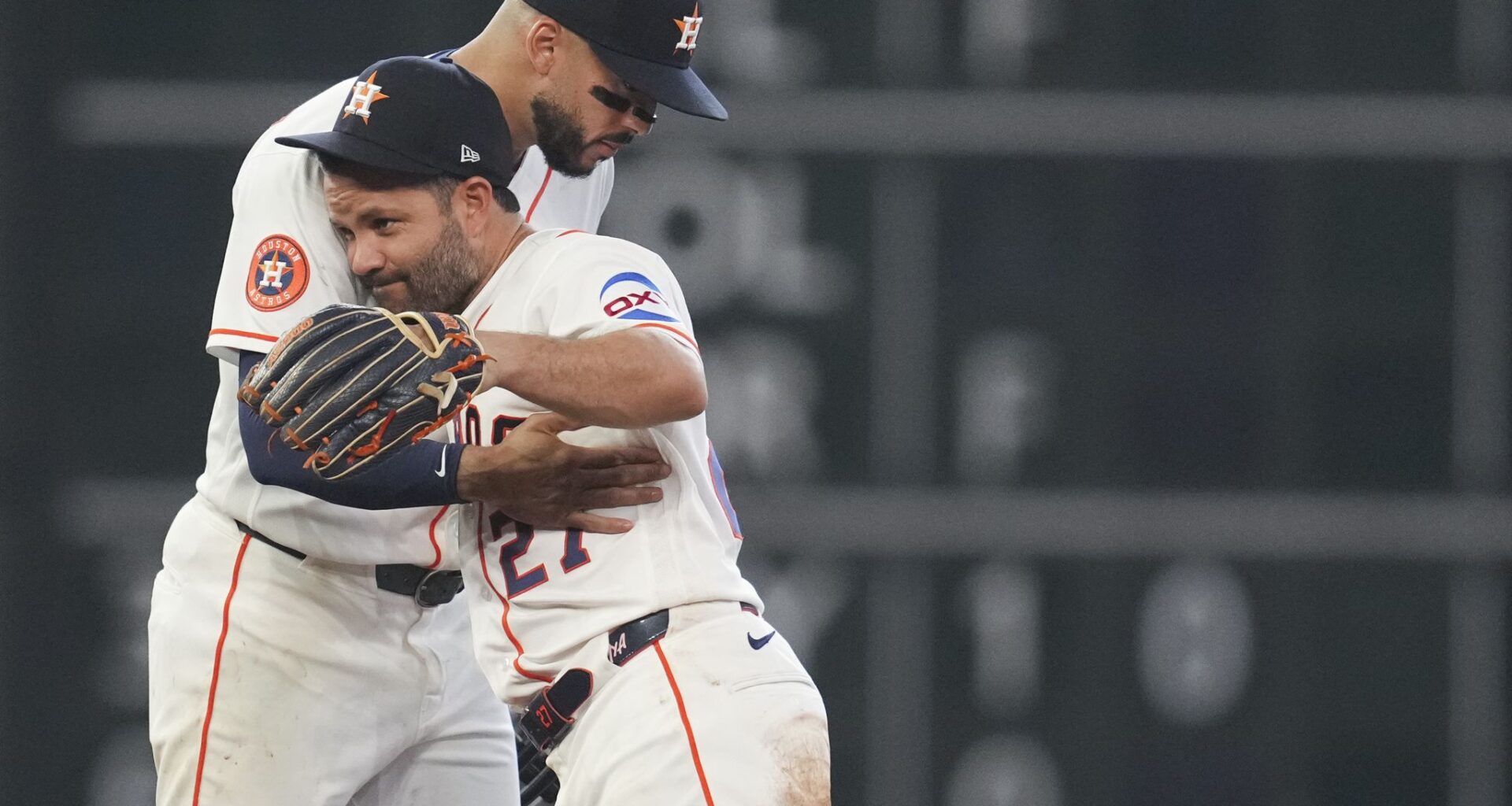
Houston Astros shortstop Carlos Correa (1) celebrates with second baseman Jose Altuve (27) after beating the Boston Red Sox 6-4 during a MLB baseball game at Daikin Park, Wednesday, April 1, 2026, in Houston.
Jason Fochtman/Houston Chronicle
One of the league’s top left-handers stood between the Houston Astros and a sweep Wednesday. Their lineup got to Garrett Crochet, scoring five runs against last year’s AL Cy Young runner-up to complete a one-sided series against the Boston Red Sox and a strong opening homestand.
The Astros outscored the Red Sox by a 23-7 total in their three-game set, hitting eight home runs in the series, and left Houston on the heels of five consecutive wins. Their offense totaled 43 runs and 52 hits across those five games after two listless losses to the Los Angeles Angels.
“Like I said in spring training, when all the guys in the lineup are healthy, this lineup is very dangerous,” said Carlos Correa. “And we’ve shown that the first week of the season.”
Article continues below this ad
Houston’s first road trip is a lengthy one, starting with three games against the A’s in West Sacramento. Three games at Coors Field and four against the Seattle Mariners, who unseated the Astros atop the AL West last season, will follow. First, here are three takeaways from Houston’s opening homestand:
Houston Astros pitcher Bryan Abreu reacts as catcher Yainer Diaz comes to talk with him after giving up a 3-run home run to Los Angeles Angels Nolan Schanuel during the ninth inning of a MLB baseball game at Daikin Park, Saturday, March 28, 2026, in Houston.
Jason Fochtman/Houston Chronicle
A bounce-back for Bryan Abreu
Though a tiny sample, Bryan Abreu’s first two appearances this season perhaps prompted concern. The Astros’ fill-in closer allowed four runs in 1⅓ innings against the Angels, walking as many batters (four) as he retired.
In his second outing, a save situation, Abreu walked two of three batters faced and showed diminished velocity. He averaged 93.2 mph and topped out at 94.8 mph on a dozen fastballs thrown in that outing. His fastball averaged 97.3 mph last year.
Article continues below this ad
The next day, manager Joe Espada deemed the reason for Abreu’s velocity dip “more mechanical than anything.” Abreu said Wednesday the mechanical issue was “a simple thing” – he was “rotating east to west” in his delivery and “way swinging” open with his front leg and side.
Most of Abreu’s fastball misses in his second outing were high or to his arm-side. He said he improved his direction toward home plate in a more effective showing Wednesday against Boston.
Abreu drew the ninth inning with a three-run lead. After Roman Anthony beat an 0-2 slider for a pinch-hit home run, Abreu struck out his next three batters to record his first save of the season with velocity that was more characteristic.
Abreu averaged 96.1 mph on six fastballs he threw and hit 97.4 mph. Ten of his 16 pitches were sliders. He generated six whiffs on seven swings against the slider, finishing all three strikeouts with the pitch.
Article continues below this ad
“Just attack the strike zone, trust the delivery I’ve been working on the past few days and keep moving forward,” Abreu said afterward.
Closer Josh Hader threw multiple bullpen sessions during the homestand, but it remains unclear when he might face hitters in his recovery from biceps tendinitis. General manager Dana Brown voiced hope on opening day that Hader could face hitters by “mid-April,” indicating his return is still weeks away.
Abreu will anchor the bullpen until it occurs. He acknowledged Wednesday that a rebound against the Red Sox was valuable after a rocky start.
“This is part of baseball,” Abreu said. “We’re going to have some bad outings and all this stuff. Just try to improve and fix all that as soon as we can.”
Houston Astros’ Brice Matthews, right, celebrates in the dugout after hitting a home run during the fifth inning of a baseball game against the Boston Red Sox in Houston, Monday, March 30, 2026. (AP Photo/Ashley Landis)
Ashley Landis/Associated Press
A youthful platoon
The first homestand followed a pattern with two of the Astros’ youngest hitters. Joey Loperfido started against the three right-handed starting pitchers Houston faced and Brice Matthews started against four opposing lefties.
Article continues below this ad
Loperfido and Matthews each made one start in center field, on days Yordan Alvarez started in left. But they mostly formed a platoon in left field, the clearest spot for both Loperfido and Matthews to playing time on the current roster.
“When you’re a young player, especially (on) a roster like ours, you have to kind of wait for your turn,” Espada said. “These players, they know their role. But it doesn’t mean that’s their role forever.”
Espada has often shared his view that young players need everyday playing time for their development. But Houston’s roster provides no clear path to creating it for all of Matthews, Loperfido and Cam Smith, the regular right fielder. Espada has mixed-and-matched in left and center so far to keep all involved.
“Some of these guys, it’s just that’s how you establish yourself in the big leagues,” Espada said. “As a manager, it’s putting them in a spot where they can have some success, make sure they’re facing the right pitcher right now so they can continue that success. Once they start getting going, now you can put a longer leash and let them go.”
Houston Astros center fielder Joey Loperfido hauls in a fly ball to left by Los Angeles Angels Zach Neto 00during the ninth inning of a Major League Baseball game at Daikin Park in Houston, Sunday, March 29, 2026.
Brett Coomer/Houston Chronicle
Loperfido’s early major-league career has comprised of mostly platoon matchups. The left-handed hitter entered Wednesday with 306 of 382 career plate appearances against right-handed pitchers and his .720 OPS against righties was nearly 150 points higher than his mark against lefties. He is 5-for-16 this season, with Espada noting he is hitting the ball to all fields.
Article continues below this ad
For Matthews, who had an .884 OPS against lefties and a .794 OPS against righties at Triple-A last year, a part-time role is relatively new. Moreover, Matthews is playing defensive positions in left and center field where he started zero and eight games in the minors, respectively.
Helping Matthews adapt to his role is incumbent on Houston’s staff. Matthews said he learns the night before where he’ll play the next day, if he is starting, and focuses pre-game work on practicing reads at that position. He continues to get reps around the infield to remain an option at those spots.
On days he isn’t starting, and might enter midgame, Matthews said he keeps the same routine shifted later and does cage work in-game to prepare for possible matchups where the Astros may deploy him. Both Matthews and Loperfido came off the bench after pitching changes on the homestand.
“Obviously, the adrenaline kind of takes over the body,” Matthews said. “But making sure I’m mentally prepared and staying confident in myself that whatever happens, I know I feel comfortable getting the job done.”
Though left field is relatively new to him, Matthews has not looked out of place there. Monday, he nearly threw out Trevor Story trying to stretch a double from the left-field corner; Story eluded Jose Altuve’s tag with a neat slide. Matthews also hit a 434-foot home run in that game. He is 2-for-13 in five games so far with nine strikeouts, still exhibiting swing-and-miss tendencies.
“He’s playing with a lot of confidence,” Espada said. “He knows that he belongs, he knows that there’s room for him on this roster. And I’ve got to get creative and get him in there because once he figures it out, man, he can do some damage.”
The early schedule has afforded Espada opportunities. Houston is slated to face two more left-handed starters in the upcoming series against the A’s, perhaps creating more. A broken toe sustained by Zach Cole at Triple-A last weekend may have strengthened Matthews’ spot on the major-league roster, even should the Astros face a run of right-handed pitching.
“I have the utmost trust in our staff and them putting me in the right position,” Matthews said. “So I just show up ready to go.”
Houston Astros Christian Walker (8) hits a RBI single during the first inning of a MLB baseball game at Daikin Park, Wednesday, April 1, 2026, in Houston.
Jason Fochtman/Houston Chronicle
A good start for Christian Walker
One of the Astros’ stronger offensive starts belongs to Christian Walker. The first baseman went 8-for-25 with five extra-base hits, all doubles, and drove in seven runs during the homestand, the latter total tied with Correa for the team lead.
The sample is small but perhaps more notable given Walker’s first-half struggles last season. Though his numbers improved in the second half, Walker finished with a 97 OPS-plus, below MLB average, spurring outside scrutiny in the first year of his three-year, $60 million deal.
“I think it was a good offseason work-wise, a good spring training work-wise,” Walker said. “It’s hard to put my finger on one thing, but I think where I’m selling out right now is just really trying to be on time for velocity and trust that my eyes will make decisions after that.”
Walker’s .251 average and .418 slugging percentage against fastballs last season were his lowest marks since 2020, per Baseball Savant. He saw fastballs 58.9% of the time, his highest rate since 2021.
All eight of Walker’s hits this season are against fastball types. That included hits on sinkers at 98.5 and 99.3 mph from Angels right-hander Walbert Ureña and another on a 95.9 mph sinker from right-hander Chase Silseth. He is hitless so far in eight at-bats ending on non-fastballs.
“I think the trickle-down trust on spin and making decisions like that after proving to myself that I can turn around a really good fastball changes everything,” Walker said. “It just kind of takes the tension out, calms you down a little bit, and I think when that trust is high it’s hard to get guys out.”
Despite disappointing numbers last year, Walker ranked in the 80th percentile of major-league hitters in bat speed and 65th percentile in hard-hit rate. His quality of contact in this season’s first week remained encouraging. Ten of his 20 batted balls in play carried an exit velocity above 100 mph.
In 11 plate appearances with men in scoring position, Walker was 4-for-10 with a walk and five RBIs. He began the homestand hitting seventh in the Astros’ lineup and ended it starting in the fifth spot against Red Sox left-hander and AL Cy Young runner-up Garrett Crochet.
Jeremy Peña was absent from the order Wednesday for the fourth time in seven games, still building up after his fractured fingertip. But the shortstop is expected to resume a more regular playing schedule in the upcoming series against the A’s.
That would make juggling Houston’s infield surplus – and finding places to play Isaac Paredes – a more frequent task for Espada. One aspect of Walker’s start may be to strengthen his status as the regular first baseman, if it was at all tenuous.