
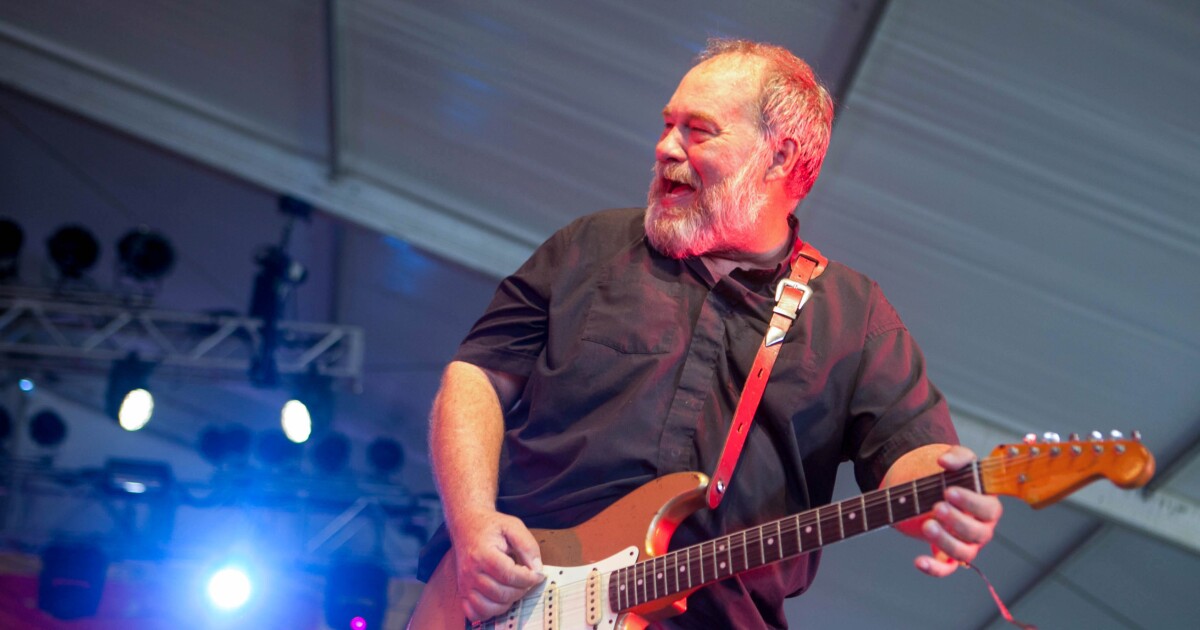
William Harries Graham took on a new role as a kind of caretaker after his songwriter father, Jon Dee Graham, died. Specifically, he had to make sure Zeus — his father’s weathered, beloved pieced-together Fender Stratocaster — wouldn’t go silent.
And as a left-handed player, that meant Graham had to get the instrument restrung and modified from its right-handed orientation to feel at home in his hands.
“I don’t think any other guitar could sound like Zeus and do what Zeus did,” he said Wednesday, hours before taking the stage at The Continental Club for the regular weekly gig he and his father played with their band, The Fighting Cocks.
“It’s definitely my most prized possession,” he said. “To be able to even play it or touch it … there’s an uncanny kind of spiritual element where it feels almost like … a guitar that has a mind of its own.”
Wednesday’s show wasn’t intended as a formal tribute to Jon Dee Graham, but friends and family acknowledged it would serve as the first in an expected string of concerts and gatherings to honor his many years as one of Austin’s most respected performers.
The 67-year-old died last week from a fall in his home after a series of health complications that had increasingly limited his ability to perform, even as he continued writing and recording new music.
For those who knew him, the loss lands less like the end of a career than the absence of a local constant.
“There’s an uncanny kind of spiritual element where it feels almost like … a guitar that has a mind of its own.”
William Harries Graham, Jon Dee’s son
Musician Kevin Russell, who leads the band Shinyribs and collaborated with Graham regularly over the years, first encountered him in the 1980s as a young fan in Louisiana, when Graham was playing with the True Believers.
“He lived 1,000 lives, that guy,” Russell said, acknowledging that Graham’s struggles with health and sobriety through the years were among his sources of songwriting fodder. “That’s what fueled him.”
Beyond his hundreds of songs, Russell said, that special intensity shaped how the musician moved through the world. He recalled once seeing Graham interact with a regular Wednesday-night attendee, picking up on the fan’s pain caused by a recent divorce.
“He came straight up to him and said, ‘What’s wrong?’ And then the next day they had dinner. And then they kept doing that. He helped that guy through his life,” Russell said. “He had a sixth sense for suffering. He could feel it.”
Graham’s low-key, understated presence showed up in smaller ways, too. Russell said he would sit in during early Shinyribs shows at Threadgill’s – with one condition.
“He said, ‘I’ll come play, but don’t introduce me. Don’t even acknowledge me,’” Russell recalled. “He was like, ‘I’m just gonna come in and leave like a ghost.’”
True to that intent, Russell said Graham would slip onstage, add a part or two, and then disappear before the set was over, heading a few blocks away to his regular Wednesday night slot at The Continental Club
While Graham became known for helping friends and colleagues throughout his career, in recent years, that instinct was met with a kind of reciprocal support from the Austin music community as his health problems mounted.
During multiple recovery periods following a series of surgeries, friends and fellow musicians organized benefit shows and stepped in to help where they could.
Russell said accepting that kind of support didn’t always come easily for Graham.
“He was a proud person … the way we’re raised, we don’t wanna ever ask for help. We help others, right? And so when we need the help, that’s a hard thing for a lot of people,” he said.
Jon Dee Graham – “Ballad of Barbara and Steve”
In the months before his death, Graham continued to play and write when he could, with William, 26, absorbing as much as he could.
“I got a literal front-row seat to him and everything he could do,” said the rising songwriter, who has released multiple albums and is working with Strolling Bones Records. “It’s unbelievable that I got to play with my dad like that.”
William said working through his father’s songs in recent days to prepare for Wednesday’s show revealed just how much was happening beneath the surface of his guitar playing.
“They’re the most simple little guitar riffs. And they’re the hardest things to play,” he said, observing that his father had a way of folding rhythm and lead together to build songs out of small, precise movements that rarely called attention to themselves.
“He was doing all these little things that most people would never think about.”
Even as his health declined, Jon Dee Graham continued writing and recording. Father and son had been working on a new album, Lloyd, a forthcoming release named for Graham’s father and centered in part on that relationship. The record was nearly complete when he died.
“He wasn’t ready to put the guitar up, but he was really, really tired,” William said.
Now, as William continues learning those songs on Zeus, the connection still feels immediate.
“It’s like the guitar is begging to play those songs,” he said.
Correction: A previous version of this story had the incorrect name of the record label William Graham is working with.